7 Best Tools to Analyze Competitor Reviews, Ranked by Job
I compared 7 ways to analyze competitor reviews, from a free CSV plus ChatGPT route to $25,000-a-year platforms, by the job a founder needs done.
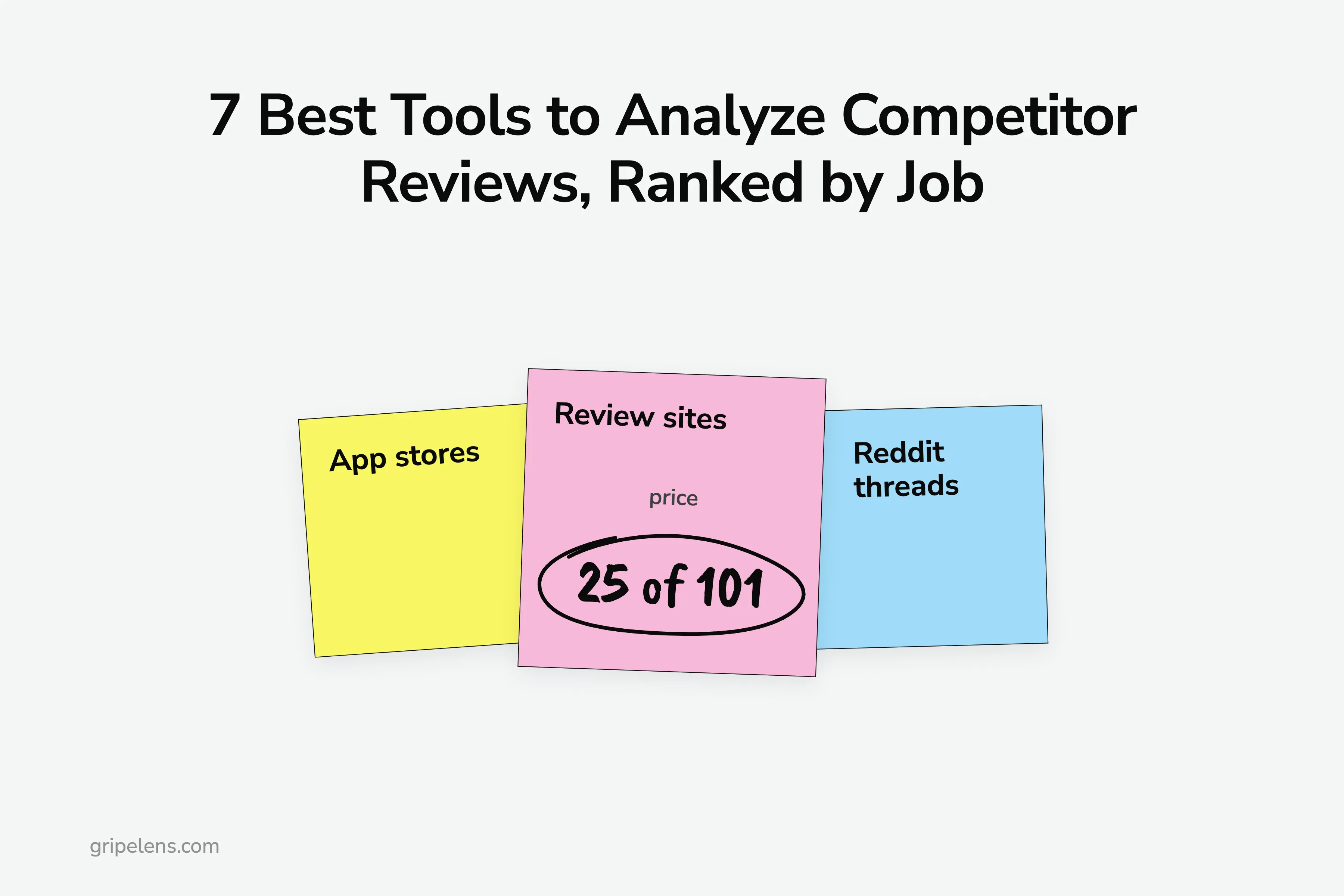
The best tool to analyze competitor reviews depends on the job: Kimola if you can paste the links, Appbot or AppFollow if your competitors are apps, and a spreadsheet plus ChatGPT if you will do the counting yourself. Google answers this search with SEO and ad tools, and none of the six top pages I read mentions Kimola, Appbot, AppFollow, Thematic or Enterpret.
I research competitor reviews by hand before I build anything: for Gripelens I logged 36 tools in this category and 101 quoted complaints about 22 of them, each with its source and date.
Below: the pick for each job, how I compared seven options, what each costs as of October 2026, and what any tool should show you before you trust its themes.
Key takeaways
- Kimola for reviews you can link to across many sites (free for 150 queries a month); Appbot or AppFollow when your competitors are apps; a CSV (a spreadsheet file) plus ChatGPT on a zero budget.
- None of the other five tools I compared shows automatic competitor discovery on its public pages: each one starts from links or app URLs you supply.
- Prices run from free (Kimola Starter, AppFollow Free) and $49 a month (Appbot Small, billed annually) up to $25,000 a year (Thematic Foundation), and Enterpret is demo only.
- Whatever you use, demand a count with its base (“25 of 101”), a date and a link on every quote. Without them a summary can’t tell a 5% complaint from a 0.5% one.
- GummySearch, the Reddit research tool founders used for pain points, closed to new users on 2025-11-30; if you used it, here are GummySearch alternatives before it deletes all data on 2026-12-01.
What Is the Best Tool to Analyze Competitor Reviews?
It depends on which job you have. Here’s one pick per job.
| Job | Pick | Why | Price (Oct 2026) |
|---|---|---|---|
| Read competitor apps’ store reviews | Appbot, or AppFollow’s free plan | You add competitor apps by hand; Ask Appbot shows the review count and date range (Large plan) | Appbot from $49/mo, billed annually; AppFollow free: 10 competitors, 7-day history |
| Read G2, Capterra, Reddit, Amazon and Trustpilot in one report | Kimola | Paste links from about 20 sites; the extension covers 24 more | Free for 150 queries/mo; Basic £39/mo |
| Do it free and count it yourself | CSV plus ChatGPT or Claude | You pick the sources and keep the dates | Free, plus your chat plan |
| Get competitors found, then themes counted and cited | Gripelens | Finds the competitors, then counts themes across six sources with a dated quote behind each | Pricing page |
| Analyze thousands of your own feedback rows | Thematic or Enterpret | Thematic advises 2,000+ rows; Enterpret 1,000+ records a month | Thematic $25,000/yr; Enterpret demo only |
The gap is competitor discovery: none of the other five tools I checked showed it on its public pages, so with them you need to know your competitors before you start. Gripelens finds them for you.
How I Compared
I build Gripelens, so weigh this accordingly. I applied six criteria, in this order:
- Does it find the competitors for you, or do you supply them?
- Which review sources does it read?
- Does it count each theme with a sample size?
- Does it keep each quote’s source, date and link, and flag old quotes?
- Does it flag review bursts (a pile of reviews in a short window, often a vendor campaign; here’s what a review burst looks like on a real listing)?
- What does it cost, and how do you buy it?
I read each vendor’s public pricing, feature and docs pages in October 2026 and wrote a dated profile for each. I didn’t buy paid accounts or test the paid tools hands-on. Where a capability wasn’t on the public pages, the table says “not seen”, never “no”.
The 7 Tools, Ranked
The other tools are ordered by how much of a founder’s job each covers at a founder’s budget. Gripelens comes after the tools I don’t make, because I build it. The enterprise platforms come last because they’re built for a different buyer, not because they’re weak.
| Option | Finds competitors | Sources | Counts and dated quotes | Price (Oct 2026) |
|---|---|---|---|---|
| Kimola | Not seen; you paste links | About 20 link sites, plus 24 via extension (G2, Capterra, Reddit) | Not seen | Free for 150 queries/mo; £39/mo |
| CSV plus ChatGPT or Claude | No; you choose | Whatever you paste | Only if you count and keep the links | Free |
| Appbot | Not seen; added by hand | App Store, Google Play, Microsoft Store | Count, date range and links in Ask Appbot (Large plan) | From $49/mo, billed annually |
| AppFollow | Not seen; added by name or URL | Six app stores, Steam, Trustpilot | Not seen | Free; ASO $19/mo, billed annually |
| Gripelens | Yes, from a product or category name | Six public sources | Counts per source; dated, linked quotes; “may be fixed” flag | Pricing page |
| Thematic | Not seen; you connect the apps | Your own feedback; app stores incl. competitors’ apps; no G2 | Not seen; vendor says themes trace to source words | $25,000/yr |
| Enterpret | Not seen | App stores, G2, Trustpilot, Google My Business; no Reddit | Not seen | Demo only |
Kimola
Kimola is best suited to founders who already know their competitors and want reviews from many sites in one self-serve report. You paste links from about 20 platforms (Amazon, Trustpilot, the App Store and Google Play among them), or use its Chrome extension, which collects the visible reviews on 24 sites including G2, Capterra and Reddit.
Kimola’s free Starter plan covers 150 queries a month, no credit card needed. Basic is £39 a month (£32 billed annually) for 3,000 queries. If Kimola is close but not quite right, I compared Kimola alternatives by the sources they read and whether they find competitors for you.
The catch is the metering. Each analyzed row up to 500 characters counts as one query, and longer rows cost one query per 500 characters, so a long review costs more than one query; scraping and classification use queries too.
Link scraping stops at 500 reviews per product on Amazon and the App Store (5,000 on Google Play). You supply every link yourself, and prices are in GBP.
A CSV Plus ChatGPT or Claude (the DIY Route)
The DIY route is best suited to a founder with one afternoon and fewer than a few hundred reviews, who will check the counts by hand (with thousands, cut and sample the pile first). Past that, or once you scrape G2 and Capterra instead of copying, the build-or-buy math changes. It’s the method founders already reach for. On r/AmazonFBA, one seller’s whole answer was: “You can copy all reviews on a product listing and paste them in ChatGPT, then ask it to analyse those reviews properly.”
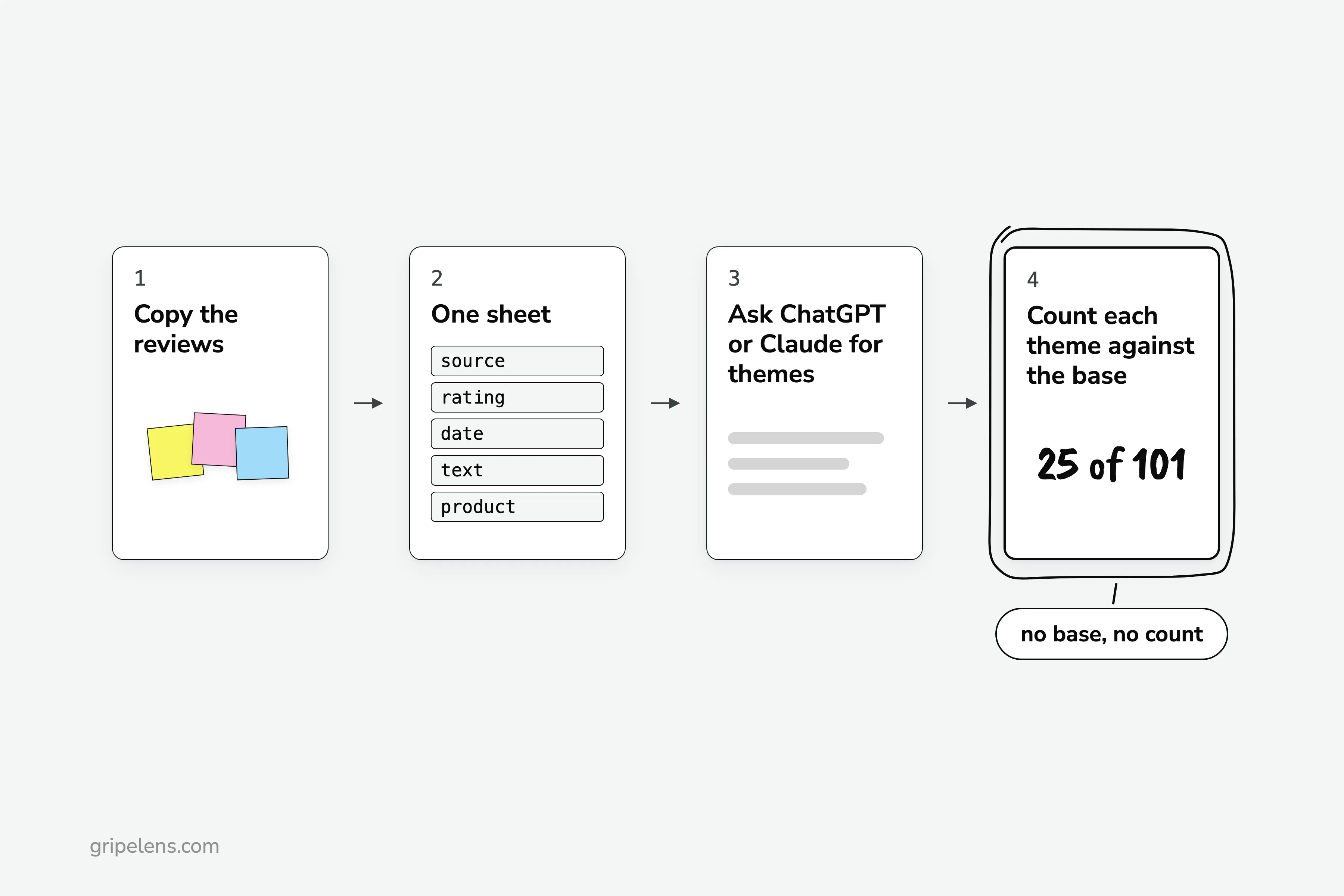
Here’s the version that holds up:
- Copy or export the reviews into one sheet with columns for source, rating, date, text and product.
- Ask ChatGPT or Claude to group them into themes.
- Count each theme yourself against the total, and write the base next to it, as in “25 of 101”.
- Keep the link beside every quote you plan to reuse.
The trade-off: the model groups themes, but it doesn’t keep a sample size, dates or links unless you build them into the sheet. Skip the count and you lose what one r/SaaS commenter put well: “I’d guess a complaint that shows up in 5% of reviews is a bigger deal than one that’s only in 0.5%… even if both are ‘obvious.’”
Collection is the slow part. G2 blocked my direct reads with HTTP 403 and a captcha on 2026-10-07.
On X, @KeisukeIshikawa described a seller who “pulled 300-600 reviews from the top 10 listings in a category. 1, 2, and 3 stars only.” That filter is a fair start. It misses something, which I come to below.
Appbot
Appbot is best suited to app teams who want competitor apps’ App Store, Google Play and Microsoft Store reviews tracked over time beside their own. You add competitor apps by hand, by store URL, and its Compare page shows volume, rating, sentiment and trend side by side.
On the Large plan, Ask Appbot (a chat over your classified reviews) states how many reviews each answer rests on and the date range, and links to the reviews. Of the tools you can buy today, that’s the closest to a count with its base.
The trade-offs:
- App stores only: no G2, Capterra, Trustpilot or Reddit. If that rules it out, here are Appbot alternatives that read beyond the app stores.
- No free plan, though there’s a 14-day free trial of Large with no credit card.
- Appbot starts at $49 a month billed annually ($59 monthly) for 1 user and 5 sources, and each competitor app in each store counts as a source.
- Ask Appbot, CSV export and the Appbot MCP server for Claude or Cursor start at Large, from $166 a month billed annually.
AppFollow
AppFollow is best suited to an indie app developer who wants to watch a handful of competitor apps for free. The free plan covers 2 apps and 10 competitors, and it reads more stores than Appbot: App Store, Google Play, Microsoft Store, Samsung, Amazon Appstore, Huawei and Steam, plus Trustpilot.
So what does free cost you?
History. AppFollow’s free plan keeps 7 days of history, and a week of reviews is a thin sample. The ASO plan (app store optimization, the store-ranking side of the product) is $19 a month billed annually with 30 days; a full 365 days needs Essential at $129 a month billed annually.
AppFollow watches competitor apps from public data only, so store connections, integrations and replies don’t apply to them. The product is built around managing your own app’s reviews and store ranking. Competitor watching sits beside that.
Gripelens
Gripelens is best suited to founders who want the whole chain in one place: you type a product or category, and it finds the competitors, reads their public reviews across six sources, and returns complaints and feature requests counted per source, with a dated quote behind each. It also marks review bursts and thin samples, and flags quotes older than 18 months as “may be fixed”.
The trade-off: it reads public reviews only, so your own surveys, tickets and calls stay out, and its six sources are fewer than the sites Kimola’s links and extension reach. I also make it (see the disclosure above).
The sample report on time trackers shows the output: 2,685 App Store reviews read, 261 negative items coded, with price at 67 of 261. Prices live on the pricing page.
Thematic
Thematic is best suited to a customer experience (CX) team with thousands of its own feedback comments a year that wants editable themes. In its own words: “Every theme traces back to the exact words that created it.” Its App Store and Google Play integrations pull reviews of “you and your competitors’” apps.
The trade-off is size and price. Thematic’s Foundation plan is $25,000 a year for up to 25,000 comments and 3 datasets, sold through a custom demo or a paid pilot, with no free trial seen. Its pricing FAQ says it “works best with at least 2,000 rows of verbatims”. That $25,000 is the floor of the sales-led tier; in my dated price ladder for review analysis software, the highest self-serve plan is $599 a month. G2 isn’t in its integrations list.
Enterpret
Enterpret is best suited to a company with a steady flow of its own feedback. Enterpret recommends at least 1,000 feedback records a month, combined across all sources. Its listed review sources are the App Store, Google Play, G2, Trustpilot and Google My Business; Reddit isn’t in the integrations list.
The trade-off: no public price and no self-serve signup, only “Book a demo”, and it’s built around your own feedback. If you’re below its volume floor, I compared Enterpret alternatives by price and the feedback volume each needs. Want a quick look at competitor apps? Its free App Review Analyzer compares up to 5 App Store or Google Play URLs you paste in.
Why Do the Usual “Competitor Analysis” Lists Not Help With Reviews?
Because Google reads “competitor analysis” as SEO and ad research. The top-ranked list for this search, Zapier’s September 2026 roundup, names ten tools: Similarweb, Sprout Social, Ahrefs, Semrush, Owletter, Owler, AlphaSense, Morning Consult, Wappalyzer and HypeAuditor. None of them is built to read a competitor’s customer reviews.
I searched the text of the six top pages for Kimola, Appbot, AppFollow, Enterpret, Thematic and GummySearch. Zero of six mention any of them.
Founders feel the hole. An r/SaaS poster who compared nine competitor-monitoring tools wrote that “there’s basically nothing between ‘free change alerts with no interpretation’ and ‘$15K+/year enterprise CI platforms.’” The $15K figure is theirs, for competitive-intelligence platforms that track rivals for sales teams.
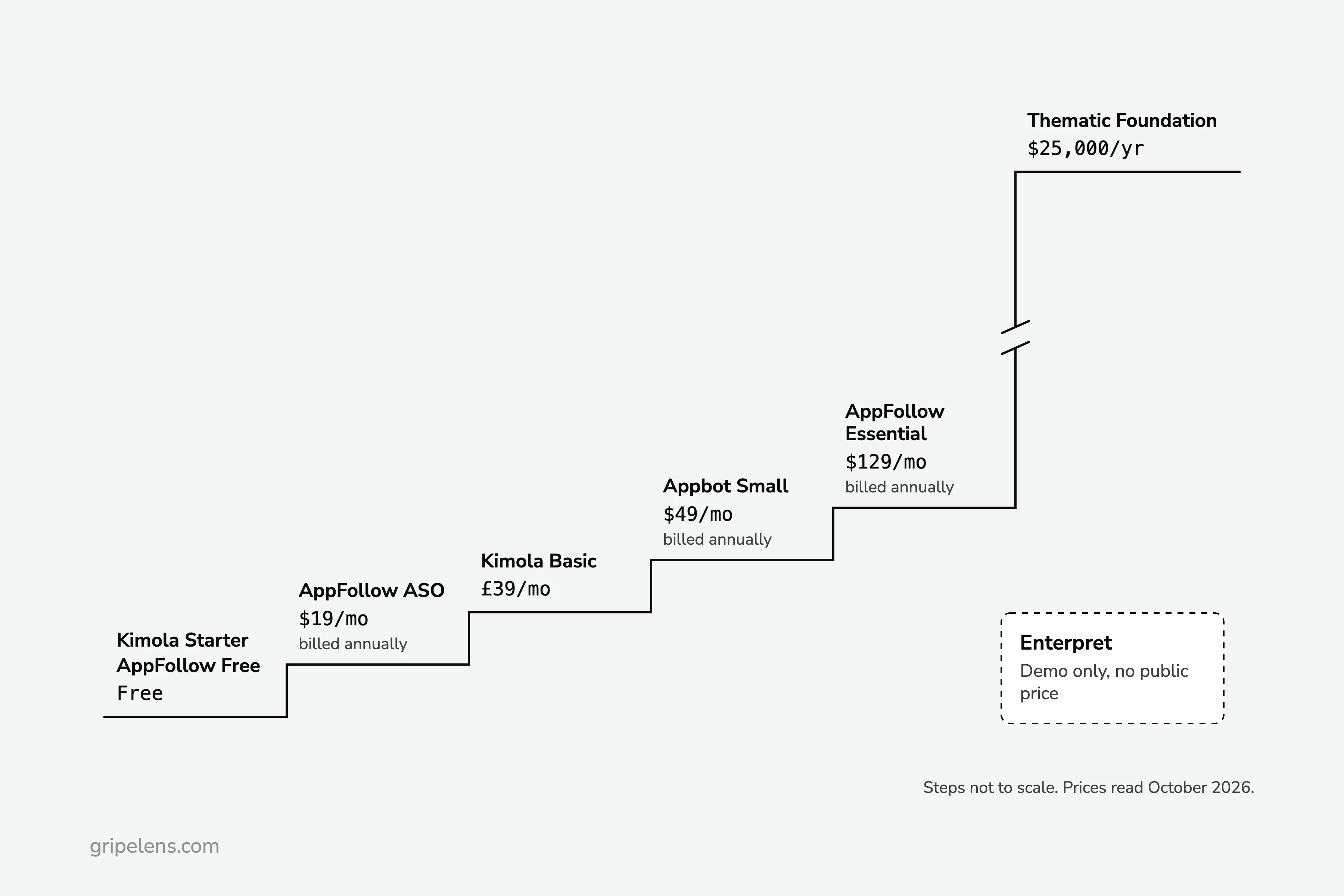
For reviews, there is a middle. It just isn’t on those lists:
- Free: Kimola Starter, AppFollow Free
- $19 a month, billed annually: AppFollow ASO
- £39 a month: Kimola Basic
- $49 a month, billed annually: Appbot Small
- $129 a month, billed annually: AppFollow Essential
- $25,000 a year: Thematic Foundation
- Demo only, no public price: Enterpret
What Should Any Tool Show You Before You Trust It?
Four things, whichever tool you pick, a spreadsheet included:
- A count with its base: “25 of 101”, not “price is a common complaint”.
- The source and date of each quote, with a link you can open.
- A flag on old quotes. As one r/AmazonFBA seller put it, “check recent reviews only since older issues may already be fixed.”
- A warning on review bursts.
Why insist?
Because a summary without them hides where the complaints are and how big they are. In my own research on 2026-10-07, I logged 101 complaints across 22 tools in this category, each quoted with its source and date. Price came first at 25 of 101.
The surprise was where they sat. Most of the 101 came from the cons fields (the “what do you dislike” box) of 4- and 5-star Capterra reviews, not from the angry ones. That’s what the “1, 2, and 3 stars only” filter from the DIY section misses: a star filter alone would have thrown out the reviews that carried most of the complaints.
Bursts are the other trap. When I dated Chattermill’s Capterra reviews (Chattermill is another feedback-analysis vendor), 23 of its 25 fell in two short windows: October 2021, and December 2022 to January 2023. For Enterpret, 9 of the 10 G2 reviews that AWS Marketplace mirrors land between 2026-01-31 and 2026-02-18.
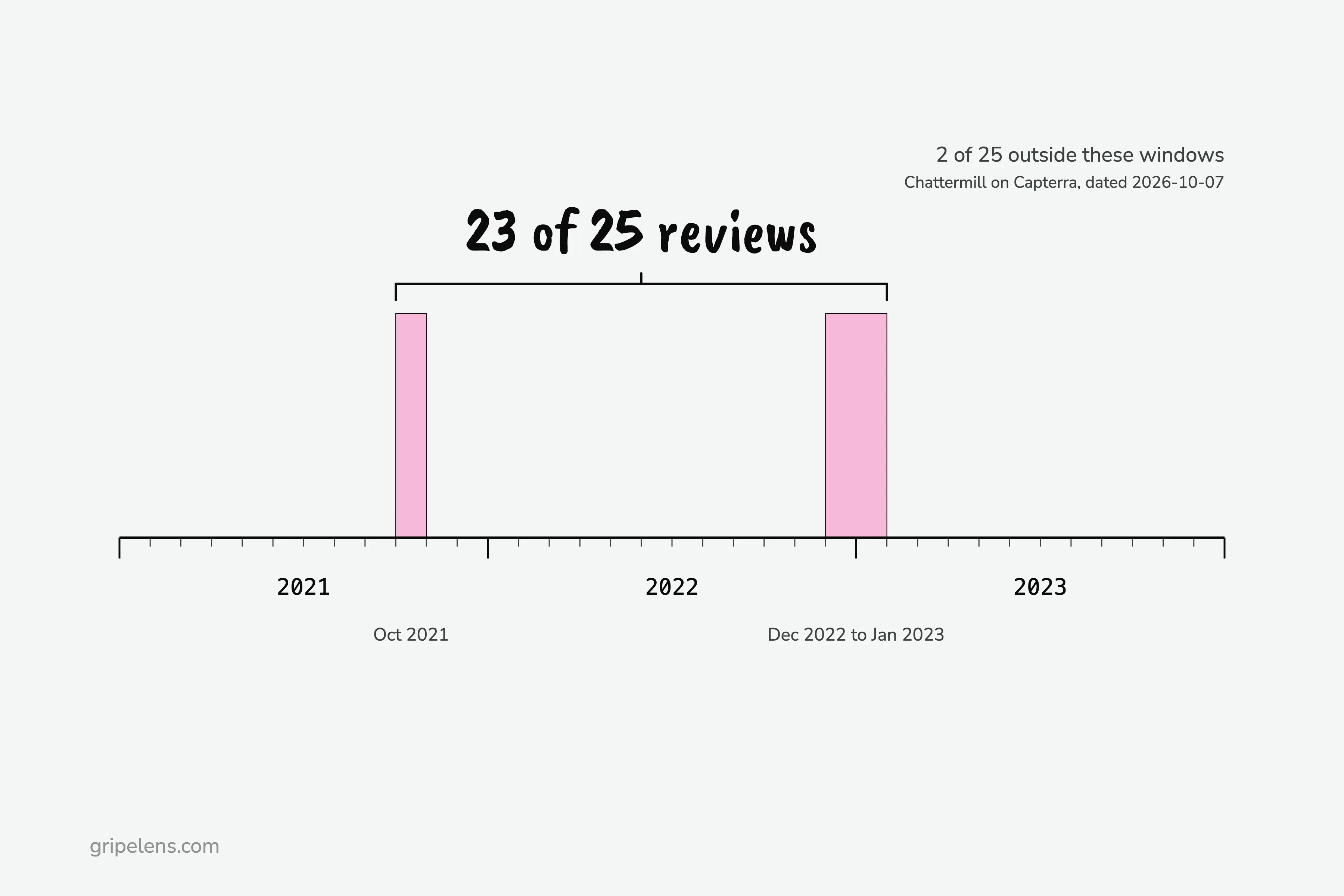
That looks like a vendor review drive. It isn’t proof. It is a reason to weigh those reviews less than the scattered ones.
None of the other five tools I compared shows a burst flag on its public pages, so by hand you sort by date and look for clumps. The counting is the step that hurts most by hand: do it in the sheet, or have Gripelens do it. The sample report shows what a counted theme looks like, for example Harvest’s repricing at 38 of Harvest’s 70 negative items.
What Happened to GummySearch?
GummySearch closed to new users and payments on 2025-11-30. Its own timeline says GummySearch shuts down entirely on 2026-12-01, with all user data deleted. The stated reason: it relied on Reddit’s API (the official way apps read Reddit data) and couldn’t reach a commercial licence agreement.
It was a Reddit-only tool, and its own alternatives page lists other Reddit tools with a note that “some of these might be affiliate links”. I compared six GummySearch alternatives with no affiliate links, sorted by the job you used it for. If you want Reddit threads next to review sites, two options from this list work:
- Kimola’s Chrome extension reads Reddit pages, along with G2 and Capterra.
- The DIY route: paste threads into the same sheet as your reviews, with the same source, date and link columns.
If you were weighing a paid listening tool like Brand24 for the Reddit side, I compared cheaper Brand24 alternatives by job: alerts for new threads on one side, tools that pull complaints from Reddit and review sites on the other.
Either way, give Reddit quotes the same treatment as reviews. A thread from three years ago is a quote that may be fixed. To see which complaints are still live, count them month by month and watch which themes keep coming back.
If You Want the Counting Done for You
If you want the competitors found for you and every theme counted with a dated quote behind it, get early access: launch pricing is locked for a year for the first wave.
Get early access. If you’d rather stay with a spreadsheet, the four checks above work with any tool.
FAQ
Can ChatGPT Analyze Competitor Reviews?
Yes, for grouping a pasted set of reviews into themes. It doesn’t keep sample sizes, dates or links unless you put them in the sheet as columns, and it can’t tell you whether a complaint sits in 5% of reviews or 0.5% unless you count. Paste the reviews with source, rating, date and link, ask for themes, then count each theme yourself against the total.
Is There a Free Tool to Analyze Competitor Reviews?
Yes, three. Kimola’s Starter plan is free for 150 queries a month with no credit card, AppFollow’s Free plan covers 2 apps and 10 competitors with 7 days of history, and the CSV plus ChatGPT or Claude route costs nothing beyond your chat subscription. Those prices were listed in October 2026, so check each pricing page before you sign up.
What Can I Use Instead of GummySearch?
GummySearch closed to new users on 2025-11-30 and shuts down entirely on 2026-12-01. For Reddit threads alongside review sites, Kimola’s Chrome extension reads Reddit, G2 and Capterra pages, or you can paste threads into the same spreadsheet as your reviews. For Reddit only, GummySearch’s own alternatives page lists other Reddit tools.
How Many Reviews Do I Need Before a Complaint Counts as a Pattern?
There’s no fixed number. Always state the base, “25 of 101” rather than “a top complaint”, so anyone reading can judge it. Thematic’s own advice for its model is at least 2,000 rows of verbatims (individual customer comments). Below that kind of volume, treat small counts as rough: a hypothesis, not a finding. To check whether one complaint is a pattern or one loud reviewer, run a five-check pattern test on it.