How to Find Competitors for a Startup Idea, Then Rank Them
Four places that list who else sells your idea, and how to rank them by review count. On Toggl Track, the biggest App Store rival had 56K ratings.
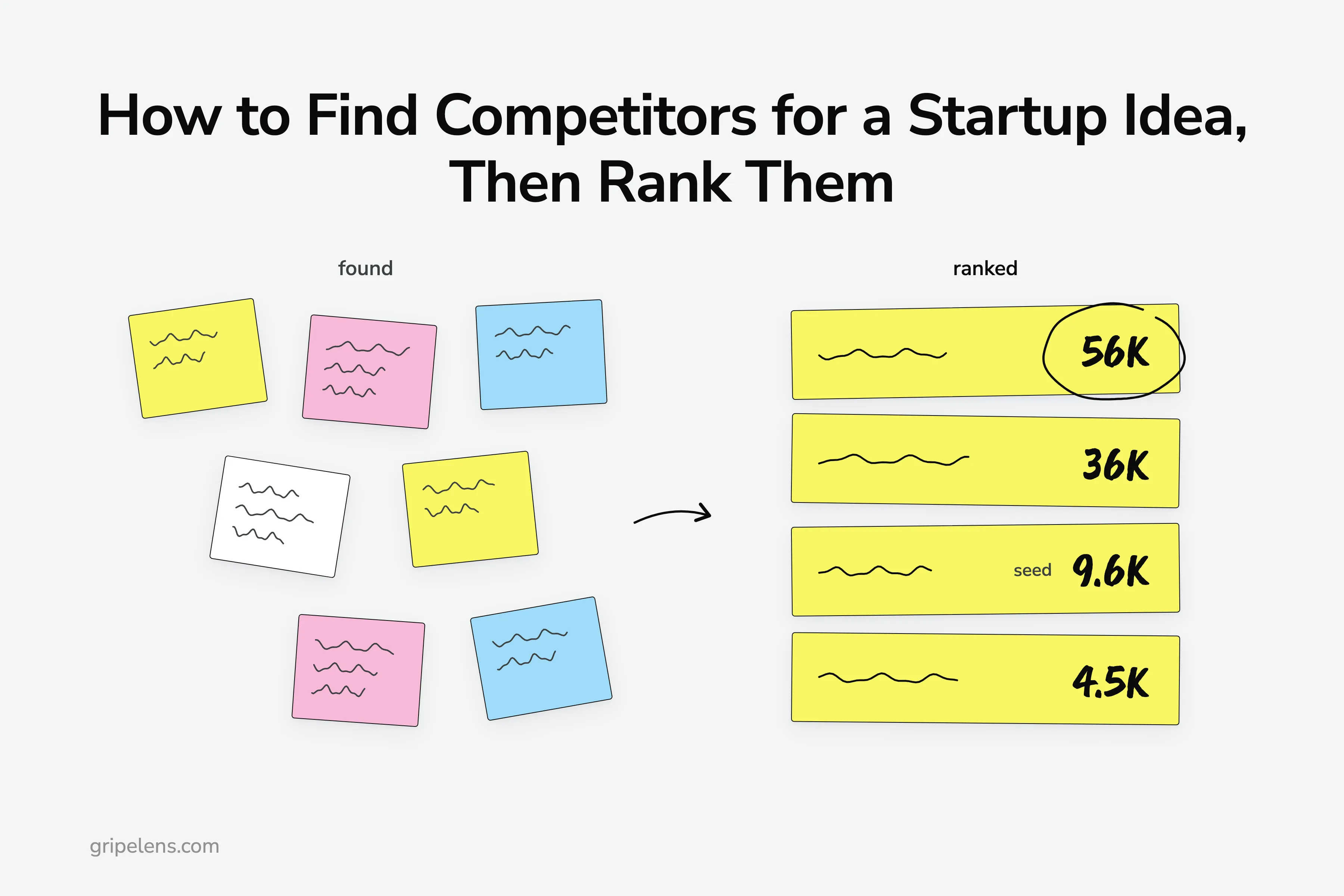
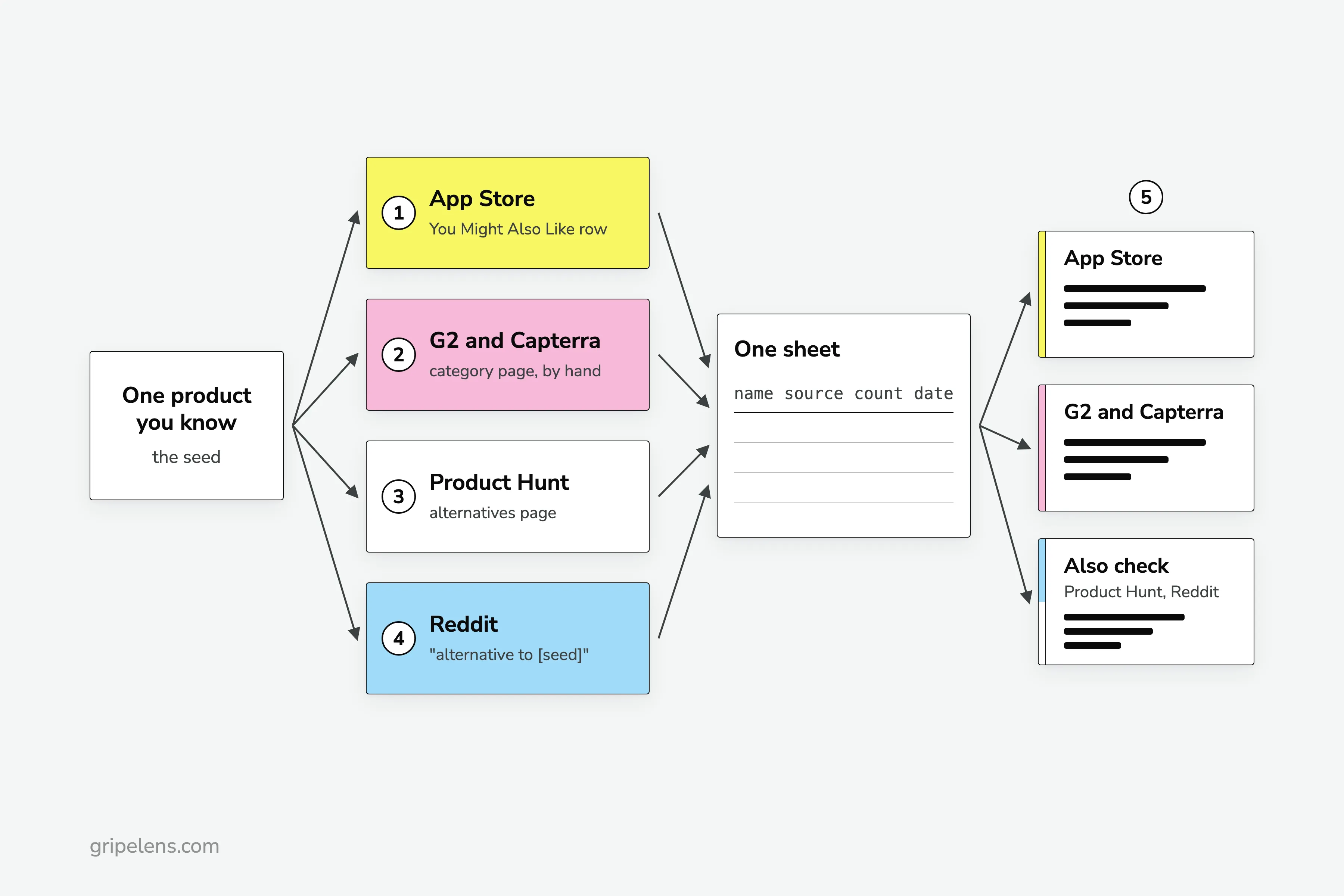
To find competitors for a startup idea, start from one product you already know, pull who else sells it from four places that list rivals with review counts (the App Store, G2 and Capterra, Product Hunt, Reddit), then rank the list by those counts and read the top few first. Five steps. The ranking matters more than it sounds: AlternativeTo lists 446 alternatives to Toggl alone.
I research competitor reviews by hand before building anything: for Gripelens I logged 36 tools in the category with their prices and 101 quoted complaints, each with its source and date.
Below: why Google gives you the wrong list, the five steps shown on one real category (time trackers), and whether one tool can find the competitors and then summarise their complaints.
Key takeaways
- Start from one known product and pull its neighbours from the App Store, G2 and Capterra, Product Hunt and Reddit, then rank by review count.
- The App Store’s “You Might Also Like” row is a free list but a noisy one: on 2026-10-26, 4 of the 10 apps it showed beside Toggl Track were not competitors.
- The obvious rival is often not the biggest: Hours Tracker (56K ratings) and Punch Time Clock (36K) outrank Toggl Track (9.6K) on the US App Store.
- Product Hunt and Reddit find the small, new and self-hosted tools the stores miss; rank them separately, because their counts don’t compare.
- Read the top 3 to 5 by review count first. That’s where the complaint evidence is.
Why Does Google Give You the Wrong List?
Search for how to find competitors for a startup idea and Google hands you two things: “competitor analysis” tutorials that mean typing your website into an SEO tool, and SWOT templates. Neither tells you who else sells your idea.
The same goes for X. The high-engagement “find your competitors” posts there (one has 565 likes) mean putting your URL into Semrush, which shows who ranks for your keywords. That’s a different question from who a customer would buy instead.
Then there are the idea checkers. One on page 1 promises “the real, funded companies already in your space.” Funded is the problem. A solo founder mostly competes with the free app, the tiny paid tool and the spreadsheet, and none of those raised a round.
What’s missing from page 1?
- A list built from places where buyers leave reviews.
- Any ranking of that list. None of the 6 page-1 results ranks competitors by review volume.
Even the review tools assume you already have the list: most review tools start from links you paste. So the question to ask is “who else sells this”, or, as u/Lanzone31 put it on r/startups: “I’d suggest to focus on the broader ‘existing alternatives’ rather than competitors.”
Step 1: Open the App Store Page of One Product You Know
Pick the best-known product in your idea’s space. Call it the seed. Open its App Store page, scroll to the “You Might Also Like” row, and copy every app in it with its rating count, then cross out the ones that aren’t competitors.
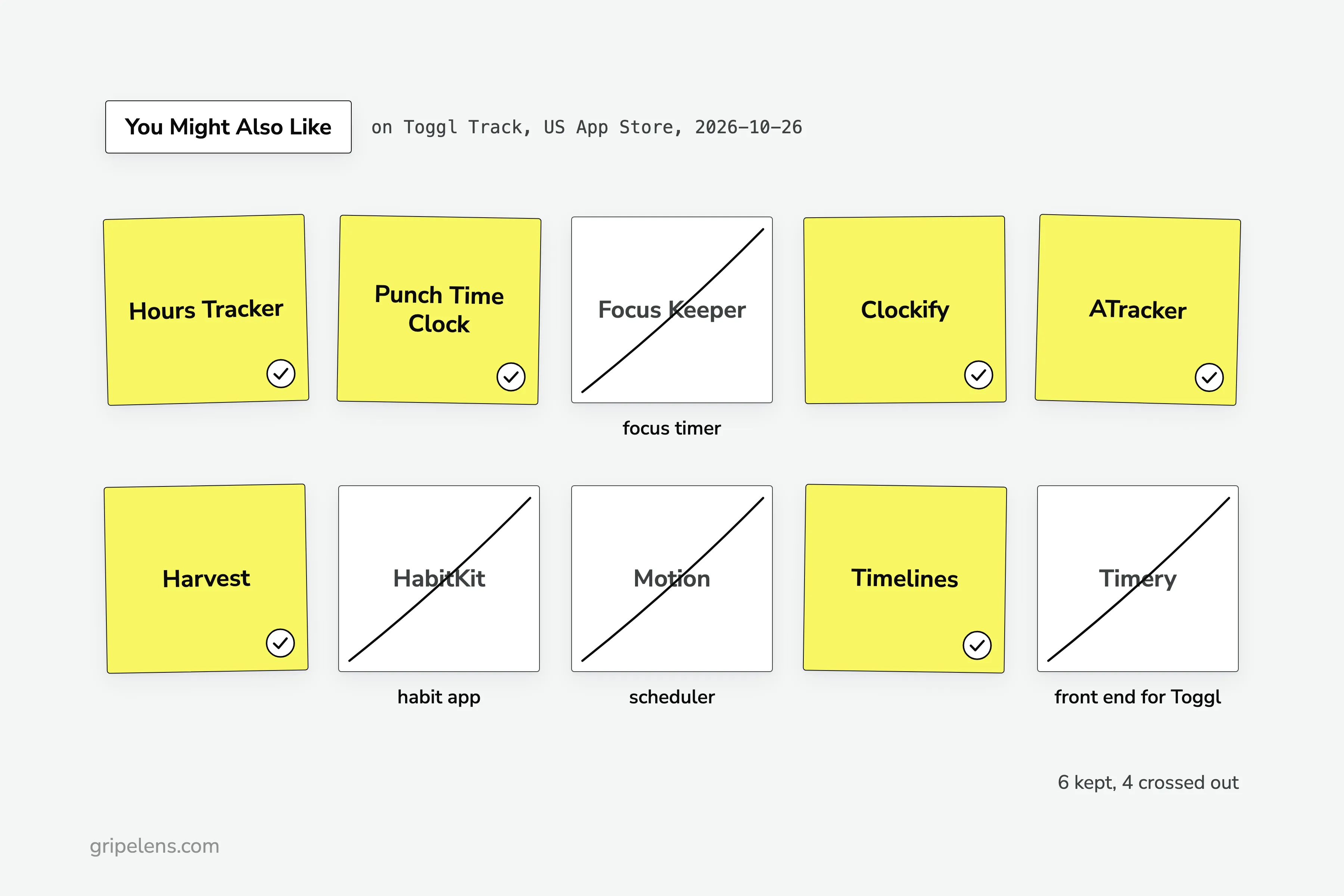
Here’s what that looked like for time trackers. On 2026-10-26, Toggl Track’s App Store page suggested 10 apps (Toggl Track itself had 9.6K ratings, averaging 4.8). Six were real competitors:
- Hours Tracker, Punch Time Clock, Clockify, ATracker, Harvest and Timelines.
Four were not:
- Focus Keeper, a focus timer
- HabitKit, a habit app
- Motion, a scheduler
- Timery, a front end for Toggl itself (“Easy time tracking with Toggl”)
A pomodoro timer is not a time tracker’s competitor, whatever the store thinks. So the row is a free first draft of the list, not the list.
Is your idea web-only? Check anyway. Plenty of SaaS tools ship a mobile app, and the store shows rating counts for free, no login. Two cautions: the counts move daily, and they differ by country, so write the date and the storefront next to every number you copy.
Step 2: Copy the G2 and Capterra Category Page by Hand
For B2B software, the review sites are the second list. Find the category page for your space on G2 and on Capterra (for this example, time tracking software) and copy each product name with its review count into the same sheet as Step 1. On 2026-10-26, G2’s time tracking category listed 896 products, each with a star rating and a review count, sorted by “G2 Score” by default. Its first three results were BambooHR (8,304 reviews), ClickUp (15,165) and TriNet PEO (2,169): an HR suite, a project tool and a payroll service. Same lesson as the App Store row: copy everything, then cross out what isn’t a time tracker.
Why by hand? Because these pages don’t like being read any other way. When I tried to read G2 directly on 2026-10-07, it returned HTTP 403 (access refused) and a captcha. Capterra’s time-tracking category page returned a 403 to an automated read on 2026-10-26 as well. So this step happens by hand, in your own browser.
Sort in your sheet, not on the site. Your columns:
- Product name
- Source (G2 or Capterra)
- Review count
- Date you copied it
Keep G2 and Capterra rows apart from the App Store rows. A review on G2 and a rating on the App Store are different things, and Step 5 ranks within each source for that reason.
Step 3: Check Product Hunt’s Alternatives Page for New and Small Launches
Product Hunt keeps an alternatives page per product, and it surfaces small and recent launches the stores tend to miss. Expect tiny numbers. That’s the point.
On 2026-10-26, Product Hunt’s Toggl alternatives page showed 10 products in its first block, with 17 reviews at most: Rize had 17, Chronoscope 11, and Desklog.io none. The only sort on offer was “Most relevant”. And none of the 10 had appeared in the App Store suggestions from Step 1.
Between them, the two pages gave 16 candidates (the 6 App Store keepers and Product Hunt’s 10), and not one name appeared on both. Is that the full list? Not even close. AlternativeTo, a crowd-built directory, lists 446 alternatives to Toggl, which is far more than anyone can read. You need the lists to find names. You need the counts to decide which names matter.
Copy the Product Hunt names into the sheet with their review counts, tagged “Product Hunt”.
Step 4: Search Reddit for “Alternative to [Product]”
Search Reddit for “alternative to [seed]”, in quotes. You’ll get noise and old threads, and you’ll also get the tools no store lists: free, open-source and self-hosted ones, plus the reason people want to switch.
The noise is real. On 2026-10-26, Reddit’s search for “alternative to toggl” returned 25 results, and about half were off-topic matches on “toggle”: Skyrim, Nanoleaf, SteelSeries. The on-topic threads went back to 2014.
The signal was real too. The highest-voted on-topic result was a self-hosted tool, “Solidtime - Underrated toggl alternative!!”, 162 points on r/selfhosted with 53 comments, posted 2024-09-04. Solidtime appeared in neither the App Store row nor the Product Hunt block.
Read the thread titles as well as the tools. Why bother? “Affordable alternatives to Toggl / Harvest?” (r/SaaS, 2025-11-10) names the switching reason before you open it: price. “Any free, selfhosted alternative to toggl track?” (r/selfhosted, 2022-05-10) names two. Write those reasons in a column next to each tool.
Step 5: Rank by Review Volume, Within Each Source
Now sort. Put the App Store competitors in one table, ordered by rating count, with the date. Here’s the time-tracker list from Step 1, US App Store, as of 2026-10-26:
| App | Ratings | Average |
|---|---|---|
| Hours Tracker | 56K | 4.8 |
| Punch Time Clock | 36K | 4.8 |
| Toggl Track (seed) | 9.6K | 4.8 |
| Clockify | 4.5K | 4.6 |
| ATracker | 3.2K | 4.7 |
| Harvest | 2.7K | 4.5 |
| Timelines | 1.6K | 4.8 |
Also check, from Product Hunt: Rize and Chronoscope; from Reddit: Solidtime (self-hosted).
The obvious rival came third. Toggl Track was the seed because it’s the best-known name, yet Hours Tracker had 56K ratings, about 6 times Toggl Track’s 9.6K. The Product Hunt and Reddit finds sit in a separate line because 17 reviews and 162 upvotes don’t compare with thousands of ratings. Rank within each source, never across.
Then read the top 3 to 5 first. More reviews means more complaints to count. Before you trust any count, check the review dates for bursts: a pile of reviews landing within a few weeks can be a vendor campaign.
A long, crowded list can feel like a verdict on the idea. It isn’t one. As u/romantic_potassium wrote on r/saasbuild: “Most markets look crowded from the outside but the actual user experience for existing solutions is usually garbage.” The ranked list is how you find out whether that’s true for your market.
What does reading the top of a list produce? When I read five time trackers’ reviews for a sample report on 2026-10-08, 2,685 App Store reviews gave me 261 negative items over 24 months. Price came up in 67 of the 261. That’s one number you can’t get from a list of names. It’s also the first theme I throw out when I filter complaints into app ideas.
Is There a Tool That Finds Competitors and Summarises Their Complaints?
Yes. Gripelens does both: you type a product or a category, it finds the competitors, then reads their public reviews across six sources (App Store, Google Play, Trustpilot, G2, Capterra, and community threads on Reddit and Hacker News) and returns the recurring complaints counted per source, with a dated quote behind each one.
Why would you want that? Because the route above is four sources per seed, then a sheet, then the reading and counting. A builder on r/SaaS described the manual version bluntly: “Open 50 browser tabs, read competitor sites, search for market reports, build a spreadsheet. Works, but takes days and most people quit halfway.” He was promoting his own tool in that post, so weigh it accordingly. The tabs part is accurate.
Most tools cover one half. The free idea checkers stop at the list. Most tools that read competitor reviews for you need you to bring the competitors.
The critics have a fair point too. On r/SaaSSolopreneurs, u/snezna_kraljica said clustering reviews can “replace one kind of noise through another one.” I agree, which is why a theme should never arrive alone:
- a count, and the sample it came from
- a dated quote with its source and link
- a “may be fixed” flag on quotes older than 18 months, since a complaint from 2023 may describe a bug that’s gone
Gripelens reports carry all three on every theme. If a theme can’t show its receipts, treat it as an opinion.
If You Want the List Found for You
If you want the competitors found and their complaints counted, with a dated quote behind every theme, get early access: launch pricing is locked for a year for the first wave.
Get early access. If you’d rather keep the spreadsheet, the five steps above work for any category.
FAQ
How many competitors should I list for a startup idea?
List everything the four sources return, then read only the top 3 to 5 by review count within each source. You can’t read them all: AlternativeTo lists 446 alternatives to Toggl alone, so the ranking is what makes the list usable.
What if I can’t find any competitors?
Widen the seed. Search for the problem instead of a product, and count what people use today, including spreadsheets, email and doing it by hand; one commenter on r/startups suggested focusing on “existing alternatives” rather than competitors. If nothing turns up even then, it usually points to a tiny or unproven market, not an open field.
Is a crowded market a reason to drop the idea?
Not on its own. A crowded list is where the complaints are, and as one commenter on r/saasbuild put it, the experience of existing solutions is often worse than the crowd suggests.
Do App Store rating counts mean the same as G2 review counts?
No. They come from different stores, different buyers and different review formats, so the numbers sit on different scales. Rank competitors within each source and never compare counts across sources.
Can a tool find competitors and summarise their complaints in one go?
Yes. Gripelens finds the competitors from a product or category name, then returns their complaints from public reviews, counted per source with a dated quote behind each one.