Are G2 and Capterra Reviews Fake? I Dated 136 of Them
Are G2 and Capterra reviews fake? G2 says it removed 20,671 as fake in three months. I dated 136 reviews on two listings: they cluster in batches.
Are G2 and Capterra reviews fake? Some are: G2 says it removed 20,671 of 230,998 submitted reviews as fake between May and July 2026, but the bigger pattern on the listings I dated was batches, reviews arriving in a few short windows instead of a steady trickle. The two listings are Chattermill’s on Capterra and Enterpret’s on G2: a sample of two vendors, not a platform-wide rate, and batched or labelled reviews are allowed practice, not evidence of fakes.
I research competitor reviews by hand before building anything: for this post I dated all 136 reviews on those two listings on 2026-10-20 and counted them by month and by who asked for them.
Both vendors came up when I compared tools that analyze competitor reviews, where the bursts were a side note. This is the full count.
Below: what I found on each listing, why the vendor-invited reviews all say 5 stars, what changed when G2 agreed to buy Capterra, what the FTC rule bans, and a five-step check you can run on any listing.
Key takeaways
- Fakes exist and get removed at volume: G2 says it removed 20,671 of 230,998 submissions as fake from May to July 2026 (8.9%, its own figures), but the pattern you can see on a live listing is batches.
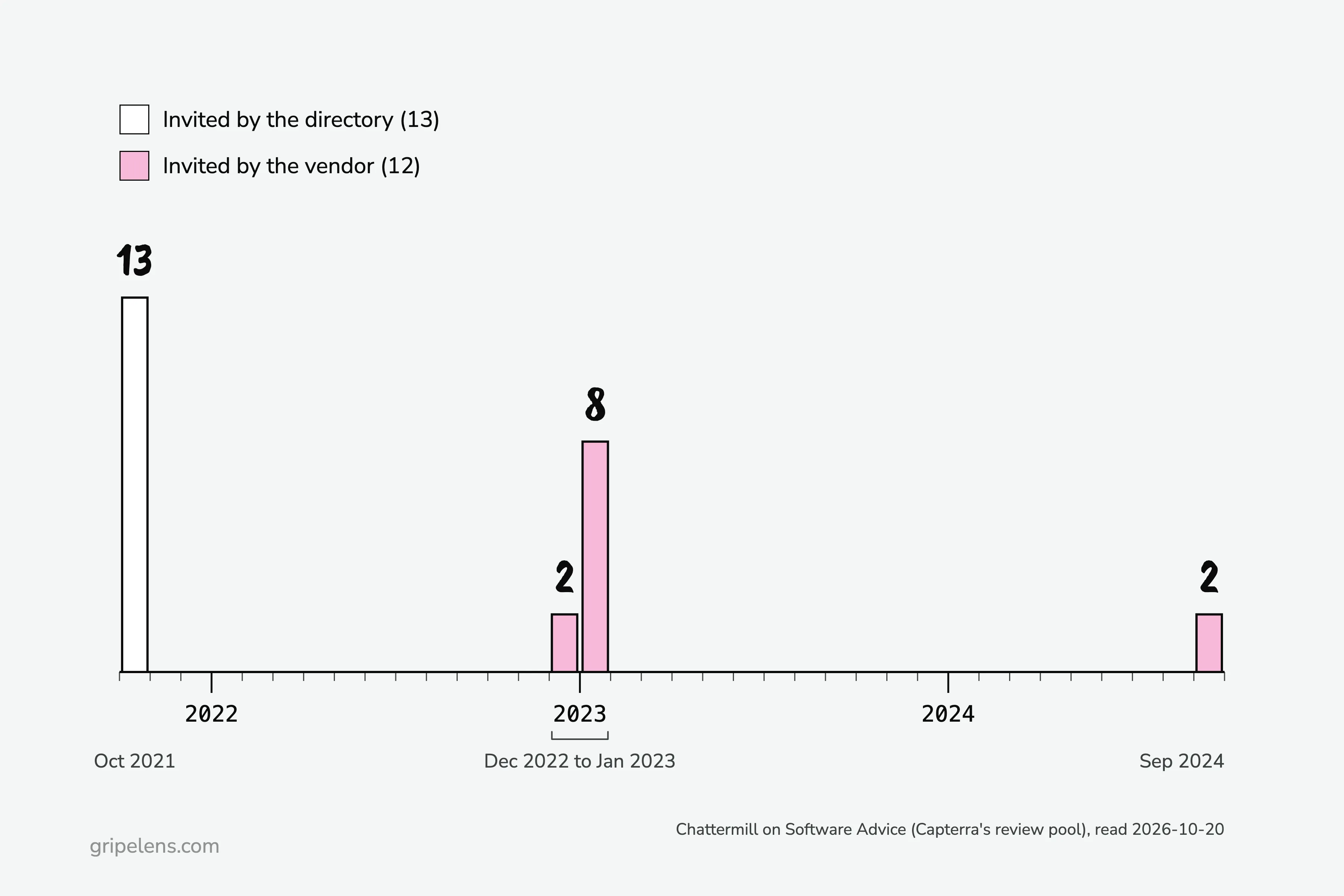
- 23 of Chattermill’s 25 Capterra-network reviews landed in two windows (October 2021, and December 2022 to January 2023), and all 25 carry an “Incentivized” label.
- Chattermill’s 12 vendor-invited reviews are 12 of 12 five-star; the 13 the directory invited average 4.08 and hold the only 2-star and 3-star reviews.
- 40 of Enterpret’s 111 G2 reviews (as mirrored on AWS Marketplace) landed in 18 days, from 2026-01-19 to 2026-02-05.
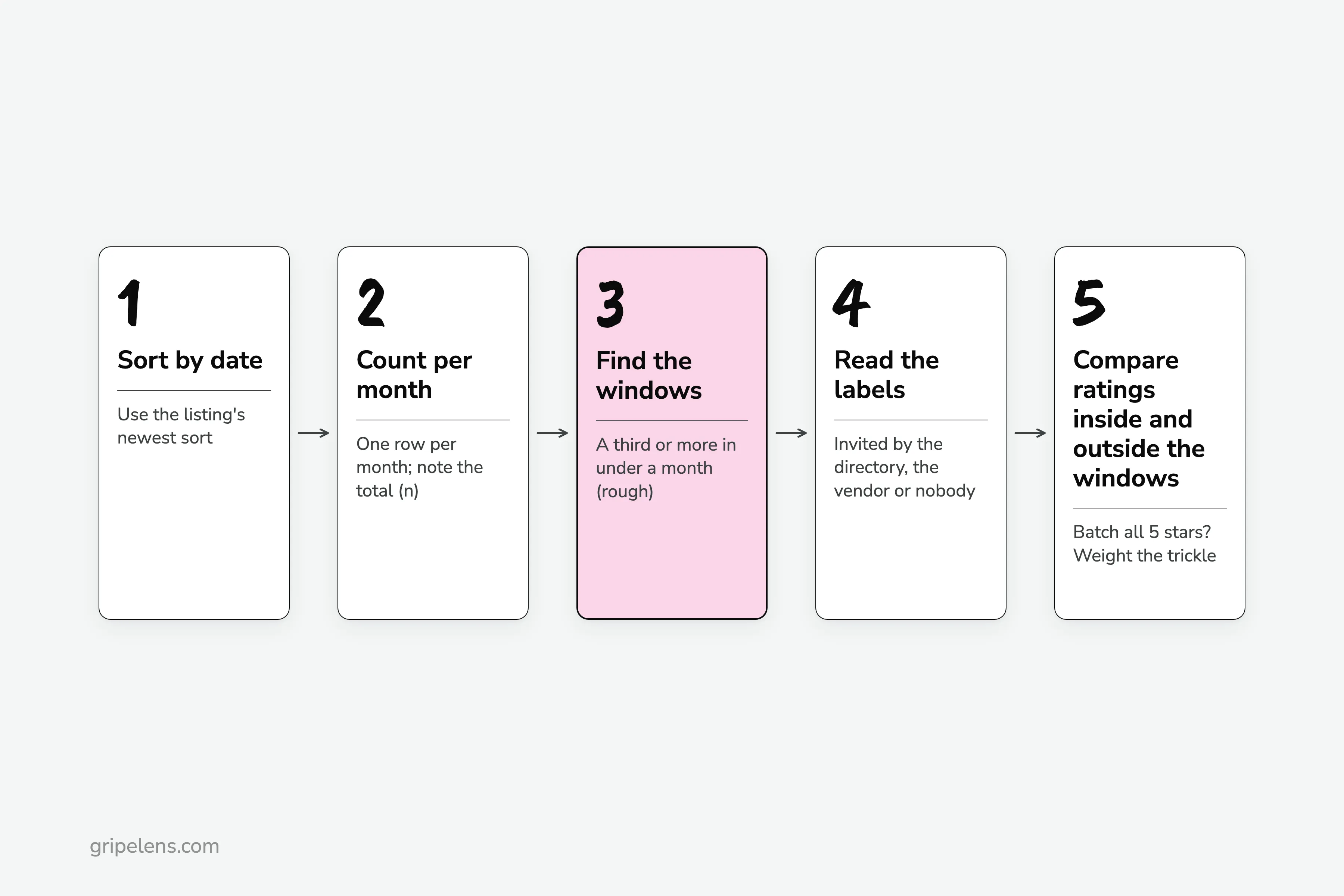
- You can check any listing in five steps: sort by date, count by month, find the windows, read the labels, compare ratings inside and outside the windows.
Are G2 and Capterra Reviews Fake?
Some are, and a lot of them get caught. G2 says it removed 20,671 of 230,998 submitted reviews as fake between May 1 and July 31, 2026. These are G2’s own, self-reported figures:
- 230,998 reviews submitted
- 161,970 published (70.1%)
- 69,018 removed (29.9%)
- 20,671 removed as fake (8.9% of submissions)
- 15,298 removed for identity issues, 5,373 for incentive abuse
The page doesn’t say whether Capterra, Software Advice or GetApp are included.
So fakes are a real category, and the FTC has a rule against them. The reviews that stay up raise a different question, though: who asked for them, and when? Buyers tend to blur the two. “G2 pays for reviews because people can’t be bothered to spend their time actually reviewing a software,” wrote u/Kundrew1 on r/sales in August 2024.
Three different things get called “fake” in threads like that one:
- Fake: no real customer behind the review. Banned everywhere.
- Incentivised: a real customer got a small thank-you, and the review carries a label. G2 caps review incentives at $100 and says “If a review is incentivized, G2 will clearly label the review as incentivized.”
- Cherry-picked: real customers, but only the happy ones were asked.
Labels handle the second. Nothing on the page labels the third. Dates can.
What Happened When I Dated 136 Reviews?
Capterra and G2 both showed my browser a Cloudflare bot check (an “are you human?” wall) on 2026-10-20, so I read each listing through another site. Chattermill’s 25 reviews came from Software Advice, which shares Capterra’s review pool: same 25 reviews, same 4.5 rating, same 16/7/1/1/0 star split. Enterpret’s 111 G2 reviews came from its AWS Marketplace listing, which shows G2 reviews marked “Review provided by G2”.
Two limits. Software Advice dates Chattermill’s reviews by month only, and the AWS mirror doesn’t show G2’s incentive labels.
Why these two? Both are feedback-analysis vendors from this blog’s competitor research, and any listing works the same way. Clustered dates and labelled incentives are disclosed, allowed practice on both directories, and nothing below is evidence of fake reviews.
Chattermill: 25 Reviews, Two Windows
Every one of Chattermill’s 25 dated, labelled reviews carries one of two labels. Thirteen say: “Incentivized. This reviewer was invited by us to submit an honest review and offered a nominal incentive as a thank you.” The other 12 say: “Incentivized. This reviewer was invited by the software vendor to submit an honest review and offered a nominal incentive as a thank you.”
| Month reviewed | Reviews | Label |
|---|---|---|
| October 2021 | 13 | invited by the directory (“invited by us”) |
| December 2022 | 2 | invited by the software vendor |
| January 2023 | 8 | invited by the software vendor |
| September 2024 | 2 | invited by the software vendor |
| Total | 25 | 25 of 25 “Incentivized” |
That’s 23 of 25 in two windows: October 2021, and December 2022 to January 2023. Nothing has arrived since September 2024, 25 months before my check, so treat what these reviews say as “may be fixed” territory.
Enterpret: 111 Reviews, 40 in 18 Days
Enterpret’s 111 G2 reviews on AWS Marketplace show a 4.5 rating, 71% five-star and 28% four-star. Here’s when they arrived:
| Window | Reviews |
|---|---|
| 2022-06 to 2023-11 | 27 |
| Between 2023-11-21 and 2025-02-28 | 0 (465 days) |
| 2025-02-28 to 2025-04-22 | 31 (26 of them in March 2025) |
| 2025-12-23 to 2026-02-18 | 52 |
| of which 2026-01-19 to 2026-02-05 | 40 |
| of which 2026-01-25 to 2026-01-31 | 23 |
| 2026-07-09 | 1 |
Of the 10 newest reviews, 9 fall between 2026-01-31 and 2026-02-18. Across the full history, 83 of 111 (75%) arrived in two windows totalling under four months.
By month, the spikes are March 2025 (26) and January 2026 (40), followed by 8 in February 2026.
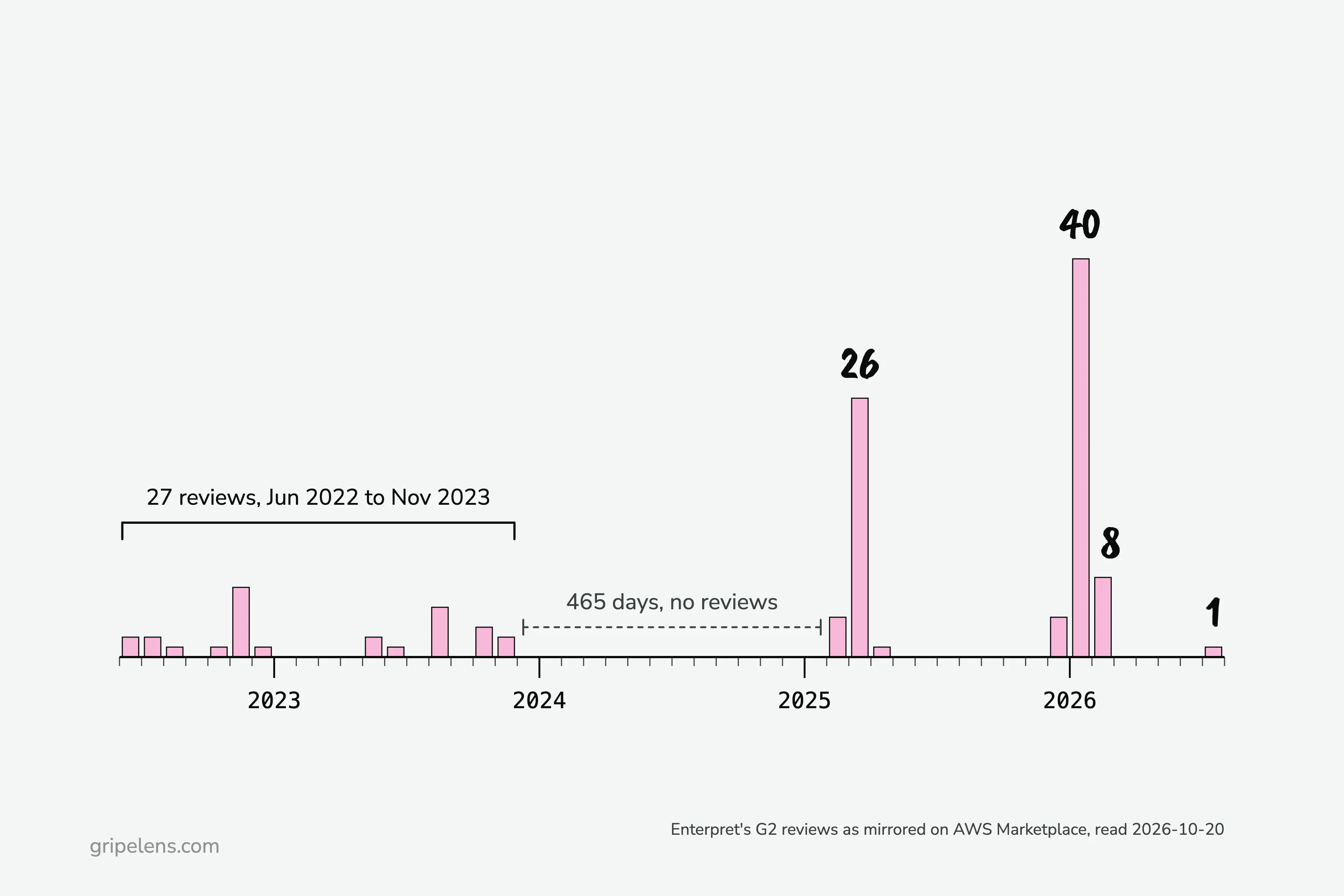
I can’t see whether these reviews were invited or incentivised, because the mirror drops G2’s labels. A 465-day silence followed by 26 reviews in one month is the shape a review drive leaves. It isn’t proof of one. If you’re weighing Enterpret against similar tools, I compared Enterpret alternatives by price and volume floor.
Why Do Vendor-Invited Reviews Skew 5 Stars?
On this listing, who picked the reviewer predicts the rating better than anything else I can see. Chattermill’s 12 vendor-invited reviews are 12 of 12 five-star. The 13 the directory invited average 4.08 (one 2, one 3, seven 4s, four 5s), and the listing’s only 2-star and 3-star reviews sit in that batch.
Twelve for twelve. That’s the pattern you’d expect when a vendor picks who gets asked.
G2, for one, bans “collecting reviews by any method that segments out potentially negative reviews or exclusively targets positive reviews”. A 12-of-12 split isn’t proof that a vendor did that. Happy customers are easier to ask and more likely to answer. Buyers have spotted the pattern for years: “they set up programs to have happy customers write reviews. (Note just the happy ones),” wrote u/jg12_12 on r/software in a 2020 thread that’s now archived.
A label doesn’t always tell you who arranged the thank-you, either. On r/marketing in July 2024, a G2 vendor found “G2 Invite” and “Incentivized” tags on a review and wrote: “I can assure you I absolutely did not offer any incentive”. If that’s accurate, the invite came from G2’s side.
Are G2 and Capterra the Same Company Now?
They’re still separate sites. But G2 agreed to acquire Capterra, Software Advice and GetApp from Gartner, announced January 29, 2026, bringing together a network of “nearly 6 million verified customer reviews”.
That changes how you cross-check. Capterra, Software Advice and GetApp already show the same reviews for a product: Chattermill’s 25 are the same set on all three. Checking a listing on all three sites is one source, not three, and with G2 agreeing to buy them, G2 isn’t an independent fourth.
So where do you get a second opinion?
From a different kind of source: Reddit threads, app store reviews, Trustpilot. Each has its own problems, but not the same owner. For Reddit, GummySearch is closing, so here are tools that still search Reddit threads for you. If you’d rather have those threads and reviews collected for you, I compared Brand24 and its cheaper alternatives for exactly that: Reddit alerts on one side, complaint research across reviews and threads on the other.
What Does the FTC Rule Ban, and What Does It Allow?
The US Federal Trade Commission announced its final rule banning fake reviews and sentiment-conditioned incentives on August 14, 2024. It took effect on October 21, 2024.
Banned:
- Reviews that “misrepresent that they are by someone who does not exist, such as AI-generated fake reviews”.
- Incentives “conditioned on the writing of consumer reviews expressing a particular sentiment, either positive or negative”.
Allowed:
- A small thank-you for an honest review, offered whatever the rating. That’s what both directories’ labels describe, and G2’s guidelines say eligibility “is never based on the opinions, positive or negative, expressed in the review.”
Neither ban says anything about timing, so a vendor asking customers in one batch isn’t what the rule targets.
When the rule took effect in October 2024, the r/news thread about it filled with doubts about enforcement, like u/bdash1990’s “Cool. Now let’s see how effectively they actually enforce it.”
So what’s left for you as a buyer?
Labels and dates. The rule decides what’s allowed; it doesn’t make an allowed batch representative of everyone who uses the product.
How Do You Check a Listing Yourself?
You need the listing’s date sort and a spreadsheet. Checking a whole category? Rank your competitors by review count first, then date the listings at the top. These are the five steps I ran on both listings.
Step 1: Sort the Reviews by Date
Use the listing’s “newest” sort. On Capterra-network sites the date is month-level; on AWS Marketplace each G2 review shows “Reviewed on” with the full date.
Step 2: Count Reviews per Month
Make one row per month in a sheet, with the count next to it. Note the total (n), because every share you work out later needs it.
Step 3: Find the Windows
A window is a short stretch holding a big share of all reviews. My rule of thumb from these two listings is a third or more in under a month, so treat this as rough. Enterpret’s 40 of 111 in 18 days clears it, and so does Chattermill’s 13 of 25 in October 2021.
Step 4: Read the Labels
Find out who invited each reviewer: the directory, the vendor or nobody. Software Advice and Capterra say it in a “Review source” line, and G2 tags incentivised reviews.
Step 5: Compare Ratings Inside and Outside the Windows
If the batch is all 5 stars and the rest averages lower (Chattermill’s 12 of 12 against 4.08), weight the steady trickle and the cons fields more than the stars.
Counting dates and labels across several listings is the step that hurts most by hand, so you can also have Gripelens do it: it marks review bursts as likely vendor campaigns and keeps the source, date and link on every quote. Here’s a sample report with counted themes and dated quotes, and my comparison of tools that read competitor reviews for you.
If You’d Rather Not Count Dates by Hand
If you want competitor reviews counted for you, with bursts flagged and a dated quote behind every theme, get early access: launch pricing is locked for a year for the first wave.
Get early access. If you’d rather keep the spreadsheet, the five steps above work on any listing.
FAQ
Are G2 Reviews Trustworthy?
Trust them more as real reviews than as a fair average. The reviews G2 publishes passed its checks, and G2 says it removed 20,671 of 230,998 submissions as fake between May and July 2026, which is its own figure. Weigh the labels and the date pattern more than the star rating: a big share of reviews landing in a few weeks tells you who was asked, not how good the product is.
Are G2 and Capterra the Same?
They’re separate sites, but G2 agreed to buy Capterra, Software Advice and GetApp from Gartner, announced January 29, 2026. Capterra, Software Advice and GetApp already share one review pool, so a product’s reviews are the same set on all three. For an independent cross-check, use a different kind of source, such as Reddit, app stores or Trustpilot.
Is It Legal to Pay for Software Reviews?
In the US, a small thank-you for an honest review is allowed when it doesn’t depend on the rating. The FTC rule in effect since October 21, 2024 bans incentives conditioned on a positive or negative review, and bans reviews from people who don’t exist. G2 also caps incentives at $100 and labels incentivised reviews.
How Can I Tell If a Vendor Ran a Review Campaign?
Sort the reviews by date and count them by month. If a large share landed in a few weeks (I use a third or more in under a month as a rough line), read the labels in that window and compare its ratings with the rest. That shows a batch consistent with a campaign. It doesn’t prove one, and it says nothing about whether any review is fake.
Are Incentivized Reviews Fake?
No. They come from real customers who got a small thank-you, and the review carries a label saying so. Who asked matters more: on Chattermill’s listing, the 12 reviews the vendor invited are 12 of 12 five-star, while the 13 the directory invited average 4.08.