App Ideas From One-Star Reviews: 5 Steps, With Receipts
I ran 261 dated complaints about 5 time trackers through 3 filters. Here's the 5-step method, what survived, and why price gripes didn't.
To find app ideas from one-star reviews, work in five steps: list every app that does the same job, pull their dated 1 to 3 star reviews, count each complaint per app, keep only the complaints that show up in 5+ apps, in the last 12 months, about more than price, then read what survived. When I ran that on 261 dated complaints about five time trackers, the strict rule passed nothing, and lost entries came out as the one gap worth testing.
I research competitor reviews by hand before building anything: for this product I logged 36 tools in the category with their prices and 101 quoted complaints, each with its source and date. On 8 October 2026 I did the same for five time trackers: I read 2,685 App Store reviews, plus their Trustpilot and G2 reviews, and coded 261 negative items for the sample report.
Below: why the idea lists that rank for this fall apart, the five steps, the filter table with every count, and what to read before you build.
Key takeaways
- Five steps: list every app that does the job, pull dated 1 to 3 star reviews, code and count per app, run three filters (5+ apps, last 12 months, not price), read what survived.
- On 261 coded complaints about five time trackers, no theme reached all five apps; two of the apps had too few reviews to rule any theme out.
- Price was the loudest theme (67 of 261), and the filter threw it out on purpose.
- Lost entries and sync failures (19 complaints in the last 12 months across Toggl, Clockify and Harvest) was the strongest gap worth testing.
- A one-star pile is a biased sample: 110 of the 178 App Store items I coded were one-star, the rest 2 and 3 stars.
Why Do One-Star Idea Lists Fall Apart?
The idea lists I could read for this search that do count complaints attach a number to each idea and stop there. One idea database’s listing page shows four idea cards backed by 5, 3, 2 and 1 “real complaints”. The listing names no apps and shows no dates, and the card resting on 1 complaint still carries a score of 57 and a revenue estimate of $6.0k a month.
The Reddit version works the same way. One r/AppIdeas post backs an idea with “11 threads” and links none of them, and a reader asked for the threads behind the list: “Cool ideas but i will appreciate it more if you give included threads.” (u/aaatings, about March 2026)
The most specific rule in the results comes from r/SaaS: “20+ mentions of same issue = validated pain point”. Its top example is pricing (“subscription model sucks”, 61 mentions), and none of its counts carries a date or a link. Read them as self-reported and illustrative.
Credit where it’s due. One guide in the top results already asks for “at least three relevant products” and “recent” reviews, and another r/SaaS post says to “check if top 5 competitors have the SAME complaints.” The cross-app idea isn’t new.
What’s missing, of the results I could read, is that filter actually run across apps, with dated, linked counts you can check.
On X the pitch is simpler still: screenshot the one-star reviews, build a better version, and call it “validation already done / demand already proven” (@azeribatman, February 2026).
Is it, though? So I counted.
Step 1: List Every App That Does the Same Job
Pick the competing apps before you read a single review, and aim for five or more. A complaint about one app is a bug report; the same complaint across five apps that do the same job might be a hole in the market. Build the list from places where buyers leave reviews: find every competitor before you count, then keep only the apps that do the job yours would do.
How many reviews is enough?
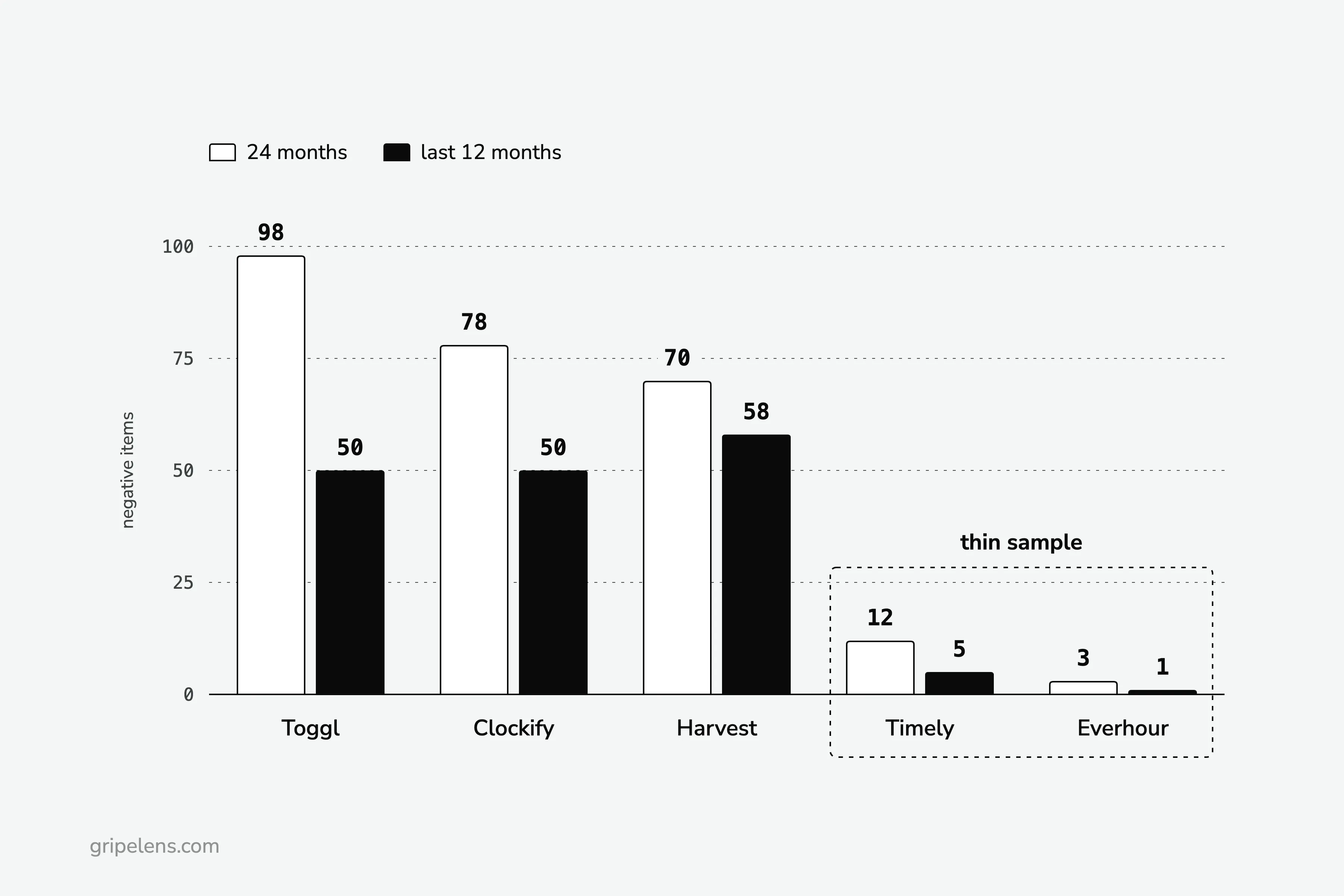
There’s no fixed number. Count each app’s negative reviews in your window first; mine didn’t all have enough. Negative items per app, over 24 months and over the last 12:
- Toggl: 98 and 50
- Clockify: 78 and 50
- Harvest: 70 and 58
- Timely: 12 and 5
- Everhour: 3 and 1
An app with 1 complaint in a year can’t rule a theme out, and it can barely confirm one. Timely and Everhour are thin samples here, and that turns out to decide Step 4.
My rule of thumb, not a standard: before you start, write each app’s count of negative reviews in your window next to its name. If an app has a handful, flag it as a thin sample and keep it in the table. Don’t drop it silently.
Step 2: Pull the 1 to 3 Star Reviews With Their Dates
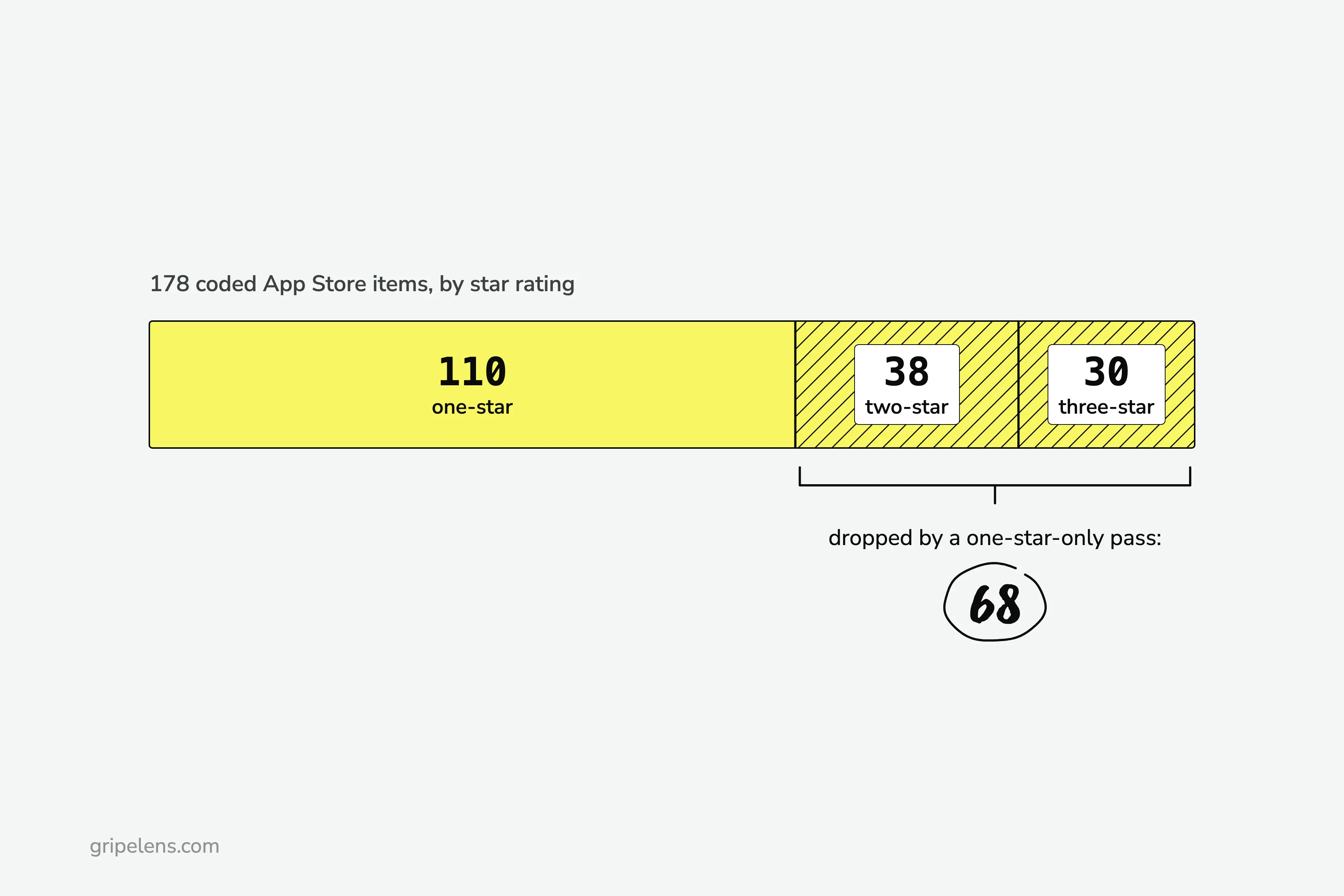
Why not one-star only? Because one-star reviews are a biased sample, and a one-star-only pass throws away the milder complaints. Of the 178 App Store items I coded, 110 were one-star, 38 two-star and 30 three-star: a one-star-only pass would have dropped 68 of them.
You can see the bias in a thread on r/AppStoreOptimization, where people say they never leave one-star reviews, or use them to ask a question. “I never give 1 star ratings, I just uninstall it if I dont like it,” wrote u/Jero9871. “I give 1 star when I want to ask a question or make a suggestion,” wrote u/Ambitious_Muscle_362. Both about June 2026.
So a one-star pile mixes in support questions and leaves out the people who left quietly.
Keep six things per review:
- the app
- the store and country
- the stars
- the date
- the text
- the link
The date is the one people skip. Step 4 can’t run without it.
For scale, I read 2,685 App Store reviews across four storefronts (US, GB, CA, AU) over a 24-month window, 9 October 2024 to 8 October 2026.
Step 3: Code Each Review and Count It per App
Coding means giving each review one or more themes from a fixed list. A review saying the app lost all its data gets “lost entries and sync failures”; if it also complains about the price, it gets both. My sample ended with ten themes, and the full grid is on the sample report.
If you haven’t done this before, here’s how to code and count reviews by hand without your theme list drifting halfway through.
Then count per app, not in total.
Why per app?
Totals lie. Sign-in and sign-up failures came to 37 items, which reads like a market-wide problem until you split it: 28 were Toggl’s, 9 were Clockify’s, and the other three apps had none. That’s mostly one vendor’s problem, not an idea.
While you’re in there, check the dates for bursts. Nine of the ten newest Toggl reviews on G2 are dated 6 October 2026, which looks like a review campaign, so I kept their cons but weighted them less. Dated review bursts can inflate one app’s theme in a single day.
This is the step that hurts by hand: copying reviews out of several stores, keeping every date, counting each theme per app. Do it in a spreadsheet, or have Gripelens do this step: it reads the reviews, groups them into themes counted per app, flags thin samples and review bursts, and keeps a dated quote behind every theme. The sample report shows the output.
Step 4: Run the Three Filters
Write the filters as numbers, so you can’t fudge them later:
- The same theme shows up in 5+ competing apps.
- It’s dated in the last 12 months (8 October 2025 to 8 October 2026).
- It’s about more than price.
The 12-month split below comes from the same coded data as the 8 October 2026 sample report; the public report shows whole-window counts only. Apps are out of five (Toggl, Clockify, Harvest, Timely, Everhour).
| Theme | Apps (24 months) | Apps (last 12 months) | Items (last 12 months) | Verdict |
|---|---|---|---|---|
| Price rises and paywalled features | 4 | 2 | 64 | out: price |
| Crashes and freezes | 4 | 4 | 20 | pass at 4 of 5 |
| Lost entries and sync failures | 3 | 3 | 19 | pass in all 3 apps with enough reviews |
| Surprise charges, no refunds | 3 | 3 | 16 | out: price |
| Logged out, sign-in and sign-up failures | 2 | 2 | 15 | out: under 4 apps in 12 months |
| Missing features | 3 | 3 | 15 | pass in all 3 apps with enough reviews |
| Clunky time entry | 3 | 3 | 12 | pass in all 3 apps with enough reviews |
| Support unreachable | 4 | 2 | 8 | out: under 4 apps in 12 months |
| An update made it worse | 4 | 4 | 7 | pass at 4 of 5 |
| Mobile app lacks web features | 4 | 2 | 6 | out: under 4 apps in 12 months |
Filter 1 passes nothing. No theme reaches all five apps, over 24 months or over 12, and the cause is sample size: Everhour had 3 negative items in 24 months and Timely 12, too few to rule a theme out: an absence there means nothing. So I read the rule as “every app with enough reviews”, and I’m telling you that here instead of loosening it quietly.
Read that way, there are two results:
- At 4 of 5 apps in the last 12 months, only crashes and freezes (20 items) and “an update made it worse” (7) survive, and both reach a fourth app only through the thin samples (Timely’s 5 recent crash reviews; Everhour’s single recent review for “an update made it worse”). Both are reliability complaints about the incumbents. They say the existing apps break, not that a product is missing.
- Across the 3 apps with enough reviews (Toggl, Clockify and Harvest, each with 50 or more negative items in the last 12 months), lost entries and sync failures (11, 5 and 3 items, so 19) is the strongest product-shaped gap. Missing features covers different asks, not one product, and clunky time entry rests on a single Harvest item.
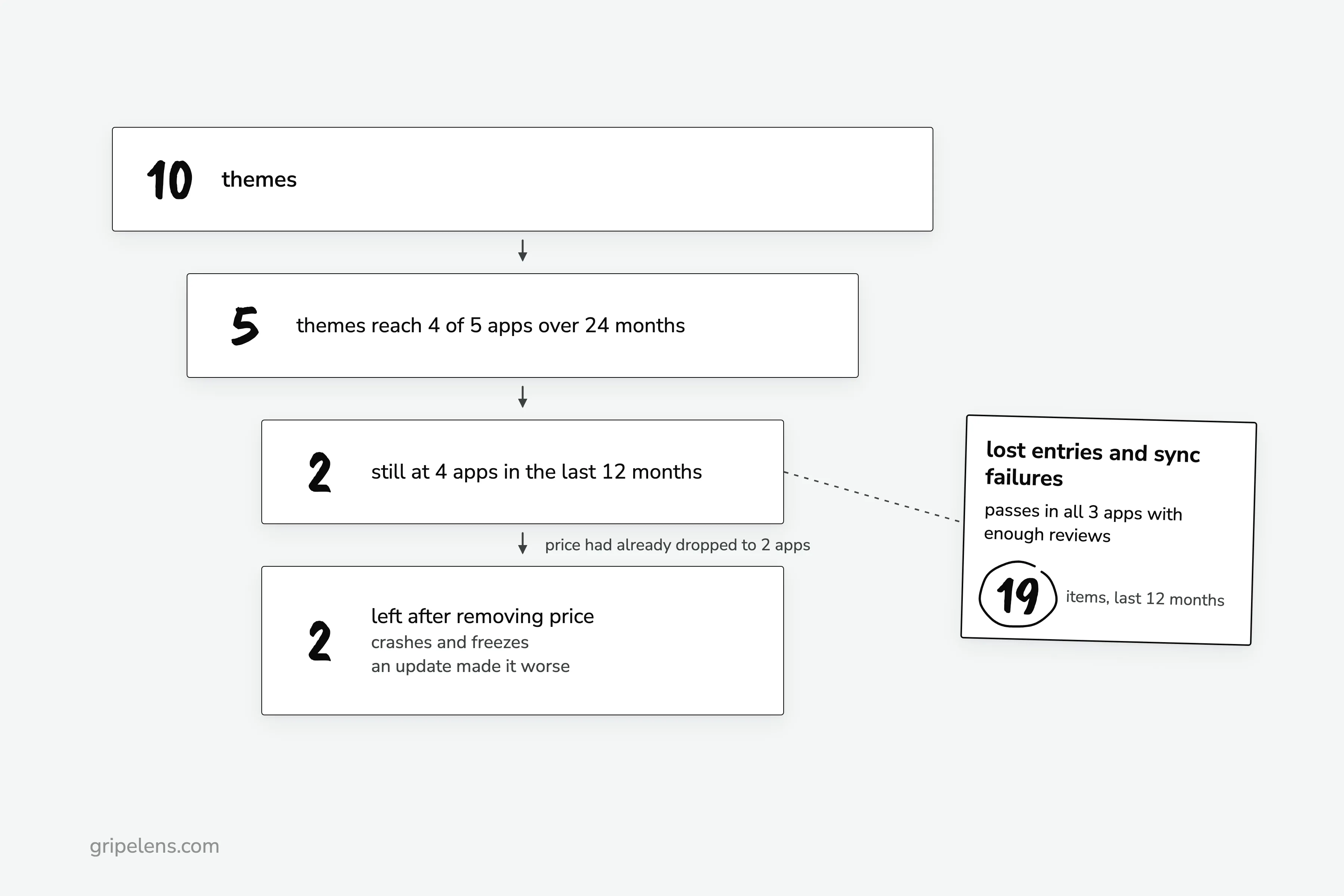
As a funnel: 10 themes, then 5 that reach 4 of 5 apps over 24 months, then 2 still at 4 apps in the last 12 months, then the same 2 after the price filter, because price had already dropped to 2 apps.
Is a Price Complaint Ever an App Idea?
Price was the loudest theme by a distance: 67 of 261 items (26%), 64 of them in the last 12 months. All 64 came from two apps, Clockify (26, after its mid-June 2026 free-plan cut) and Harvest (38, after its 2026 repricing). It’s recent, it shows up across review sites, and it’s real.
One Clockify reviewer, 1 star, 6 July 2026: “I’m ok with a limited free version. I’m not ok with having to pay for features that once were available for free.”
So why is it out? Because it’s about one vendor’s decision, not a missing product. A cheaper clone competes on price with a company that can cut its price back whenever it likes.
And price anger follows any paywall, good product or not. “Users will trash your app with 1 star reviews the second they see a paywall,” as @Hartdrawss put it on X (271 likes, 12 February 2026). That’s a developer’s opinion, not data.
Where do people go when they leave? Of 24 Reddit comments that name the tool someone moved to, 9 name Keito, 4 Clockify and 2 Productive: at least 15 of the 24 went to a tool that already exists.
The r/SaaS rule above ranks this kind of complaint first; I rank it out.
Verdict: a pricing play, not a product gap. As positioning against one rival, though, the same complaint is the strongest opening in the sample.
Step 5: Read What Survived Before You Build
A count tells you where to look. The quotes tell you whether the count holds. Open the dated reviews behind the survivor and check that they describe the same failure. For lost entries, they do:
- “Horrible!!!! Lost all the data. Don’t use it. Highly unreliable” (Clockify, 1 star, 14 April 2026)
- “Lately some entries have gone missing!” (Harvest, 1 star, 9 March 2026)
- “Time tracking often fails to save locally or takes a very long time.” (Harvest, 2 stars, 1 July 2026)
- “Worked great, until it didn’t. Nothing in the app currently works and I have lost all data entered.” (Toggl, 1 star, 24 February 2026)
Three apps, one failure: the hours you logged are gone.
What about crashes?
Crashes read differently. “Used it every day for years, now all it does is crash on launch. Reinstalled, same issue.” (Toggl, 2 stars, 2 June 2026) A reliability complaint is a reason to switch to a competitor that already exists, not a product to build.
And switching is cheap now. Of those 24 Reddit movers, 4 say they built their own, including a Harvest user leaving after 15 years: “Using Claude, I built an app that works just like Harvest” (r/HarvestApp, 7 September 2026).
That isn’t a price complaint turning into an idea. It shows how low the bar to leave has dropped, which is bad news for any pitch that reads “the same app, but cheaper”.
Before you build, check three things:
- Who already handles offline sync well, and what their own reviews say about it.
- Whether anyone says they’d pay to stop losing entries.
- Whether the survivor holds up on one page: write a one-page report of what survived, with its counts and quotes.
Then keep the warning from r/SaaS in mind: “it is easy to cherry-pick one loud complaint.” (u/Otherwise_Wave9374, about February 2026).
Nineteen complaints across three apps beat one loud one, and that’s the most I’d claim for app ideas from one-star reviews. They’re still a direction to test, not validated demand.
If You Want the Counts Without the Spreadsheet
If you want the competitor list, the per-app counts and the dated quotes without building the spreadsheet yourself, that’s the job Gripelens does.
Get early access: launch pricing is locked for a year for the first wave. If you’d rather keep the spreadsheet, the five steps above work by hand.
FAQ
Are one-star reviews a good source of app ideas?
Yes, as a list of failures to count across apps, not as a list of ideas. A single app’s one-star pile mixes product failures with support questions and paywall anger: on r/AppStoreOptimization one person said they give 1 star “when I want to ask a question or make a suggestion”, and another said they never give one at all. Count the same complaint across competing apps before you call it a gap.
How many apps do I need before a complaint counts as a pattern?
Five or more competing apps, each with enough reviews in your window to count. In the time-tracker sample, two of the five apps had too few negative reviews (3 and 12 over 24 months), so the rule became “every app with enough reviews”, which meant three apps.
Should I only read one-star reviews?
No. Read 1 to 3 stars. Of the 178 App Store items I coded, 68 were 2 or 3 stars, and a one-star-only pass would have missed every one of them.
What app idea did the time-tracker reviews point to?
A time tracker that never loses entries, including offline. Lost entries and sync failures came to 19 complaints in the last 12 months across Toggl, Clockify and Harvest. Treat it as a direction to test, not proven demand.
Can I just use a ready-made list of app ideas?
Use one as a starting point, then check the apps, threads and dates behind each count yourself. A count with no dates can’t tell you whether the problem is still there: 53 of the 261 items in my sample were older than 18 months and may describe problems that have since been fixed.