Review Mining for Positioning: 5 Steps on a Real SaaS Rival
I turned 70 counted complaints about one SaaS rival into a positioning line, then listed reviewers' own words for the copy. Five steps, with receipts.
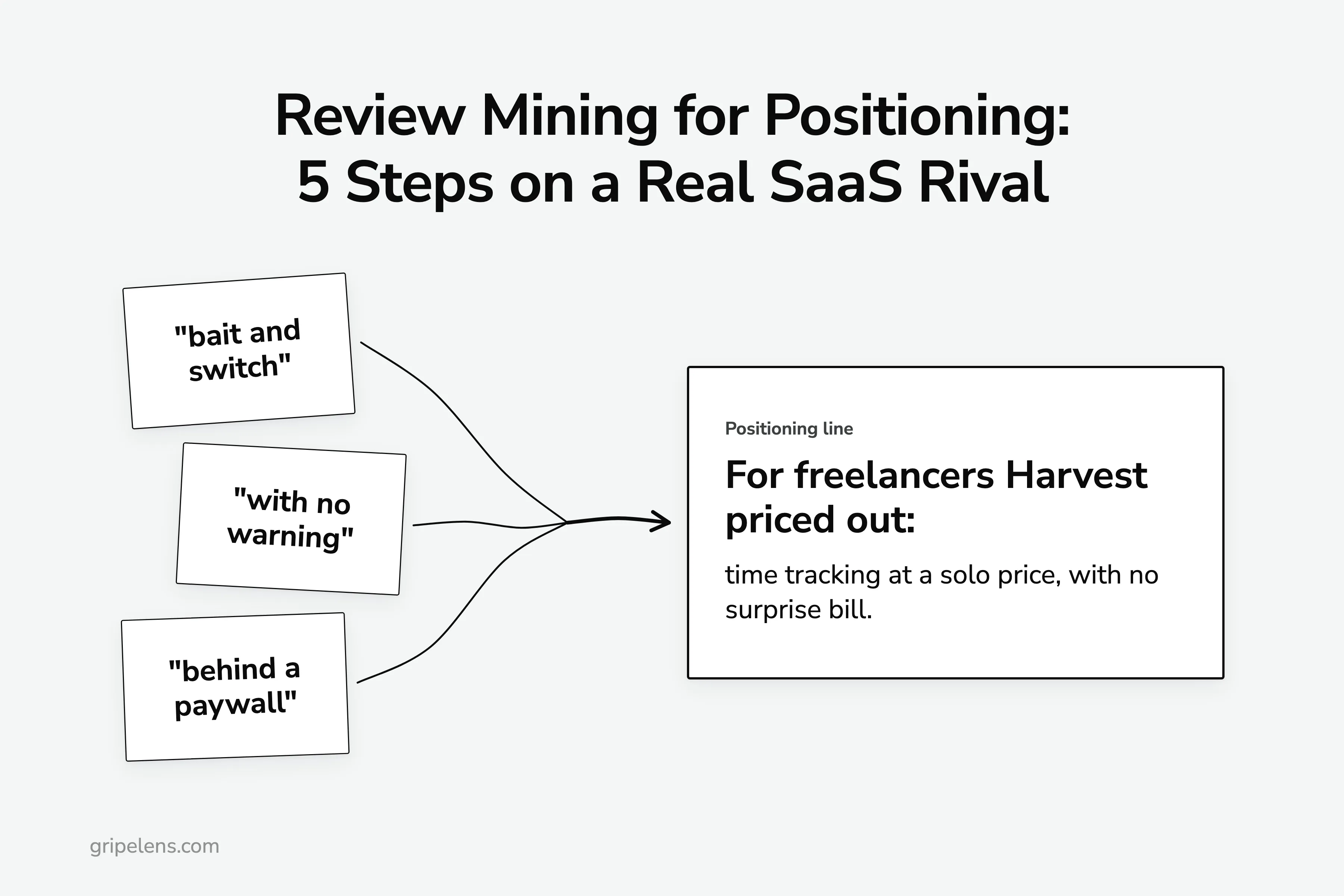
Review mining for positioning means reading one named competitor’s negative reviews, counting the complaint themes, and turning the biggest gap into a positioning line plus a list of reviewers’ own words for your landing page. I ran the five steps on Harvest, where 38 of 70 negative items in two years are about its 2026 price rise, and on Toggl Track, where the same steps give a different line.
I research competitor reviews by hand before building anything: for this product I logged 36 tools in the category with their prices and 101 quoted complaints, each with its source and date. The worked example is a time-tracker report I hand-ran on 8 October 2026. It holds 261 negative items about Toggl Track, Clockify, Harvest, Everhour and Timely, coded from the App Store, Trustpilot and G2, plus Reddit threads read for switching.
Below: why most review-mining guides stop at copy, the five steps from picking a rival to a finished wording list, and the checks a line needs before it goes on a page.
Key takeaways
- Review mining for positioning takes one named competitor’s counted complaints and turns the biggest gap into a positioning line, then lists reviewers’ own phrases for the headline, subhead and FAQ.
- Harvest’s row gives the line: 38 of its 70 negative items (Oct 2024 to Oct 2026) are about its 2026 repricing, so the buyer it priced out is the buyer to court.
- The same steps on Toggl give a different line: 28 of its 98 items are about being logged out, and only 2 about price.
- Sort every theme into a positioning gap, a wrong-buyer warning or a service fix; only the first two go forward, and a wrong-buyer warning only when that buyer is yours.
- A line is a hypothesis with a date on it: 61 of the 67 price complaints in the sample were posted in the last six months, so recheck it before it ships and again later.
Why Do Most Review-Mining Guides Stop Short of Positioning?
Of the pages that rank for review mining for positioning, the how-to guides teach copywriting or a general workflow, and none ends with a positioning line against a named rival. Joanna Wiebe of Copyhackers reads reviews by the hundred: “Hundreds of them, on Amazon, until my customers write my headlines for me.” Her showcase is SweatBlock, an antiperspirant whose headline came almost word for word out of its reviews.
For an antiperspirant, that’s the right job. The output is a swipe file of lines customers already wrote.
Amazon armpits are not your market.
A founder positioning a SaaS product against an incumbent needs three things a swipe file doesn’t give:
- One named rival, not a product category.
- A count per complaint theme, with its n (the number of review items behind it) and dates.
- A sentence that says who you serve instead.
u/pop6996pop put it plainly on r/Entrepreneur in August 2026: “Most people do competitor research wrong because they copy features instead of figuring out positioning.”
The reading is the same. What changes is the target (one rival, not a category) and the output: a counted line plus a wording list, not a folder of good phrases.
Step 1: Pick One Competitor and the Buyer Who’d Switch
Pick the rival whose unhappy buyers you could actually serve, and write that buyer down before you read a single review. My test for the rival: one theme dominates its row, and that theme is recent.
Harvest passes. 38 of its 70 negative items over two years are about the 2026 repricing that followed the Bending Spoons acquisition, with reviewers quoting rises of 4x to 14x. Everhour fails: 3 negative items in the same window support nothing.
So who is the buyer? The money signals in the sample point at one:
- Solo freelancers pay $5 to $17 a month without complaint.
- Reviews turn to cancellation when a bill passes about $100 a month.
- Of 24 Reddit comments that name the tool someone moved to, 9 name Keito, 4 Clockify, 4 say they built their own and 2 name Productive.
Treat Keito’s 9 as rough. Keito’s founder posted in r/HarvestApp, so some may be promotion; they come from different accounts, and I couldn’t verify any of them.
Some of the people leaving are long-time customers. “I’m leaving after 15 years. Using Claude, I built an app that works just like Harvest,” one r/HarvestApp member wrote on 7 September 2026.
So the buyer for Harvest is a freelancer whose bill jumped. Write yours in one line now. Step 3 needs it.
Step 2: Start From That Competitor’s Counted Row
This post starts where the counting ends. Collecting and coding reviews is the full collect, filter and count method; here I only cover the inputs, because they decide what the row can tell you:
- 1 to 3 star reviews from the App Store and Trustpilot.
- The cons field (the “what do you dislike” box) of G2 and Capterra reviews at any rating.
- A date on every item.
That’s a deliberate choice against Copyhackers’ advice to skip the 1s and 5s: “The 2, 3 and 4-star reviews are where people explain what they wanted, what was missing and how they talk about the problem.” For copy, fair. Middle reviews carry desire language, but positioning needs the reasons people leave, and those sit in low reviews and cons fields.
In my own research, most of the 101 complaints came from the cons fields of 4 to 5 star Capterra reviews.
Harvest’s counted row, n = 70, top three themes:
- Price rises and paywalled features: 38
- Surprise charges, no refunds: 12
- Crashes and freezes: 8
These are the top three of ten themes, and one item can carry several themes, so the full row adds up to more than 70. Keep the row as a report with theme, count, n and a dated quote per row, so every number you use later has a receipt.
Copying, coding and dating reviews from four sources is the slow part. Do it in a sheet, or have Gripelens do this step: the sample report shows the counted grid and the exact list of customer wording it returns.
Step 3: Sort the Themes Into Positioning Gap, Wrong-Buyer Warning or Service Fix
Not every complaint about a rival is an opening for you. u/Calm-Dimension3422 framed it on r/SaaS: “Some complaints are ICP warnings, some are positioning gaps, and some are service/process gaps.” (ICP is your ideal customer profile: the buyer a product is built for.)
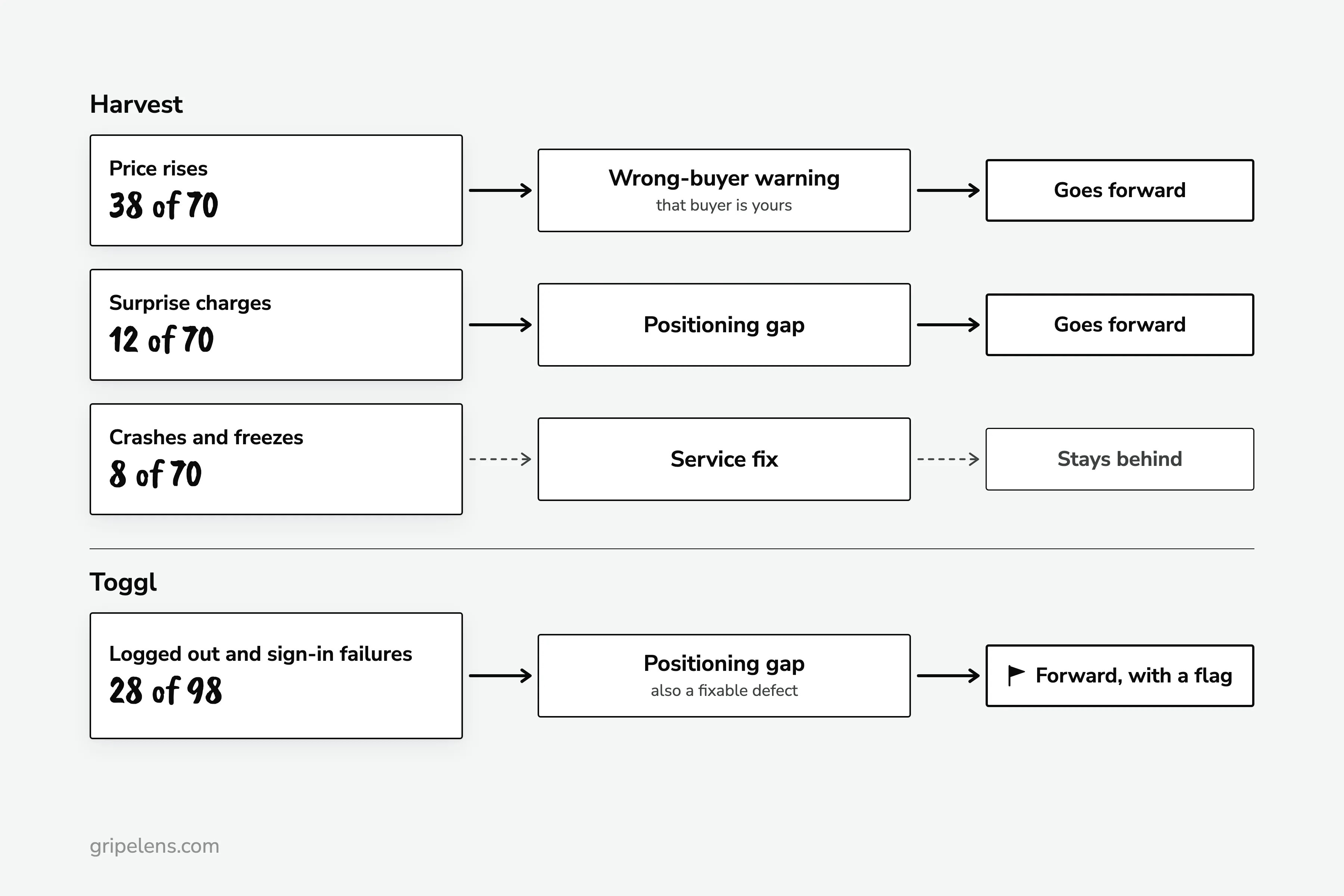
Three buckets, one rule:
- Positioning gap: the rival fails at something your product does differently. Goes forward.
- Wrong-buyer warning: the complaint comes from a buyer the rival doesn’t serve. Goes forward only when that buyer is yours.
- Service fix: support, or a bug the rival can patch. Stays behind.
The wrong-buyer bucket comes from the same thread, where u/Altruistic-Cherry433 added: “One caveat. some negative reviews come from the wrong customer, someone the product was never built for. those are still useful, because they tell you who your competitor fails to serve, which might be exactly who you should be targeting.”
Harvest’s row, routed:
- Price rises, 38 of 70: wrong-buyer warning, goes forward. After the repricing, the solo freelancer is the wrong buyer for Harvest, and that’s your buyer from Step 1. A 1-star Trustpilot review from 13 August 2026: “I pay around $12 as a freelancer with a few projects each month. Just got an email to say my price increase was going up to $113 PER MONTH.”
- Surprise charges, 12 of 70: positioning gap, goes forward. A bill you can predict is something you can offer.
- Crashes and freezes, 8 of 70: service fix, stays. Harvest can patch it.
Price won by a distance in my own research too: 25 of 101 complaints across 13 tools. Price gripes make poor app ideas, because the vendor can cut the price back; as positioning against one named rival, the same theme is the strongest opening in the sample.
Toggl routes differently. Its top theme, logged out and sign-in failures, is 28 of 98: a positioning gap, since staying signed in is a promise you can make. It’s also a fixable defect you could file as a service fix, so I send it forward with a flag.
Step 4: Write the Positioning Line From the Top Counted Gap
One template: For [the buyer the rival fails], [your product] [does the thing the top theme says the rival stopped doing]. The count and the date stay in your notes, behind the line, not in it.
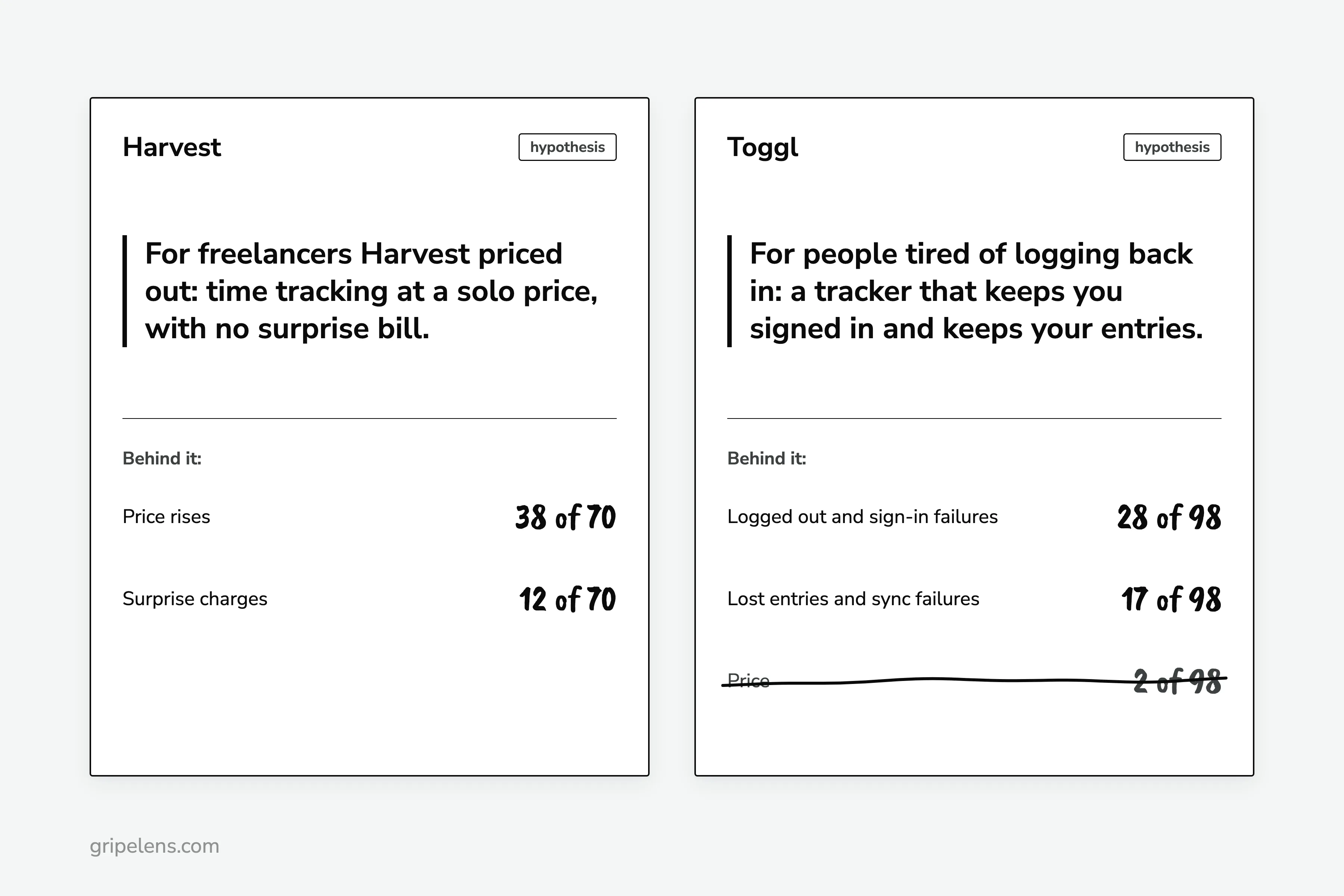
Filled in for Harvest:
For freelancers Harvest priced out: time tracking at a solo price, with no surprise bill.
Behind it: price rises 38 of 70 plus surprise charges 12 of 70, 9 October 2024 to 8 October 2026. Both themes survived Step 3, so both shape the line: “a solo price” answers the first, “no surprise bill” the second.
Toggl, same template:
For people tired of logging back in: a tracker that keeps you signed in and keeps your entries.
Behind it: logged out and sign-in failures 28 of 98, lost entries and sync failures 17 of 98.
Why not a price line against Toggl too? It would rest on 2 of 98 items. Same category, same dataset, different rival, different line. That’s why Step 1 picks one competitor: a market-wide average would have handed you price for both.
The second half of the line has to be true of your product today. If it isn’t, the line is wrong, not the reviews.
Both lines are a hypothesis, not a finding. The count says where the complaints are, not which headline converts, so test the line on a page before you rebuild your site around it.
Step 5: Build the Exact-Wording List for Landing-Page Copy
The second deliverable is a list of reviewers’ own phrases, each mapped to a counted theme and given a slot on your page. u/Altruistic-Cherry433 gave the reason on r/SaaS: “a reviewer describing a pain point writes in the exact vocabulary your landing page should use, not the vocabulary your product team uses internally.”
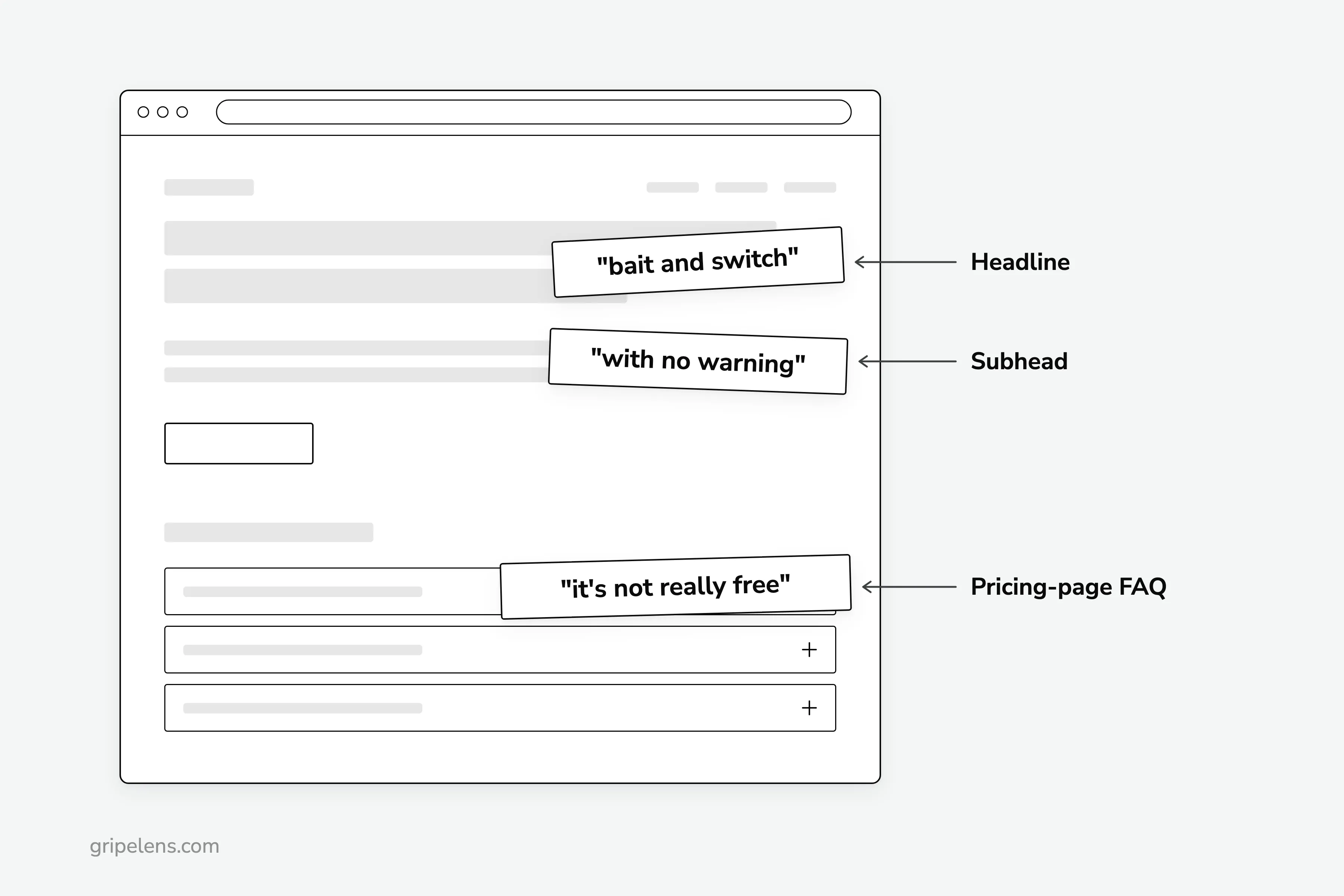
The phrases come from the sample report’s 16-phrase wording list. That list is category-wide and doesn’t tag phrases to a competitor or a theme, so the theme column is my mapping, and the count is the theme’s across all five tools. The report has no per-phrase counts.
| Phrase | Theme it maps to (my mapping) | Theme count, all five tools, n = 261 | Where it goes |
|---|---|---|---|
| ‘bait and switch’ | Price rises and paywalled features | 67 of 261 | Headline |
| ‘behind a paywall’ | Price rises and paywalled features | 67 of 261 | Subhead |
| ‘it’s not really free’ | Price rises and paywalled features | 67 of 261 | Pricing-page FAQ |
| ‘with no warning’ | Surprise charges, no refunds | 22 of 261 | Subhead or billing FAQ |
| ‘your session has expired’ | Logged out, sign-in and sign-up failures | 37 of 261 | Toggl-switcher page headline |
| ‘lost all my data’ | Lost entries and sync failures | 33 of 261 | Feature section |
| ‘crashes on open’ | Crashes and freezes | 41 of 261 | Reliability FAQ |
| ‘Bring back the old app’ | An update made it worse | 16 of 261 | Changelog or FAQ |
Three dated quotes from the report sit close to the list:
- “1000% price hike. From $2000/year to $22,000 (!) per year - charged to my credit card without warning.” Harvest, 1 star, Trustpilot, 31 July 2026. “Without warning” is a variant of the list’s “with no warning”, not the same phrase.
- “every couple of days it logs me out saying that my session has expired.” Toggl, 2 stars, App Store, 18 March 2025: older than 18 months, so it may be fixed. “My session has expired” is a variant of the list’s “your session has expired”.
- “The whole point of a time logging app is to log time.” Clockify, 3 stars, App Store, 30 May 2026. Not one of the 16 phrases; it’s the clunky-time-entry theme (26 of 261) in one sentence.
The rule: use a phrase in your copy freely, and cite the review only when you quote it whole. Never pin a list phrase on one rival unless you hold a dated quote from that rival’s reviews that carries it.
How Do You Check the Line Before It Ships?
A counted line can still be wrong by the time someone reads it. Whether a theme is a pattern at all is the pattern test; run that first. These four checks are about the line:
- Is the wave recent, and will it fade? 61 of the 67 price complaints in the sample were posted in the last six months. Date the line and recheck it.
- Is the lead quote old? 53 of 261 items are older than 18 months and may describe fixed problems. Toggl’s “session has expired” quote is from 18 March 2025.
- Is it a burst? Nine of the ten newest Toggl reviews on G2 are dated 6 October 2026. That looks like a review campaign, so I kept the cons and weighted them less.
- Does it survive copying? u/anoopmc on r/SaaS, 22 March 2026: “Most of this works early, then breaks once others copy it.” Every rival can read the same public reviews.
So how do the two lines hold up?
Harvest’s line rests on a vendor decision: a recent repricing I don’t expect Harvest to reverse soon. It holds while the price does.
Toggl’s line rests on a fixable defect. Across all five tools, sign-in complaints (37 of 261) trend down, and the lead quote is from March 2025. Shorter shelf life.
Either way, recount the themes every month while the line is live, and drop it when its theme stops producing new reviews.
If You’d Rather Not Count by Hand
If you want one rival’s counted row and its reviewers’ own wording without building the sheet, that’s the job Gripelens does.
Get early access: launch pricing is locked for a year for the first wave. If you’d rather keep the sheet, the five steps above work by hand.
FAQ
What is review mining for positioning?
It means reading one named competitor’s negative reviews, counting the complaint themes with an n and a date on each, and turning the top gap into a positioning line plus a list of reviewers’ own phrases for your page. Copy-focused review mining reads a whole product category for headline wording; this version targets one rival and asks who it fails.
Which reviews should I mine for positioning: 1 star or 2 to 4 stars?
For positioning, read 1 to 3 star reviews plus the cons field at any rating, because that’s where people explain why they leave. The 2 to 4 star reviews suit a different job: desire language for copy. Keep both lists if you have both jobs, but don’t mix them.
How many complaints does a competitor need before I write a line against it?
Enough that one theme stands out against that rival’s own n. Harvest’s 70 negative items, with 38 on one theme, are enough. Everhour’s 3 support nothing, and Timely’s 12 are thin, so I wouldn’t write a line against either from this sample.
How often should I recheck a positioning line built from reviews?
Recheck whenever the theme’s newest dated items stop arriving. In the sample, 61 of the 67 price complaints came in the last six months, so check monthly while a wave like that runs, and drop the line once it fades.