Kimola Alternatives: 7 Best Tools for Competitor Reviews
Kimola makes you paste every link. I compared 7 alternatives by the review sources they read, whether they find competitors for you, and price.
The best Kimola alternative depends on whose reviews you read: Appbot or AppFollow for competitor apps, Thematic, Unwrap, Enterpret or Chattermill for a customer-experience (CX) team’s own feedback, and Gripelens if you want the competitors found and their complaints counted. Kimola itself is a decent start. It just makes you paste every link.
I research competitor reviews by hand before building anything: for this product I logged 36 tools in the category with their prices and 101 quoted complaints, each with its source and date. I also build Gripelens, one of the seven below, and I say so again where it appears.
If you are still choosing a category of tool, start with my wider comparison of tools for reading competitor reviews; this page is for people who tried Kimola or nearly did.
Below: how I compared them, one table with all eight tools, what Kimola does well and where it stops, the seven alternatives one by one, and which to pick by job.
Key takeaways
- Pick by job: Appbot or AppFollow when your competitors are apps, Thematic, Unwrap, Enterpret or Chattermill for your own feedback at volume, and Gripelens when you want the competitors found and their reviews counted across sources.
- Kimola is a cheap, self-serve start (free for 150 queries a month, Basic £39 a month), but every report starts from a link, keyword or file you supply; none of the seven alternatives below except Gripelens finds the competitors for you either.
- For competitor apps, Appbot (from $49 a month billed annually) and AppFollow (free for 2 apps and 10 competitors) read the app stores; neither reads G2, Capterra or Reddit.
- Thematic ($25,000 a year) and Unwrap (from $24,000 a year) are sales-led; Enterpret and Chattermill publish no price and sell by demo.
- Chattermill says it is not a fit below 5,000 pieces of feedback a month, and Enterpret recommends at least 1,000 records a month, so both are built for your own feedback, not a competitor scan.
How I Compared Them
I build Gripelens, so weigh this accordingly. There are no affiliate links on this page.
Why not just take a directory’s list? When I searched “kimola alternatives” on 2026-10-23, all 9 results on Google’s first page were directory lists, company-data pages or vendor pages, and none was an independent article. G2’s best overall alternative to Kimola is SurveyMonkey, a survey tool. GetApp picks its 20 by “common software categories, shared features and the number of verified user reviews”, which is how Wolfram Mathematica ends up on the list. So I kept only tools that read reviews.
I applied five criteria, in this order:
- Does it find competitors for you, or do you supply them?
- Which review sources it reads, and how G2, Capterra and Reddit get in: built in, through a browser extension, or not at all.
- Whose reviews it is built for: competitors’ public reviews or your own feedback.
- Counts and quotes: a sample size per theme and dated, linked quotes, where the vendor’s pages say so.
- Entry price and how you buy it: free plan, self-serve paid plan, or a sales-led annual contract.
I read each tool’s public pricing, feature and docs pages on 2026-10-17 and built a fact sheet from them. I didn’t test the paid plans hands-on. Prices are as each page showed them, Kimola’s in GBP.
Kimola Alternatives at a Glance
Eight rows: Kimola as the reference, then the seven alternatives in the order I cover them.
| Tool | Finds competitors for you | Review sources read | G2, Capterra, Reddit | Built for | Entry price | Self-serve or demo |
|---|---|---|---|---|---|---|
| Kimola | Not seen; you paste links | About 20 link sites, plus 24 via the Airset Generator extension | Extension only | Reviews you link to, plus your own files | Free (150 queries/mo); Basic £39/mo | Self-serve |
| Gripelens | Yes, from a product or category name | Six: App Store, Google Play, Trustpilot, G2, Capterra, Reddit and HN | Yes, built in | Competitors’ public reviews | See pricing | Self-serve, early access |
| Appbot | Not seen; added by hand, each counts as a source | Apple App Store, Google Play, Microsoft Store | No | Apps, yours and competitors’ | Small $49/mo billed annually ($59 monthly); no free plan, 14-day trial | Self-serve |
| AppFollow | Not seen; added by name or store URL | App stores, plus Steam and Trustpilot | No | Apps; competitors read-only | Free (2 apps, 10 competitors); ASO $19/mo annual | Self-serve |
| Thematic | Not seen; you name the apps | Apple Store, Google Play (yours and competitors’), other feedback integrations | No G2 listed | Your own verbatims (2,000+ rows) | Foundation $25,000/yr | Demo or paid pilot |
| Unwrap | Not seen | Documented integrations; Amazon by ASIN (100 most recent) | No | Your own feedback | From $24,000/yr; 30-day trial on your data | Sales-led |
| Enterpret | Not seen | App Store, Google Play, G2, Trustpilot, Google My Business | G2 yes; Reddit not listed | Your own feedback (1,000+ records/mo) | No public price | Demo only |
| Chattermill | Not described | 21 review sites and 12 social sources, connected to your feedback | Yes, connected to your feedback | Your own feedback (5,000+ pieces/mo) | No public price | Demo |
Prices are as shown on 2026-10-17, Kimola’s in GBP. “Not seen” means not on any public page I read, so a feature hidden inside the app can’t be ruled out.
What Does Kimola Do Well, and Where Does It Stop?
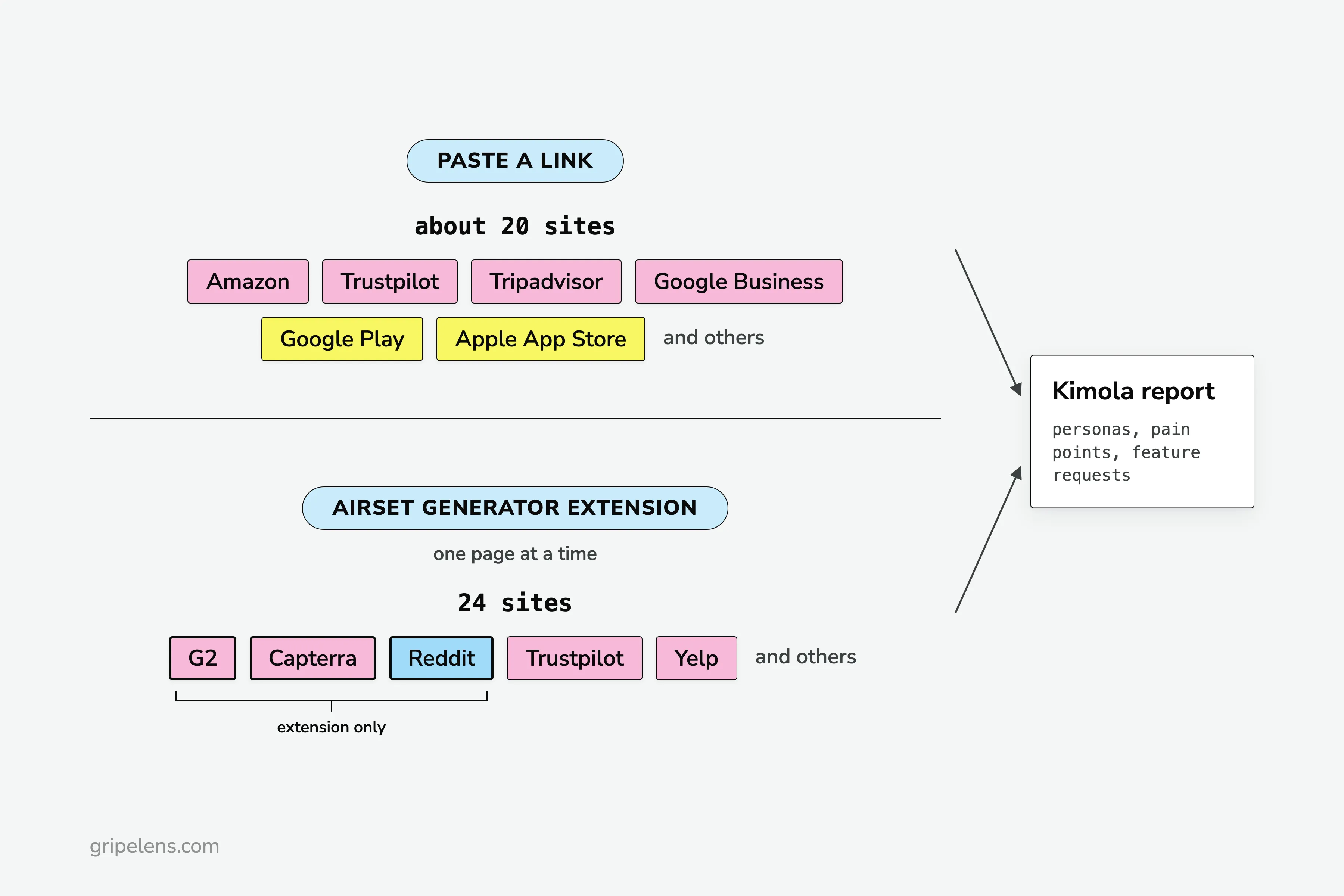
Kimola reaches reviews two ways: you paste a link from one of about 20 supported sites, or you open a page and its Airset Generator Chrome extension collects the reviews visible on it, across 24 sites. G2, Capterra and Reddit are reachable only through the Airset Generator extension.
It does a lot for the money. Kimola sells itself as usable “without talking to sales”, and that holds:
- Kimola’s free Starter plan covers 150 queries a month, with no credit card. Basic is £39 a month (£32 billed annually) for 3,000 queries.
- One report can take one link or several, from Amazon, Trustpilot, Tripadvisor, Google Business, Google Play and the Apple App Store, among others.
- The extension adds sites such as G2, Capterra, Trustpilot, Yelp and Reddit.
- Reports carry personas, motivations, pain points, unmet needs and feature requests, and export to PowerPoint, PDF, Excel, CSV and TSV.
So where does it stop? At the first step. Every collection path starts from a link, keyword or file you supply, and I saw no competitor discovery on any public page. You need the competitor list before Kimola can help.
The other limits:
- G2, Capterra and Reddit come in one page at a time, through the extension.
- Each analyzed row of up to 500 characters is one query, longer rows count one per 500 characters, and scraping and classifier queries count too.
- Link scraping caps out at 500 reviews per Amazon product, 500 on the App Store and 5,000 on Google Play.
The extension-only path matters more than it looks. G2 is the source a B2B founder most needs and the hardest to read by hand: when I read G2 directly on 2026-10-07, it answered with HTTP 403 (access denied) and a captcha. With Kimola, you open each of those pages yourself. For Reddit alone, see my GummySearch alternatives.
One naming note. Directories still call it “Kimola Cognitive” (5 of the 9 first-page titles). Same product.
What Are the Best Kimola Alternatives?
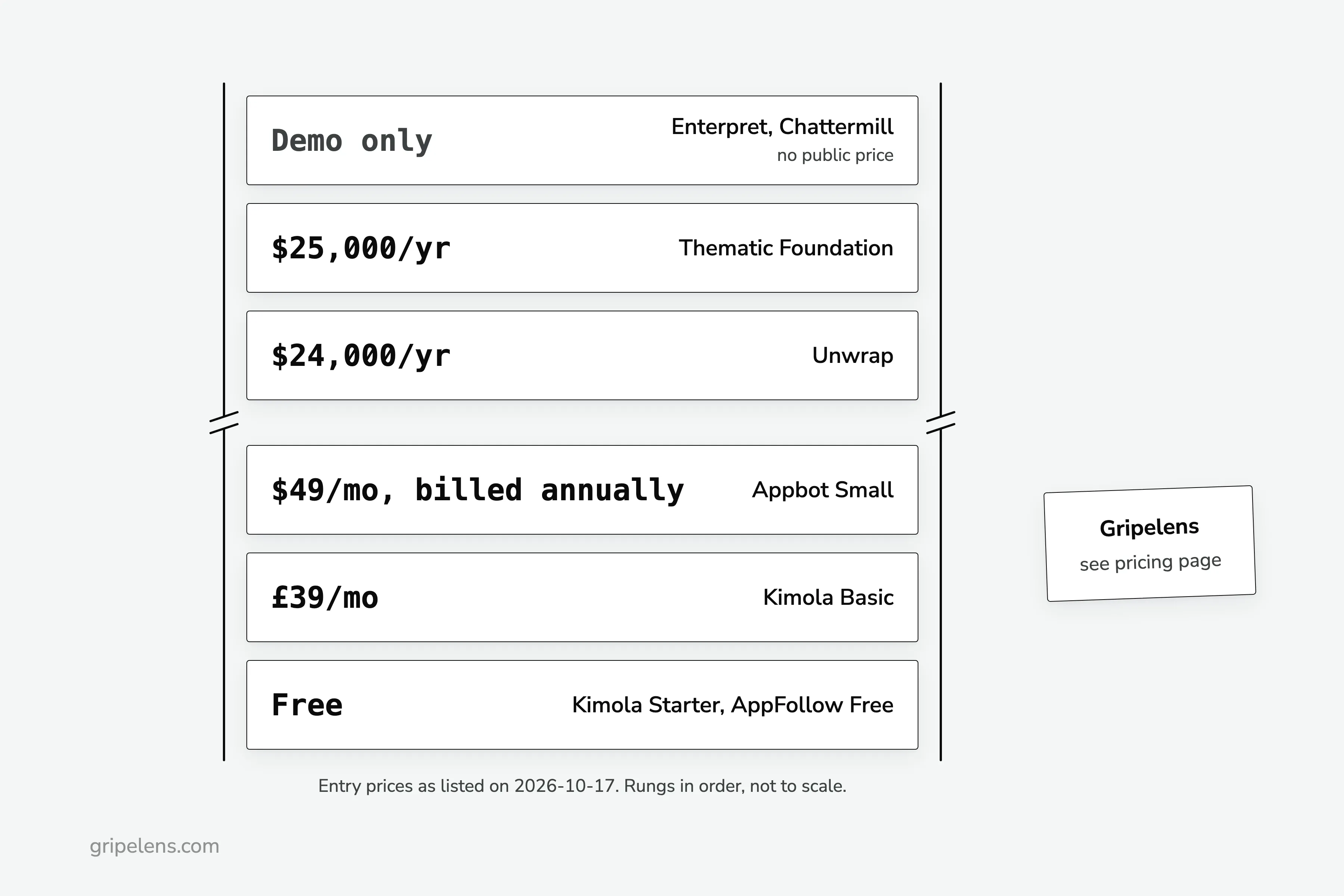
Seven tools, grouped by job, each with who it suits and one downside. Entry prices run from free (Kimola Starter, AppFollow Free) through £39 a month (Kimola Basic) and $49 a month (Appbot, billed annually) to $24,000 and $25,000 a year (Unwrap, Thematic), with Enterpret and Chattermill on demo only.
Gripelens
This is the one I build. Gripelens is best suited to founders who know their category but not every competitor, and want complaints counted across sources with a dated quote behind each theme.
You type a product or category, and it finds the competitors: the step Kimola leaves to you. It reads their public reviews across six sources and merges them into complaint themes, each with a count and a sample size. It also:
- shows every quote’s source, date and link
- flags quotes older than 18 months as “may be fixed”
- marks review bursts and thin samples
- exports Markdown, PDF, CSV or a share link, and has an API and an MCP server (a connector that lets an AI assistant such as Claude query the tool)
The trade-offs: six sources are fewer than Kimola’s links and extension reach, and it reads public reviews only, so your own surveys and tickets stay out. It’s in early access. The sample report shows the output format, and prices are on the pricing page.
Appbot
Appbot is best suited to app founders tracking a handful of competitor apps in the Apple App Store, Google Play and the Microsoft Store. Those three stores are all it reads.
Appbot’s Small plan is $49 a month billed annually, or $59 monthly, for 1 user and 5 sources. There’s no free plan, but you get a 14-day trial of the Large plan with no card. Ask Appbot and the Appbot MCP server come with Large and up, from $166 a month billed annually.
Is 5 sources enough?
For a narrow app category, maybe. You add each competitor app by hand and each one counts as a source on your plan, so Small runs out quickly. There’s no G2, Capterra, Trustpilot or Reddit, which rules it out if your competitors sell B2B software. If it’s ruled out, I sorted the alternatives by where Appbot stops.
AppFollow
AppFollow is best suited to app founders who want a free start watching competitor apps’ reviews alongside ASO (app store optimisation, the work of ranking in store search).
AppFollow’s Free plan covers 2 apps and 10 competitors with 7 days of history. ASO is $19 a month billed annually ($29 monthly), and AppFollow ships an MCP server and AI toolkit for Claude, ChatGPT, Gemini and others.
The trade-offs:
- Competitors are read-only and added “by name or store URL”; nothing finds them for you.
- Reviews come from app stores plus Steam and Trustpilot. No G2, Capterra or Reddit.
- A year of history and CSV export start at Essential, $129 a month billed annually ($179 monthly), a jump from $19.
Thematic
Thematic is best suited to CX and research teams with thousands of their own verbatims (raw feedback comments, one per row) who want themes from their data, plus their own and competitors’ iOS and Android reviews.
Its Apple Store and Google Play integrations pull “Reviews of your and your competitors’ iOS apps”, with you naming the apps. G2 isn’t in its integrations list.
Thematic’s Foundation plan is $25,000 a year for up to 25,000 comments and 3 datasets, annual only as shown. There’s no free tier and no free trial: you get a demo or a paid pilot. Its own FAQ says it “works best with at least 2,000 rows of verbatims”.
Who has 2,000 rows of their own feedback before launch? Not a solo founder. Its MCP server is for existing customers only, too.
Unwrap
Unwrap is best suited to product teams with high feedback volume who want themes across their own channels, plus a read-only MCP server and a GraphQL API (a query interface for pulling the data into your own tools).
Unwrap’s pricing starts at $24,000 a year, based on feedback volume and integrations, never per seat. There’s no free tier; the trial runs 30 days “based on your data”.
The trade-offs are about sources:
- No G2, Capterra or Reddit among its documented integrations.
- Trustpilot needs your own Trustpilot Business account.
- Amazon reviews, pulled by ASIN (Amazon’s product ID), stop at the 100 most recent per product page.
It doesn’t find competitors either. Its Assistant web search, added in September 2026, tracks launches by competitors you name, which is news, not reviews.
Enterpret
Enterpret is best suited to companies with at least 1,000 feedback records a month across support, surveys and review sites who want one taxonomy over all of it. Its review sources include the App Store, Google Play, G2, Trustpilot and Google My Business. Reddit isn’t in its integrations list.
There’s no public price and no self-serve signup: demo only. Its MCP server is listed in the Claude Connector Directory.
What about competitors? Enterpret’s free App Review Analyzer compares up to 5 pasted App Store or Google Play URLs, and that’s as close as it gets to a competitor scan. You still supply the URLs. For more options, see my Enterpret alternatives.
Read its own reviews with care: 9 of Enterpret’s 10 mirrored G2 reviews landed within 18 days, the pattern I wrote up in review bursts on G2 and Capterra.
Chattermill
Chattermill is best suited to large CX teams already collecting more than 5,000 pieces of their own feedback a month across review sites and social channels.
That threshold is Chattermill’s own. Chattermill’s FAQ says it isn’t a good fit if you’re “not consistently collecting more than 5,000 pieces of customer feedback every month”. If you’re under it, here’s what fits under Chattermill’s 5,000-a-month floor.
Its integrations cover 21 review sites, G2 and Capterra among them, and 12 social sources including Reddit. All of it connects to your own feedback, though, not to a scan of a competitor’s listing. Pricing is custom, based on feedback volume, integrations and team size, with no per-user fee. I saw no free tier or trial, and no competitor discovery described.
Which Kimola Alternative Should You Pick?
Pick by job first, budget second.
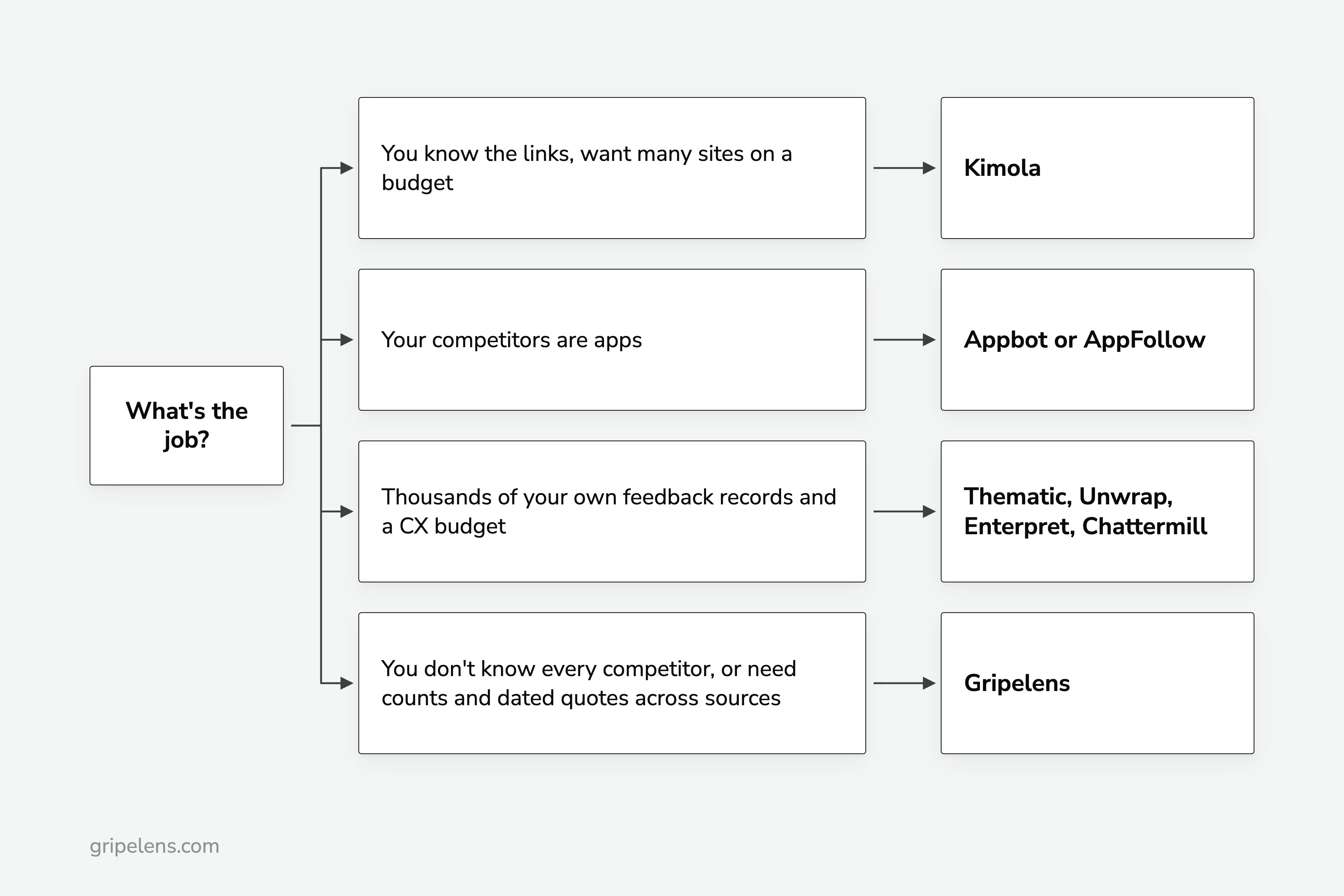
- You know the competitors and want many review sites cheaply: stay on Kimola (free Starter, £39 Basic).
- Your competitors are apps: Appbot or AppFollow, and AppFollow if you need a free start.
- You have thousands of your own feedback records and a CX budget: Thematic, Unwrap, Enterpret or Chattermill.
- You don’t know every competitor, or you need counts and dated quotes across sources: Gripelens.
Doing none of this yet? You’re in company. One r/SaaS founder checks competitor app reviews only for crashes, and wrote on 2026-05-18: “I haven’t systematically ‘analyzed’ anything. Most of the time, I’m just ‘making sure there’s no crash.’” Any tool on this page beats that. The right one depends on whether you already have the competitor list.
If You Want the Competitors Found for You
If you want the competitors found and their complaints counted across sources, with a dated quote behind each theme, look at the sample report first. Then get early access: launch pricing is locked for a year for the first wave.
FAQ
What Is the Best Free Alternative to Kimola?
For apps, AppFollow’s Free plan covers 2 apps and 10 competitors with 7 days of review history. Kimola’s own Starter plan is also free, at 150 queries a month with no credit card, so it may cover you before you need an alternative. None of the enterprise tools here, Thematic, Unwrap, Enterpret or Chattermill, has a free tier.
Does Kimola Find Competitors for Me?
No. I found no automatic competitor discovery on any public Kimola page I read in October 2026. Every report starts from links you paste, keywords you enter or files you upload, so you need your competitor list first.
Can Kimola Read G2 and Capterra Reviews?
Yes, but only through its Airset Generator Chrome extension, which collects the reviews visible on a page you have open. G2 and Capterra are not paste-a-link sources in Kimola, so you collect them one page at a time.
Is Kimola Cognitive the Same as Kimola?
Yes. Kimola Cognitive is the older name, and software directories still use it. Kimola’s own site calls the product Kimola.
Which Kimola Alternatives Are Built for Enterprise Teams?
Thematic (Foundation at $25,000 a year), Unwrap (from $24,000 a year), Enterpret and Chattermill (demo only, no public price). All four are built to analyse your own feedback at volume, not to scan a competitor’s reviews.