Appbot Alternatives: 7 Best Picks by Where Appbot Stops
Appbot reads app stores only, and each competitor app in each store uses a plan source. 7 alternatives compared on sources, competitor tracking and price.
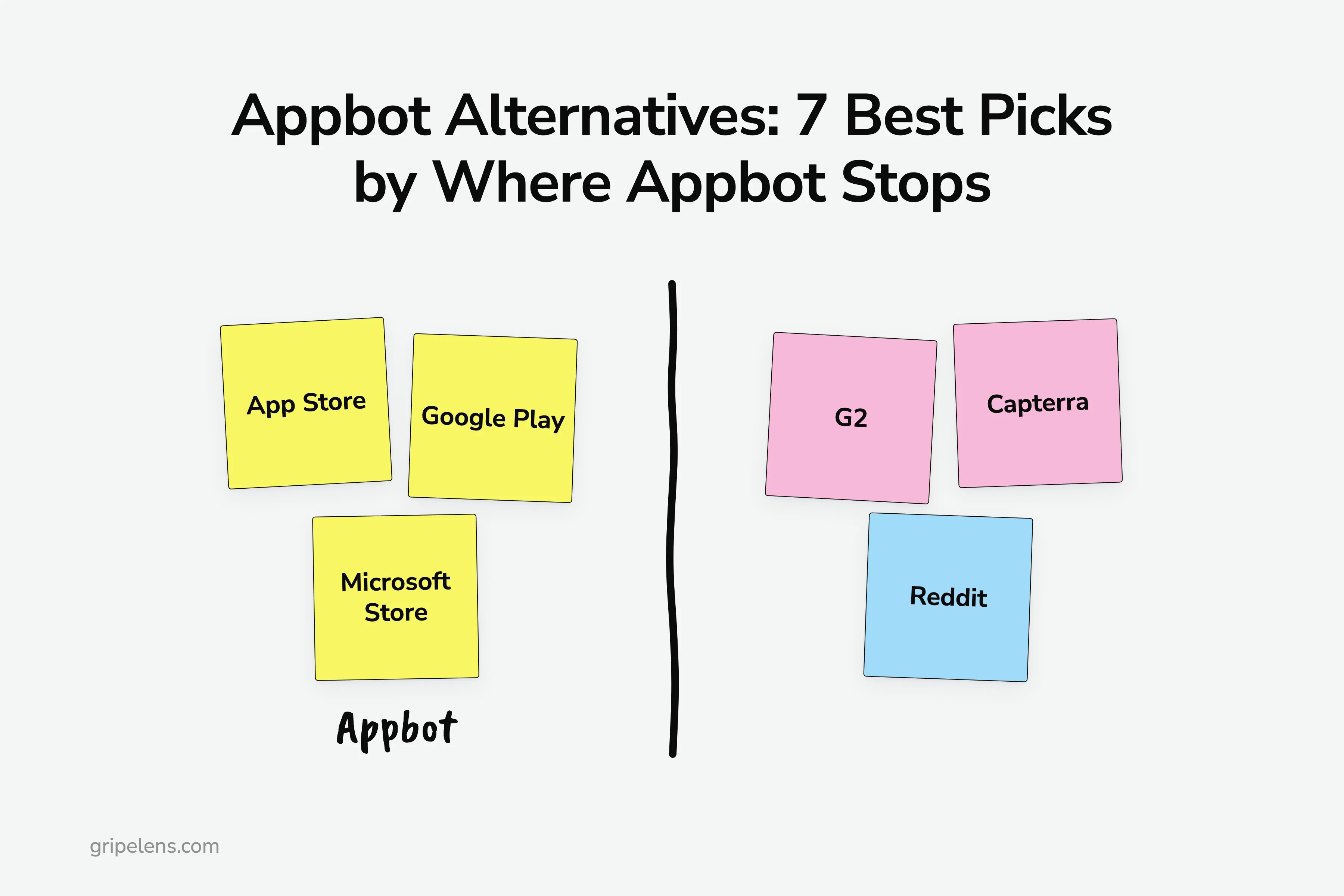
The best Appbot alternative depends on where Appbot stops for you: AppFollow if you need more competitor apps than your sources allow (its free plan tracks 10), Kimola or Gripelens if your competitors’ reviews also sit on G2, Capterra or Reddit. Thematic, Enterpret, Unwrap and Chattermill fit only a team with feedback volume and an annual budget, and if Appbot’s sources fit your apps, it may still be the right tool.
I research competitor reviews by hand before building anything: for this product I logged 36 tools in the category with their prices and 101 quoted complaints, each with its source and date. I also build Gripelens, one of the seven below, and I say so again where it appears.
Below: how I compared these Appbot alternatives, one table with all eight tools, where Appbot stops, why the ranking lists miss it, one section per alternative, and which to pick.
Key takeaways
- AppFollow if you need more competitor apps (10 on Free, 100 on Essential at $129 a month billed annually); Kimola or Gripelens if your competitors’ reviews also live on G2, Capterra or Reddit.
- Appbot reads the Apple App Store, Google Play and the Microsoft Store only, and each competitor app in each store uses one plan source (5 on Small, $49 a month billed annually).
- Thematic ($25,000 a year), Unwrap (from $24,000 a year), Enterpret and Chattermill (no public price) are built for a team’s own feedback at volume; of the four, only Thematic’s paid product pulls competitor apps’ store reviews.
- The directory pages that rank for “appbot alternatives” fill 32 list slots with 24 tools, and 1 of them, AppFollow, is built for app-store reviews.
- Stay on Appbot if you want competitor apps’ full review history in the stores and your apps fit its source count.
How I Compared Them
I build Gripelens, so weigh this accordingly. There are no affiliate links on this page.
I applied five criteria, in this order:
- Which review sources it reads, and how it reaches them: built in, through a browser extension, or through your own integrations.
- Who adds the competitors: the tool finds them from a product or category name, or you add each one by hand.
- What tracking a competitor costs on the plan: sources, slots, queries or feedback volume.
- Whose reviews it is built for: competitors’ public reviews, your own feedback, or both.
- Entry price and how you buy it: a free plan, a self-serve paid plan, or a sales-led annual contract.
I also noted whether a tool shows the sample behind each count, or flags old quotes and review bursts. Only Gripelens’s pages describe those, so they sit in its section.
I read each vendor’s pricing, feature and docs pages: Kimola on 2026-10-30, Appbot and AppFollow on 2026-11-02, and Enterpret, Thematic, Unwrap and Chattermill on 2026-11-03. I didn’t buy plans or start trials. I counted the directory lists that rank for this search on 2026-11-12.
I left out other app-store tools the ranking pages name, such as Appfigures and nsight, because I haven’t profiled them.
Appbot Alternatives at a Glance
Appbot sits in the first row as the baseline; the seven alternatives follow in section order.
| Tool | Review sources read | Who adds competitors | What a competitor costs on the plan | Built for | Entry price | Self-serve or demo |
|---|---|---|---|---|---|---|
| Appbot | Apple App Store (iOS, macOS), Google Play, Microsoft Store | You, by store URL | 1 source per app per store (Small: 5) | Your apps and competitor apps | Small $49/mo billed annually ($59 monthly); 14-day trial, no free plan | Self-serve |
| AppFollow | App Store, Google Play; Microsoft and Amazon from Team, Samsung and Huawei on Enterprise; Steam, Trustpilot | You, by name or store URL | Separate competitor slots: 10 on Free, 100 on Essential | Your apps; competitors read-only | Free (2 apps, 10 competitors, 7-day history); Essential $129/mo billed annually | Self-serve |
| Kimola | Links you paste (App Store, Google Play, Trustpilot, Amazon and others); G2, Capterra, Reddit via its Chrome extension | You paste the links | Queries (1 per 500 characters); Basic: 5 links | Market research on reviews you link to | Free (150 queries/mo); Basic £32/mo billed annually (£39 monthly) | Self-serve |
| Gripelens | App Store, Google Play, Trustpilot, G2, Capterra, Reddit/Hacker News (HN) | Found from a product or category name | See pricing | Competitors’ public reviews | See pricing | Self-serve, early access |
| Thematic | App Store and Google Play (yours and competitors’), plus your feedback integrations; no G2 | You name the apps | 25,000 comments a year on Foundation | Your own verbatims (2,000+ rows) | Foundation $25,000/yr | Demo or paid pilot |
| Enterpret | App Store, Google Play, G2, Trustpilot, Google My Business; X, Reddit, YouTube for your own handles and listings | Free analyzer: you paste up to 5 store URLs | No public price | Your own feedback (1,000+ records/mo) | No public price | Demo only |
| Unwrap | Your own channels (Amazon by ASIN, Google Maps, Trustpilot, X, Hacker News, Discord and others) | Not seen | Priced on feedback volume and integrations | Your own feedback | From $24,000/yr; 30-day trial on your data | Sales-led |
| Chattermill | App Store, Google Play, Trustpilot, G2, Capterra and more, plus Reddit, X, YouTube, connected to your feedback | Not seen | Priced on feedback volume, integrations and team size | Your own feedback (5,000+ pieces/mo) | No public price | Sales-led |
“Not seen” means not on any public page I read, so a feature inside the app can’t be ruled out. Kimola’s prices are in GBP, as it publishes them.
Where Does Appbot Stop for Competitor Research?
Fair first. For competitor apps inside the stores, Appbot does the core job well:
- It backfills the full review history from app launch on signup, for your apps and competitor apps alike.
- Its Compare page puts review volume, average rating, sentiment and trends side by side.
- You can start self-serve: the Small plan is $49 a month billed annually, and the 14-day trial of the Large plan needs no card.
Then it hits three walls.
The first is sources. Appbot reads the Apple App Store (iOS and macOS), Google Play and the Microsoft Store, and I saw no review sites outside them: no G2, Capterra, Trustpilot or Reddit. If your competitors also sell on the web, their reviews there stay out of reach.
The second is competitor slots. Appbot’s pricing FAQ says “A source is a single app in a single app store”, and each competitor app in each store counts as one source on your plan. Small holds 5.
You add every competitor by hand, by store URL, and I saw no automatic discovery. I’ve already worked out how many plan sources an app and its rivals use up; the short version is to count your listings before you pick a plan.
The third is AI and export. Ask Appbot, the Appbot MCP server and CSV or Excel export all start at Large, from $166 a month billed annually. An MCP server is a connector that lets an AI assistant such as Claude query the tool, and Appbot’s covers the competitor apps you track. I compared MCP servers that read customer reviews separately.
So who leaves? Three kinds of reader, each needing a different tool:
- you need more competitor apps than your sources allow
- your competitors’ reviews also live beyond the stores
- you’re really a team analysing your own feedback at volume
There’s a fourth route too: do it yourself. The third wall alone rarely justifies a switch, so below I note MCP and export where a tool’s pages mention them.
Why Do the Ranking Lists Miss?
The pages that rank for “appbot alternatives” file Appbot under review management, so their alternatives are tools for local businesses, shops and reputation teams.
So I counted.
TechnologyCounter (10 tools), SpotSaaS (12) and SoftwareSuggest (its first 10 of 16) fill 32 list slots with 24 distinct tools, because BirdEye, NiceJob and Yotpo appear on all three lists and Vendasta and BrightLocal on two. The only one of the 24 built for app-store reviews is AppFollow, at #8 on SoftwareSuggest.
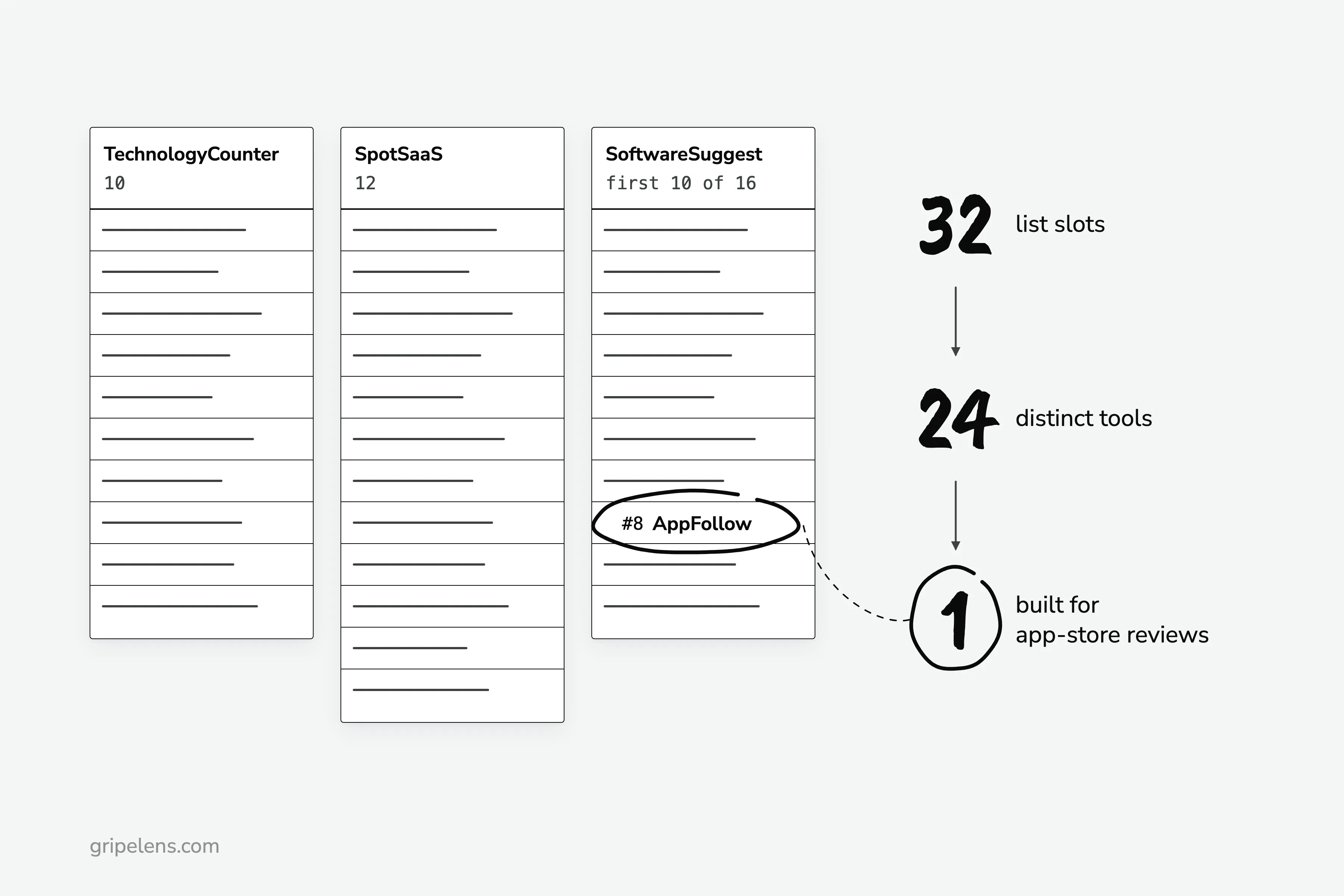
SpotSaaS titles its list “for Android”. None of its 12 is an app-store review tool.
G2 does the same thing with better data. It files Appbot under Online Reputation Management and names AppFollow (4.6 out of 5 from 195 reviews) as the best overall alternative, next to Birdeye, Reputation and Podium.
AppFollow belongs on that list. Its neighbours serve a different job.
Developers name a shorter list. On r/macapps, a developer promoting his own Mac app wrote that “AppFollow and AppBot are the other options that come up”, and called both “aimed at larger teams”.
One voice, with a stake. Still, it’s the right category.
What Are the Best Appbot Alternatives?
I ordered them by the reader each one fits, in the order above: competitor slots first, then sources beyond the stores, then the feedback-team tools, then doing it yourself. Each gets who it suits and at least one downside.
AppFollow
AppFollow is best suited to founders tracking more competitor apps than Appbot’s sources allow while staying in the app stores: 10 competitors on Free and 100 on Essential, kept apart from your own app sources.
AppFollow’s Free plan costs $0 for 2 apps, 10 competitors and 7 days of history. Essential is $129 a month billed annually ($179 monthly) for 5 apps, 100 competitors, 365 days of history and CSV export.
You add competitors “by name or store URL”, and since September 2026 competitor apps also appear in the Reviews feed with an AI summary and sentiment. AppFollow has an official MCP server, and its source list runs past the stores to Steam and Trustpilot.
The trade-offs:
- Competitors are read-only: they “cannot use store connections, integrations, or review replies.”
- Free keeps 7 days of history, and AppFollow’s pages don’t say whether that plan history limit applies to competitor apps.
- G2 reviewers rate it “More expensive” than Appbot.
- No G2, Capterra or Reddit in its source list, which is where the AppFollow alternatives that read those sites come in.
Kimola
Kimola is best suited to founders who already know their competitors and can paste the links, including G2, Capterra and Reddit pages through its Chrome extension, starting free.
Kimola’s Starter plan is free for 150 queries a month, with no credit card. Basic is £32 a month billed annually (£39 monthly) for 3,000 queries and 5 links. You paste App Store, Google Play, Trustpilot or Amazon links, and its Airset Generator extension collects reviews from 24 named sites, G2, Capterra, Trustpilot and Reddit among them.
What does that cost you? Mostly legwork:
- You supply every link; I saw no competitor discovery.
- A query covers up to 500 characters, so a long review uses several.
- App Store links stop at 500 reviews per product, Google Play at 5,000.
- The API (programmatic access to your data) comes with Enterprise only, and I saw no MCP server.
Those limits are why I gave where Kimola stops its own page.
Gripelens
This is the one I build. Gripelens is best suited to founders who know their category but not every competitor, and want competitors’ complaints counted across the app stores and G2, Capterra, Trustpilot and Reddit, with a dated quote behind each theme.
It takes the second wall away: you type a product or category, and it finds the competitors. It then reads their public reviews across six sources (App Store, Google Play, Trustpilot, G2, Capterra, Reddit/HN) and merges them into complaint themes. Each theme carries:
- a count and the sample size behind it
- dated quotes with source and link
- a “may be fixed” flag on quotes older than 18 months
- a flag for review bursts and thin samples
Exports cover Markdown, PDF, CSV and a share link, plus an MCP server and an API. The sample report shows what the output looks like: 2,685 App Store reviews of time-tracking apps read, with Harvest’s 2026 repricing behind 38 of Harvest’s 70 complaints.
The trade-offs: it’s new, with no published usage, accuracy or speed numbers. It doesn’t reply to reviews or manage your own app’s reviews, and it doesn’t read the Microsoft Store, Amazon Appstore or Steam. Prices are on the pricing page.
Thematic
Thematic is best suited to a feedback team with at least 2,000 rows of its own verbatims (raw feedback comments, one per row) and $25,000 a year, which also wants named competitor apps’ store reviews in the same place.
It’s the one feedback-team tool here that reaches competitor apps. Thematic’s Apple Store and Google Play integrations pull reviews of “your and your competitors’” apps, and you name the apps. The Foundation plan is $25,000 a year for 25,000 comments a year and up to 3 datasets, MCP server included, and Thematic says it “works best with at least 2,000 rows of verbatims”.
The trade-offs: no free tier, no trial and no monthly price, only demos on your data or a paid pilot at an unpublished price. G2 isn’t among its integrations.
Who has 2,000 rows of their own feedback before launch? Not a solo founder.
Enterpret
Enterpret is best suited to a product team with at least 1,000 feedback records a month across its own channels. The one piece a solo founder can use is free: the App Review Analyzer compares up to 5 store URLs you paste.
The volume line is Enterpret’s own: “We recommend that teams have at least 1,000 combined feedback records from all sources (support tickets, social, communities, etc.) per month.” Its review integrations cover the App Store, Google Play, G2, Trustpilot and Google My Business, and it reads X, Reddit, YouTube and review sites for your own handles, subreddits and app listings.
The trade-off: no public price and no self-serve signup, demo only. The paid product reads your listings, not your competitors’. For a smaller budget, I sorted alternatives to Enterpret for small teams.
Unwrap
Unwrap is best suited to a company with real feedback volume across its own channels and a budget from $24,000 a year.
Unwrap’s pricing starts at $24,000 a year, based on feedback volume and integrations, never per seat, with a 30-day trial on your data. Its integrations pull Amazon listings by ASIN (Amazon’s product ID), Google Maps, Trustpilot through your own Business account, X, Hacker News and Discord.
The trade-offs: there’s no free plan, and I saw no competitor discovery, no competitor review benchmarking and no G2, Capterra or Reddit integration. And by Unwrap’s own account, “a small team with light volume will get less out of it.”
Chattermill
Chattermill is best suited to enterprise customer-experience (CX), insights and product teams collecting more than 5,000 pieces of feedback a month, with review sites and social sources connected to their own data.
Chattermill’s integrations cover the App Store, Google Play, Trustpilot, G2 and Capterra, plus social sources such as Reddit, X and YouTube, and its MCP server is available to all customers. All of it feeds your own feedback.
The trade-offs: no public price, no free tier or trial seen, sales-led, and no competitor discovery seen. Chattermill’s own FAQ rules it out if “You’re not consistently collecting more than 5,000 pieces of customer feedback every month”. Under that line, here’s what to use below Chattermill’s volume floor.
App Store Connect, Play Console and Doing It Yourself
This one isn’t counted in the seven. It’s the baseline, and it’s best suited to solo developers who mainly need their own app’s reviews, or who will script the competitor part themselves.
The same r/macapps developer put it bluntly: “The main alternative most devs use is just App Store Connect itself.” On X, @umekun123, an app developer, cancelled Appbot in 2026 and automated the job with Codex, an AI coding agent, keeping paid tools for “the really complex ones”. That’s one voice, not a trend.
Does a solo developer need a suite at all? One r/AppStoreOptimization commenter, who promotes his own tool later in the thread, put it this way: “a solo dev buying a market intelligence suite is solving a problem they don’t have”.
The trade-off: the stores’ consoles show your own apps only. Anything about competitors is your own scripting and upkeep, and you do the counting.
Which Appbot Alternative Should You Pick?
Pick by the wall you hit, not by the category a directory filed Appbot under. Find your situation, then the pick.
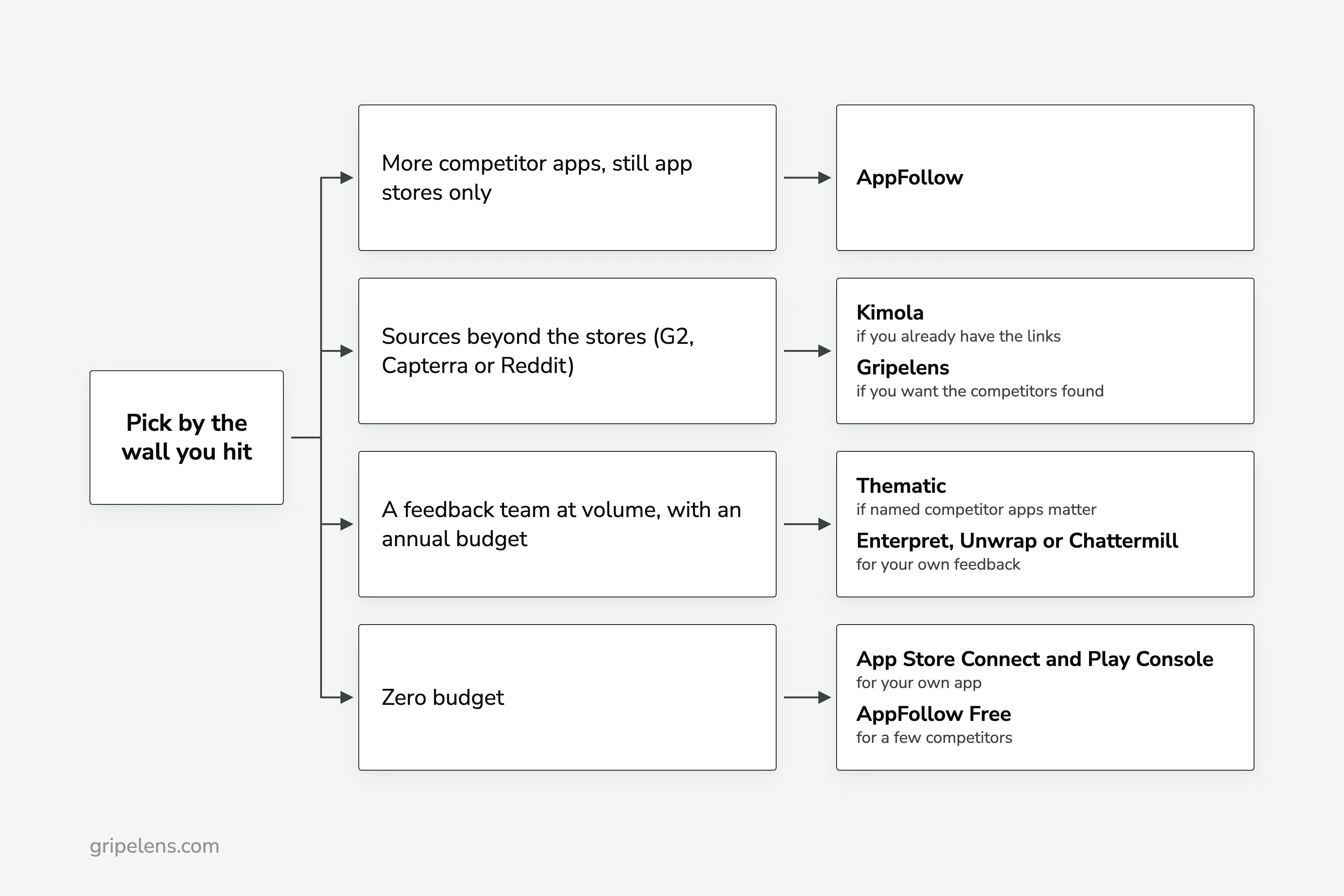
- More competitor apps, still app stores only: AppFollow. Free covers 10 competitors with 7 days of history, Essential 100 at $129 a month billed annually.
- Sources beyond the stores (G2, Capterra or Reddit): Kimola if you already have the links, Gripelens if you want the competitors found. I compared more tools that read G2, Capterra and Reddit reviews in a wider roundup.
- A feedback team at volume, with an annual budget: Thematic if named competitor apps matter; Enterpret, Unwrap or Chattermill for your own feedback.
- Zero budget: App Store Connect and Play Console for your own app, AppFollow Free for a few competitors.
- A few competitor apps, both stores, full history, and the sources fit: stay on Appbot. Its backfilled history is what you want when you’re reading what competitor apps’ one-star reviews tell you.
If You Want Competitors Found and Their Complaints Counted
If you’d rather not add competitor apps by hand, and you want their complaints counted across the stores, G2, Capterra and Reddit with a dated quote behind each theme, the sample report above shows the format. Launch pricing is locked for a year for the first wave.
FAQ
What Is the Best Free Alternative to Appbot?
AppFollow Free, if your competitors are apps: it covers 2 apps and 10 competitors with 7 days of history. Kimola’s Starter plan is free for 150 queries a month if you can paste the review links yourself, G2 and Reddit pages included through its extension. App Store Connect and Play Console are free too, but they show your own app’s reviews only.
How Much Does Appbot Cost?
Appbot’s Small plan is $49 a month billed annually ($59 monthly) for 5 sources. Medium is $99 ($119 monthly), Large starts at $166 ($219 monthly), and Premium starts at $479 a month billed annually. There’s no free plan, only a 14-day trial of Large with no card. Those are the prices as read on Appbot’s pricing page on 2026-11-02.
Does Appbot Read G2, Capterra or Trustpilot Reviews?
No. Appbot reads the Apple App Store, Google Play and the Microsoft Store, and I saw no review sites outside them. Kimola reaches G2, Capterra and Reddit through its Chrome extension, and Gripelens reads G2, Capterra, Trustpilot and Reddit as built-in sources.
Is AppFollow Cheaper Than Appbot?
It depends on how many competitor apps you track. AppFollow has a free plan and Appbot doesn’t, but Essential is $129 a month billed annually against Appbot Medium at $99, and G2 reviewers rate AppFollow “More expensive”. What decides it: AppFollow counts competitors apart from your app sources (100 on Essential), while Appbot spends a source on each competitor app in each store.
Can Appbot Track Competitor Apps?
Yes. You add each competitor app by hand, by store URL, and Appbot backfills its full review history. Each competitor app in each store uses one source on your plan, and the Small plan holds 5.