Chattermill Alternatives: 5 Best Picks by Price and Volume
Chattermill shows no price and says it isn't a fit under 5,000 feedback items a month. I compared 5 alternatives: who each suits and what it costs.
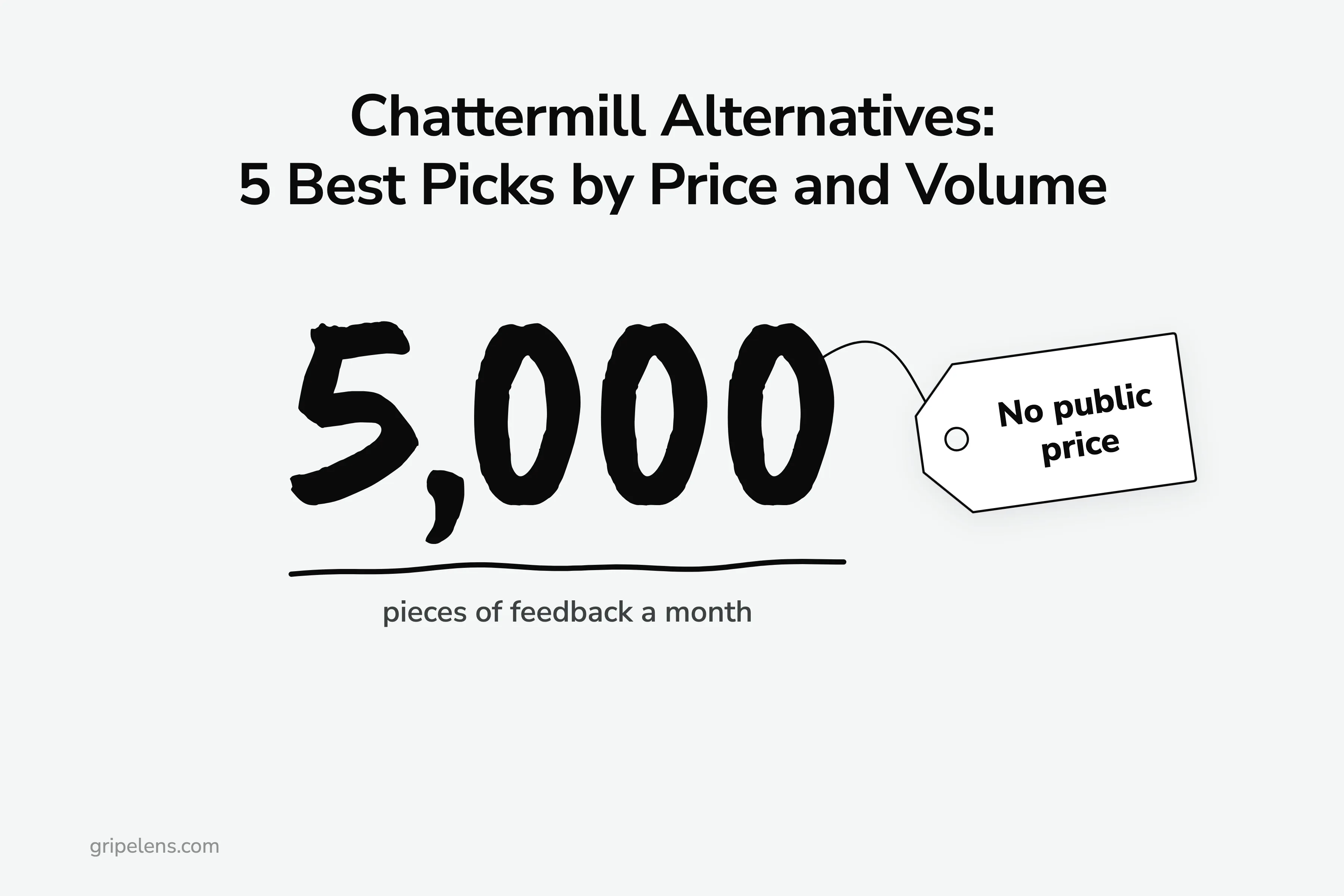
The best Chattermill alternative for a small team is the one that fits below Chattermill’s own floor: Kimola to start free on feedback you paste in, Gripelens for your rivals’ public reviews, and Thematic or Unwrap only once you have thousands of your own feedback items a month. Chattermill says it isn’t a good fit if you’re “not consistently collecting more than 5,000 pieces of customer feedback every month”, and it shows no price.
I research competitor reviews by hand before building anything: for this product I logged 36 tools in the category with their prices and 101 quoted complaints, each with its source and date.
I’ve already compared this cast from Enterpret’s side, in Enterpret alternatives compared by price and volume floor. This page starts from Chattermill’s floor and its missing price, so the Enterpret detail stays there.
Below: what Chattermill costs, who it’s built for, the five alternatives one by one, and when a chatbot is enough.
Key takeaways
- For a small team: Kimola (free plan, paid from £39 a month) to start cheap on feedback you supply, Gripelens for competitors’ public reviews, and Thematic ($25,000 a year) or Unwrap (from $24,000 a year) only at volume.
- Chattermill shows no public price, no free plan and no trial, and says it isn’t a fit under 5,000 pieces of feedback a month.
- The “$64,000 a year” figure on a rival’s comparison page cites unnamed “third-party benchmarks”. Treat it as a rival’s claim, not a price.
- Decide first whether you’re analysing your own customers’ feedback or your rivals’ public reviews. Only one of the five both finds your rivals and reads their reviews.
How I Compared Them
I build Gripelens, so weigh this accordingly. There are no affiliate links on this page.
I applied six criteria, in this order:
- Entry price, or “no public price” where the vendor shows none.
- How you start: a free plan, a trial, or a demo only.
- Stated volume floor, in the vendor’s own words.
- Whose feedback it reads: your own customers’ feedback through integrations, or public reviews of you and your rivals.
- Who finds the competitors: the tool, or you.
- Receipts: whether quotes trace back to a source, and whether each theme carries a count and a sample size (n, the number of items the count is out of).
I read each vendor’s public pricing, FAQ, feature and docs pages on 2026-11-03 for Chattermill, Enterpret, Thematic and Unwrap, and on 2026-10-30 for Kimola. I didn’t test the paid plans hands-on. “Not seen” means not on a public page, not proven absent.
Why not lean on the pages that already rank? Vendors wrote 7 of the 7 ranking pages I read for this search. Where their numbers about each other disagreed with a vendor’s own page, I used the vendor’s own page.
What Are the Best Chattermill Alternatives?
One line each, in table order:
- Kimola: start free on review links and files you supply, no sales call.
- Gripelens: your competitors’ public reviews, with the competitors found for you and every theme counted.
- Unwrap: your own support channels at volume, with a price on the page and a 30-day trial.
- Thematic: your own verbatims (raw feedback comments) at 2,000+ rows, with themes you can inspect and edit.
- Enterpret: your own feedback at 1,000+ records a month, queried by AI agents.
| Tool | Entry price | How you start | Stated volume floor | Whose feedback | Finds competitors | Quotes traced; count and n per theme | Checked |
|---|---|---|---|---|---|---|---|
| Chattermill | No public price | Demo only; no free plan or trial | Not a fit under 5,000 pieces/month | Your own (surveys, reviews, tickets, calls, social) | Not described | Quote-backed answers; n not stated | 2026-11-03 |
| Kimola | Free (150 queries/mo); Basic £39/mo | Self-serve signup | None stated | Links you paste, files you upload, Intercom/Zendesk | No, you supply links | No sample-size convention seen | 2026-10-30 |
| Gripelens | See pricing | Self-serve | None stated | Competitors’ public reviews, 6 sources | Yes | Every quote dated with source; count and n per theme | n/a (own product) |
| Unwrap | From $24,000/yr | 30-day trial on your data; demo-led | Priced on volume; says light volume “will get less out of it” | Your own channels | Not seen | Insights link to source verbatim; n not seen | 2026-11-03 |
| Thematic | Foundation $25,000/yr (25,000 comments) | Demo or paid pilot | “Works best with at least 2,000 rows” | Your own; app reviews you name | Not seen (you name the apps) | Themes trace to exact words; n not seen | 2026-11-03 |
| Enterpret | No public price | Demo only | 1,000+ records/month recommended | Your own | Not seen | Citations in Agent answers; dates not verified | 2026-11-03 |
Chattermill sits in the first row as the reference. Prices are as each vendor’s own page showed them, Kimola’s in GBP.
Read the “Whose feedback” column before the price column. Four of the six rows are built around your own feedback channels; Kimola reads links and files you hand it, plus Intercom and Zendesk; Gripelens reads public reviews. Two rows, Chattermill and Enterpret, show no price at all.
What Does Chattermill Cost?
Chattermill doesn’t say. There’s no Pricing link in its nav or footer, and every route on its site ends at sales. Its own comparison pages describe custom pricing “based on feedback volume, integrations, and team size. Contact sales for a quote.” Of the seven tools in my review analysis software pricing comparison, Chattermill and Enterpret are the two that publish no price at all.
What its site does tell you:
- No per-user fee: “we do not charge a per user fee”, so you can add users without a seat charge.
- No free plan, no trial and no self-serve signup. “Sign in” is for existing customers.
- A 2-minute product tour is the only thing you can try without a call.
So where does “$64,000 a year” come from? Canny’s Chattermill comparison page says “third-party benchmarks put the average contract around $64,000 a year”, and it names no benchmark. Canny’s page exists to sell Canny. Treat the number as Canny’s claim, not Chattermill’s price.
Vendors’ pages get prices wrong, sometimes their own. Thematic’s own Chattermill-alternatives list and another vendor’s list both say Thematic publishes no price. Thematic’s pricing page shows its Foundation plan at $25,000 a year.
The lesson fits in one line: read the price on the vendor’s own page, or don’t quote one.
Who Is Chattermill Built For?
Teams with a lot of their own feedback, by its own account. Chattermill says it isn’t a good fit if you’re not consistently collecting more than 5,000 pieces of customer feedback a month.
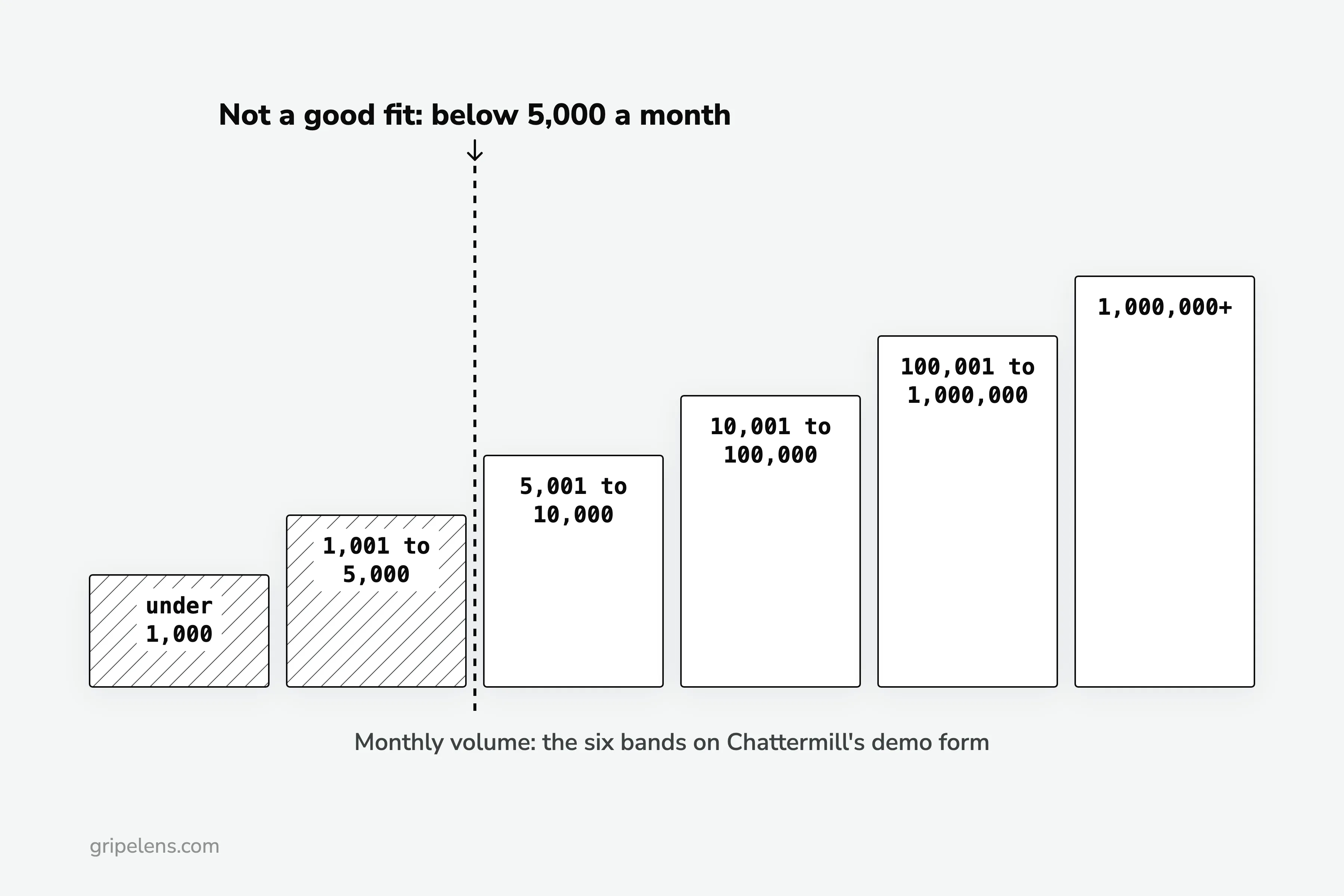
Its demo form asks for your monthly volume in six bands: under 1,000; 1,001 to 5,000; 5,001 to 10,000; 10,001 to 100,000; 100,001 to 1,000,000; and 1,000,000+. The first two fall in its “not a good fit” zone, below 5,000 a month. Whether the bands map to price, I don’t know: the site doesn’t say.
The same “not a good fit” list also rules out:
- teams looking for a tool to send surveys
- students, higher education and one-off analysis
The other vendors’ floors are in the table’s “Stated volume floor” column. None is higher than Chattermill’s.
Buyers put it in fewer words. A 30-person B2B SaaS team shopping for tools wrote in r/ProductMarketing that “Chattermill feels very enterprise for a team our size”.
In r/customerexperience, one buyer rated it “Decent on support ticket analysis specifically. Lighter on app stores, social and call transcripts vs the broader platforms.” Three days later, a Chattermill employee pushed back, opening with “Disclosure: I work at Chattermill” and adding “We’re actually not just support tickets.” At least the disclosure came first. Vendor or self-promotion comments turned up in all 5 threads I read.
Read Chattermill’s review page with a calendar, too. 23 of its 25 Capterra-network reviews (read via Software Advice, which dates them by month only) fall in two short windows: October 2021, and December 2022 to January 2023. That reads as two review campaigns, not a steady stream of happy customers. Here’s how I dated Chattermill’s Capterra-network reviews.
Your Own Feedback or Your Rivals’ Reviews?
Whose feedback do you actually mean? That one question removes half the options before price comes into it.
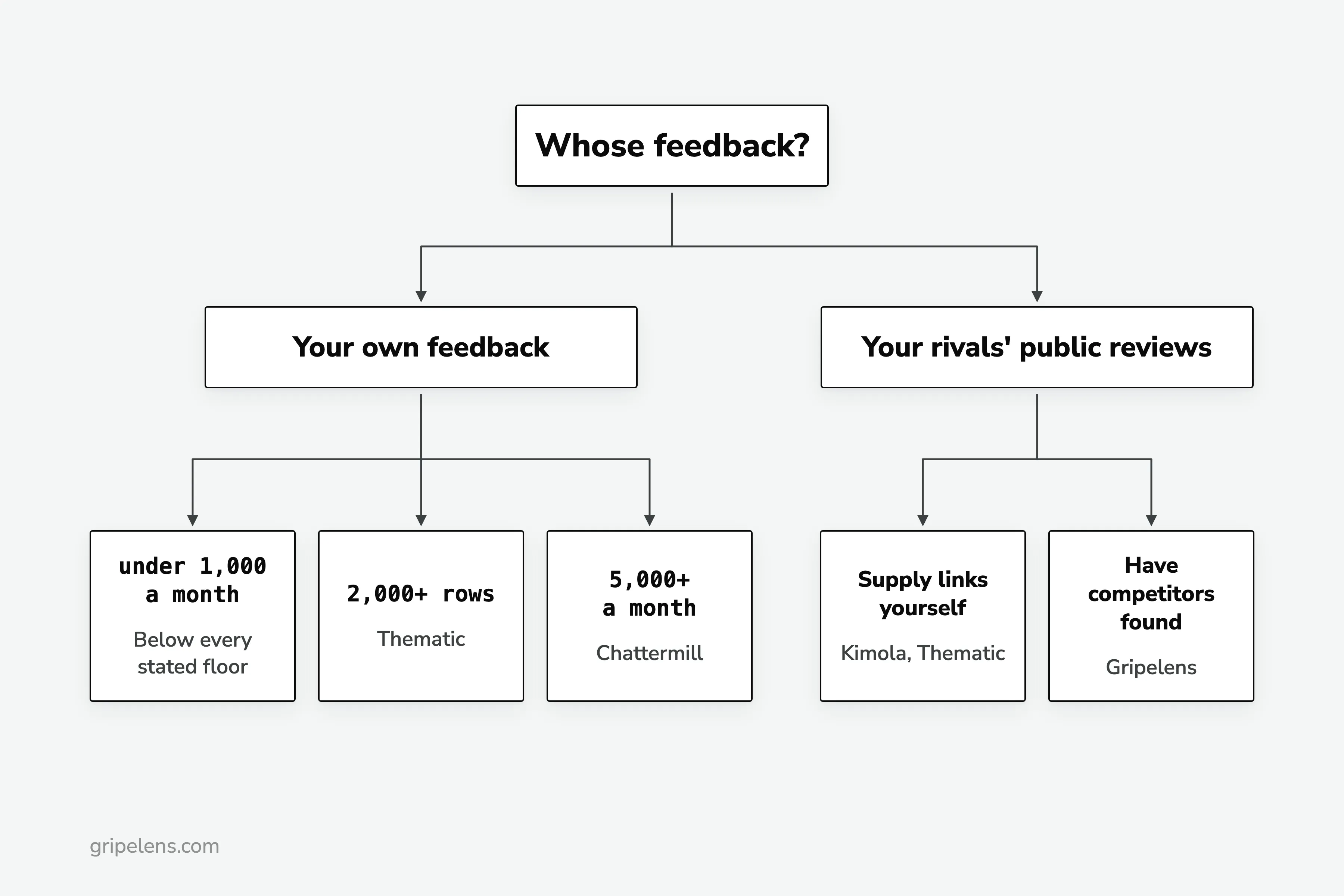
Your own feedback: under 1,000 a month sits below every stated floor, 2,000+ rows is Thematic’s, 5,000+ a month is Chattermill’s. Your rivals’ public reviews: supply the links yourself (Kimola, Thematic) or have the competitors found (Gripelens).
- Your own feedback (tickets, surveys, calls) that you want themed. Chattermill, Thematic, Unwrap and Enterpret read it through integrations, and Kimola reads what you paste, upload or connect from Intercom and Zendesk. Then volume decides: under 1,000 a month sits below every stated floor, Thematic works best from 2,000+ rows, and Chattermill wants 5,000+ a month.
- Your rivals’ public reviews on G2, Capterra, the app stores and Reddit. None of the four enterprise tools finds competitors for you, as far as their public pages show. Thematic pulls app reviews for apps you name, and Kimola takes the links you paste, so with either you supply links yourself. Or you have competitors found: Gripelens finds them and reads six public sources.
Every “doesn’t find competitors” above comes from public pages, so read it as “not seen”. If you’re on the second branch, my comparison of tools for reading competitor reviews covers a wider field.
The 5 Chattermill Alternatives, One by One
Entry prices run from free (Kimola Starter) to $25,000 a year (Thematic Foundation), with Enterpret on demo only.
What do you keep, and what do you give up by moving from Chattermill? Each one starts there.
Kimola
Kimola is best suited to a founder or small team who wants to start free on feedback or review links they supply, without a sales call.
Moving from Chattermill, you gain a free plan and a signup form instead of a demo. Kimola’s Starter plan is free for 150 queries a month, no credit card, and Basic is £39 a month, or £32 a month billed yearly. You connect fewer sources directly: Intercom, Zendesk and Google Sheets, plus Excel, CSV and TSV uploads.
I saw no call-recording integration. You still supply every review link yourself.
The trade-offs:
- No competitor discovery seen. G2, Capterra and Reddit come in through its Airset Generator Chrome extension, one page at a time.
- Usage is metered: each analysed row of up to 500 characters counts as one query.
The full tier ladder, and other tools in Kimola’s self-serve price band, are in a separate comparison.
Gripelens
I build Gripelens, so weigh this accordingly. It’s best suited to founders and small product teams who need their competitors’ public reviews read, counted and dated before deciding what to build or how to position.
Moving from Chattermill, you gain:
- competitor discovery: type a product or category and it finds the competitors
- six public sources: the App Store, Google Play, Trustpilot, G2, Capterra, and Reddit and Hacker News
- a count and a sample size on every theme
- every quote with its source, date and link
- review bursts flagged, and quotes older than 18 months marked “may be fixed”
You lose everything Chattermill does with your own tickets, surveys and calls. That’s the trade-off: Gripelens reads public reviews only, so a customer-experience (CX) team with more than 5,000 pieces of its own feedback a month still needs a Chattermill-class tool. Prices are on the pricing page.
Unwrap
Unwrap is best suited to a team with real feedback volume across support channels that wants alerts on new trends and no per-seat charges.
Moving from Chattermill, you keep pricing without seats: Chattermill charges no per-user fee, and Unwrap says “You’ll never be charged by seat”. You gain the two things Chattermill doesn’t offer. Unwrap starts at $24,000 a year, shown on the page and priced on monthly feedback volume and integrations, and it offers a 30-day trial “based on your data”.
The trade-offs:
- Its own post admits a small team with light volume “will get less out of it”.
- It’s demo-led, with no free or self-serve plan.
- Sources are your own channels. I saw no competitor discovery.
Thematic
Thematic is best suited to a CX or insights team that wants to see and edit how each theme was built and can commit to an annual contract.
Moving from Chattermill, you keep themes that trace back to the customer’s words: “Every theme traces back to the exact words that created it.” You gain a published entry tier. Thematic’s Foundation plan is $25,000 a year for 25,000 comments, with up to 3 datasets. Both put their MCP server (a connector that lets an AI assistant such as Claude query the tool) behind the contract: Thematic’s needs a Thematic contract, and Chattermill’s is “available to all Chattermill customers”.
The trade-offs:
- No free plan or trial, just a custom demo or a “comprehensive paid pilot” with no published price.
- Its pricing FAQ says it “works best with at least 2,000 rows of verbatims”.
- It pulls app-store reviews for competitor apps you name. It doesn’t find the competitors, and I saw no G2 integration.
Enterpret
Enterpret is best suited to an AI-native product team with 1,000+ feedback records a month that wants its feedback queried by agents through MCP.
Moving from Chattermill, you get the same shape: sales-led, no public price, demo only, no trial. The bar is lower, though. Enterpret recommends 1,000+ feedback records a month, against Chattermill’s 5,000.
The trade-off is a second meter. Enterpret Agent usage is billed in credits on top of the contract, and the credit price isn’t published. No competitor discovery seen.
Which Chattermill Alternative Should You Pick?
Take the fork from the section above, then add volume:
- Your own feedback, a small batch to try: Kimola’s free plan, at 150 queries a month (one per row of up to 500 characters).
- Your own feedback, a steady flow under about 1,000 items a month: Kimola Basic (£39 a month for 3,000 queries) or a chatbot (next section).
- Your own feedback, from 2,000 rows up to 25,000 comments a year, and the budget for it: Thematic Foundation at $25,000 a year.
- Your own feedback across support channels at volume, and you want a trial first: Unwrap.
- A product team at 1,000+ records a month building agent workflows: Enterpret.
- Your rivals’ public reviews, and you don’t know every competitor yet: Gripelens.
- More than 5,000 pieces a month across surveys, tickets and calls: Chattermill may still be the right call.
That last bullet isn’t a hedge. Chattermill drew its own line at 5,000 a month, and above it you’re exactly the customer it describes.
Do You Need a Platform at All?
Maybe not. In 4 of the 5 Reddit threads I read, someone said to skip the platforms and use Claude or ChatGPT, and for a one-off pile of emails that works.
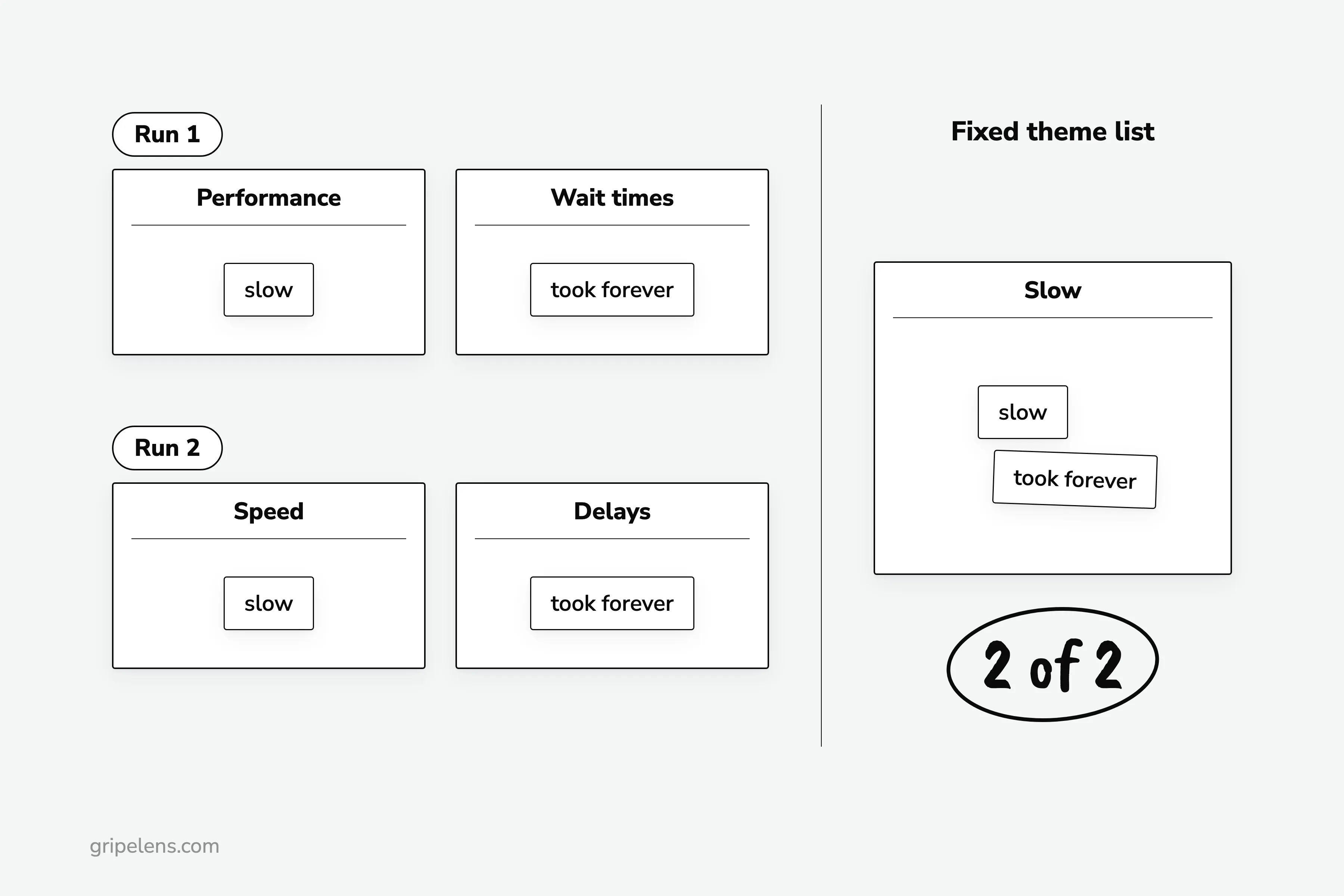
Illustrative: Run 1 filed the two complaints under Performance and Wait times, Run 2 under Speed and Delays. A fixed theme list counts both as Slow, 2 of 2.
It breaks in two places, and two commenters in r/smallbusinessowner named both:
- Categories drift. “If you just dump everything in and let an LLM re-cluster each time you add new data, the categories shift between runs”, wrote u/ThatsSoRamon. Run 1 and Run 2 on the same pile can hand you different piles.
- Wording splits. “‘slow’ and ‘took forever’ land in different piles. You still have to name the buckets,” wrote u/ColdPlankton9273.
Building your own has a cost too. In the r/ProductMarketing thread, u/Hefty_Singer1613 put it as “Build it and then spend half your quarter maintaining prompts and fixing hallucinated summaries.”
The by-hand route fixes both breaks:
- Write a fixed theme list before you count, so “slow” and “took forever” both land in one theme, Slow.
- Count each theme with its n: those two complaints become 2 of 2, not “a few people said it’s slow”.
- Date every quote, with its source and link.
Why count by hand instead of trusting the star average? Most of my 101 complaints came from the cons fields (the “what do you dislike” box on G2 and Capterra) of 4 and 5 star reviews, which a star average buries.
Counting and dating is also the step that hurts most, so for competitors’ public reviews, do it by hand or have Gripelens do this step. The sample report shows what comes out. If you’d rather keep it manual, here’s how to analyse a pile of reviews by hand.
If You Need Your Rivals’ Reviews Counted
If what you need is your rivals’ public reviews counted and cited, not your own ticket queue, that’s the job Gripelens is built for. Get early access: launch pricing is locked for a year for the first wave.
FAQ
How Much Does Chattermill Cost?
Chattermill doesn’t publish a price. When I checked its site on 2026-11-03, there was no pricing page, and its own comparison pages described custom pricing based on feedback volume, integrations and team size, with no per-user fee. The “$64,000 a year” figure on Canny’s comparison page cites unnamed third-party benchmarks, so treat it as a rival’s unsourced claim, not Chattermill’s price.
Does Chattermill Have a Free Plan or Trial?
No. Chattermill shows no free plan, no trial and no self-serve signup, and its “Sign in” button is for existing customers. You can click through a 2-minute product tour; everything else goes through a demo.
What Is Chattermill’s Minimum Feedback Volume?
Chattermill’s own FAQ says it isn’t a good fit if you’re not consistently collecting more than 5,000 pieces of customer feedback a month. The same list rules out one-off analysis, teams looking for a survey-sending tool, and students or higher education.
What Is the Cheapest Chattermill Alternative?
Kimola. Its Starter plan is free for 150 queries a month, and Basic is £39 a month, as its pricing page showed on 2026-10-30. Each analysed row of up to 500 characters counts as one query. If you need competitors’ public reviews rather than feedback you supply, Gripelens is self-serve, with its prices on its pricing page.
Can Chattermill Analyze Competitors’ Reviews?
Not in the way a founder usually means. Chattermill connects your own feedback sources and describes competitive data only as context on that feedback. I saw no automatic competitor discovery on its public pages, so any competitor data would come from sources you connect yourself.