MCP Server for Customer Reviews: 5 Best Options Compared
Which MCP server lets Claude or Cursor read your competitors' reviews? 5 options compared on sources, competitor access, counts, quotes and plan.
The best MCP server for customer reviews depends on whose reviews you want: for competitors’ app reviews, Appbot is the only app-store tool here whose pages say competitor apps come through its MCP; for G2, Capterra and Reddit too, Gripelens. Most of the pages that rank for this search are about your own customers’ feedback, the one question you already have the data for.
I research competitor reviews by hand before building anything: for this product I logged 36 tools in the category with their prices and 101 quoted complaints, each with its source and date. I also build Gripelens, one of the five below, and say so again where it appears.
If you don’t need Claude or Cursor in the loop, my wider comparison of tools for reading competitor reviews covers the dashboards.
Below: which kind of “review” MCP this is, how I compared them, one table with all five, each option with who it suits and its catch, what to check before you trust an answer, and which to pick.
Key takeaways
- Appbot’s MCP covers the competitor apps you track (App Store, Google Play, Microsoft Store, macOS), from the Large plan at $166 a month billed annually.
- AppFollow added competitor apps to its reviews feed in September 2026, but its MCP page only says “the apps you already track”, so ask before you buy it for that job.
- Syften’s MCP (PRO, $119.95 a month) hands you raw matches from Reddit, Hacker News and forums for your agent to analyse; it doesn’t read review sites or app stores.
- Gripelens reads six sources including G2, Capterra and Reddit, finds the competitors itself, and returns counts with a sample size and dated quotes; its MCP is read-only.
- Without an MCP you can still count by hand: my sample report took 2,685 App Store reviews to get 261 coded negative items.
Which MCP Server for Customer Reviews Can Read Competitors?
MCP is an open standard for connecting AI assistants to tools and data: an MCP server is the connector that lets Claude, ChatGPT or Cursor ask another product for its data. Search for a “review” one, though, and you get three different things.
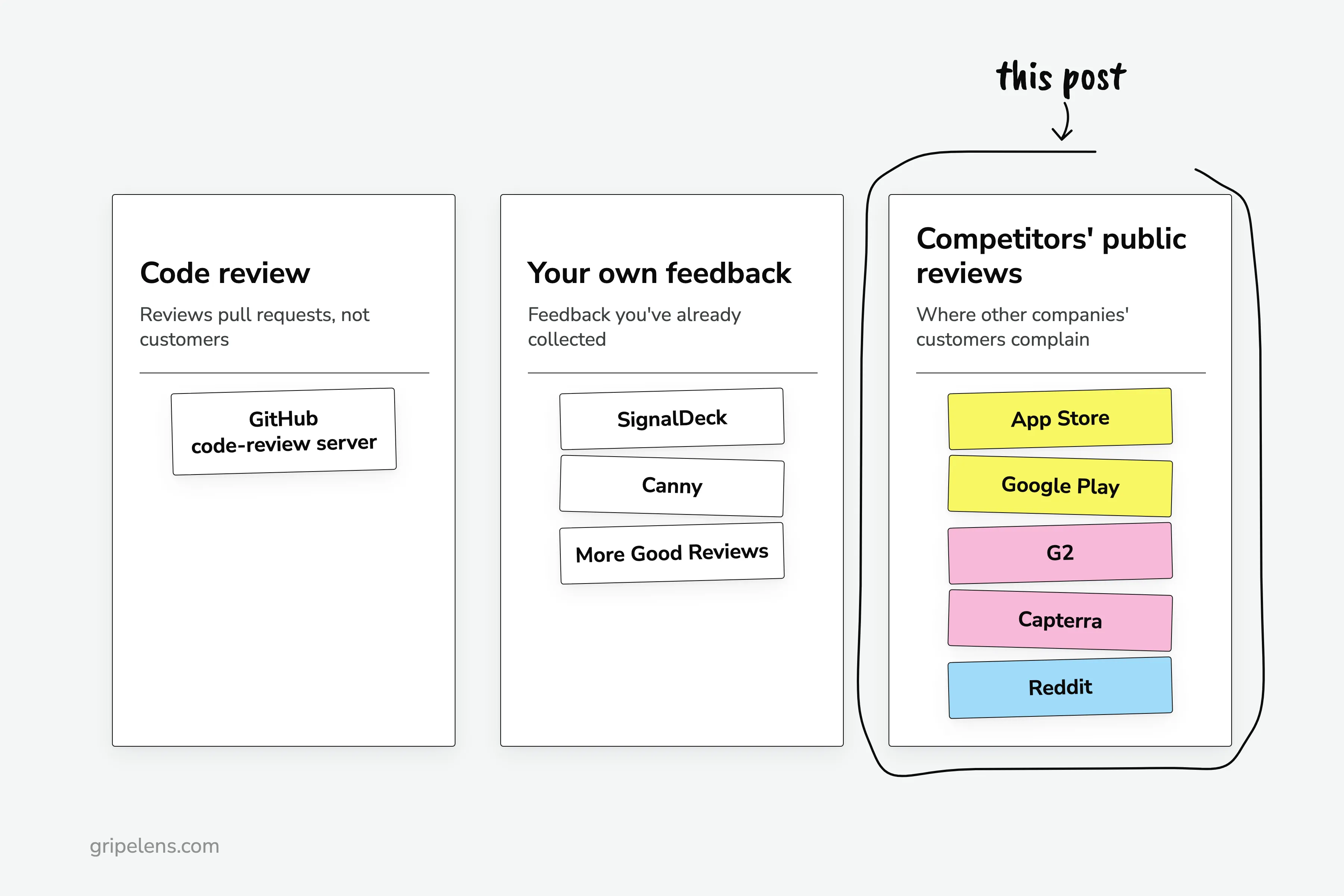
- Code review: a GitHub code-review server ranks 5th for “mcp server for customer reviews”. It reviews pull requests, not customers.
- Your own feedback: SignalDeck, Canny and More Good Reviews connect an assistant to feedback you’ve already collected. Canny’s pitch is “Ask your LLM what customers asked for”, and More Good Reviews’ docs say its server “connects AI assistants to one project at a time”.
- Competitors’ public reviews: the App Store, Google Play, G2, Capterra and Reddit threads where other companies’ customers complain. That’s this post.
When I searched the phrase on 2026-11-02, Google returned 7 organic results. None of them reads another company’s public reviews.
Is the second meaning the one you want? Then you’re buying a different thing, a feedback platform for your own customers, and I covered enterprise feedback platforms that ship their own MCP separately.
How I Compared the Options
I build Gripelens, so weigh this accordingly. There are no affiliate links on this page.
I included hosted MCP servers from vendors whose MCP reads public reviews or public conversations and who publish an MCP page I could read: Appbot, AppFollow and Syften. Gripelens is the fourth, and counting by hand is the fifth, as the baseline.
This isn’t every server out there. Self-hosted open-source scraper servers, the kind you run and maintain yourself, are out of scope. I priced that route in what running your own review scraper costs.
The criteria, in the order I applied them:
- Which review sources it reads.
- Whether competitors’ reviews come through the MCP, and how competitors get in (you add them, or the tool finds them).
- What the MCP returns: counts with a sample size (how many reviews a count is out of), dated quotes with links, or raw matches.
- The plan and price you need for the MCP.
- Whether it’s read-only or can change things.
- Evidence checks: a sample size on every count, a flag for review bursts (a run of reviews in a short window, often a vendor’s review drive), and a “may be fixed” flag on old quotes.
How did I check them?
I read each vendor’s pricing, MCP and docs pages in a browser: Appbot and AppFollow on 2026-11-02, Syften on 2026-10-21. I didn’t trial any of them hands-on, so everything below is what their own pages say. Gripelens comes from its own feature list.
Review MCP Servers at a Glance
One cell in this table is an open question rather than a fact: whether AppFollow’s MCP returns competitors’ reviews. Its pages don’t say either way, so the cell says what they do say.
| Option | Sources it reads | Competitors’ reviews through the MCP | What the MCP returns | Read-only? | Plan for the MCP (price, read date) |
|---|---|---|---|---|---|
| Appbot | App Store (iOS, macOS), Google Play, Microsoft Store | Yes: “Any source you track”, competitor apps added by hand, each counts as a source | Aggregated sentiment, topics, ratings (review_stats); the reviews behind them (reviews) |
Yes | Large, from $166/mo billed annually (2026-11-02) |
| AppFollow | App stores incl. Samsung, Amazon, Huawei, plus Steam and Trustpilot | Not stated: MCP covers “the apps you already track”; competitor apps in the reviews feed since September 2026 | Reviews, ratings, rankings, keywords; /feedback-analysis report of top bugs and feature requests |
No: can draft and post replies after approval | Any plan incl. Free, per its vs-Appbot page; paid from $19/mo annual (2026-11-02) |
| Syften | Reddit, Hacker News, Indie Hackers, Stack Exchange, GitHub, Product Hunt, Bluesky, Mastodon, forums, public web; no app stores or review sites | Mentions of competitor names you track, not their reviews | Individual matches with text, author, timestamp, URL; no counts | No: can change filters | PRO, $119.95/mo (2026-10-21) |
| Gripelens | App Store, Google Play, Trustpilot, G2, Capterra, Reddit/HN | Yes, competitors found from a product or category | Complaint themes with counts, sample sizes and dated, linked quotes | Yes | Paid plan, see pricing |
| No MCP (by hand) | Whatever you read | Yes, if you collect them | What you count | n/a | Free, plus your time |
Prices are as each vendor’s page showed them on the date in brackets. Only two of the four servers say yes to competitors’ reviews. Appbot stops at app stores. Gripelens covers the App Store and Google Play as well as G2, Capterra, Trustpilot and Reddit, so of the two it’s the one that reads G2 and Capterra, where SaaS products get reviewed.
The by-hand row is cheap but not free: my baseline run meant reading 2,685 App Store reviews to code 261 negative items.
The 5 Options, One by One
Each option below gets what it reads, how competitors get in, what comes back, who it suits and its catch.
Appbot
Appbot reads app stores: the App Store (iPhone and Mac), Google Play and the Microsoft Store. Its MCP server has three read-only tools: apps lists your sources, review_stats returns aggregated sentiment, topics and ratings, and reviews returns the reviews behind a number with their classification attached.
Competitors are where it stands out. Its MCP FAQ says it plainly: “Any source you track in Appbot is available through MCP, including competitor apps.” You add those apps by hand, in Manage Sources or by store URL. I saw no automatic discovery.
The catch is the plan. MCP and Ask Appbot (its built-in assistant) start on Large, from $166 a month billed annually or $219 month to month. Small ($49 a month billed annually) and Medium ($99) get neither, and no CSV or Excel export either.
Sources are rationed too. Each competitor app in each store uses one source slot, against limits of 5 on Small, 40 on Medium and 100 on Large, so one rival on both stores costs you two.
There’s a 14-day trial of Large with no card, and no free plan. The MCP works with Claude, ChatGPT, Gemini, Cursor, VS Code and OpenCode.
- Best suited to: an app team that wants Claude or Cursor to answer about rivals’ App Store and Google Play reviews beside its own, and can pay for Large.
- Trade-off: app stores only, so no G2, Capterra, Trustpilot or Reddit, and I saw no review-burst or quote-age flag on any page I read.
AppFollow
AppFollow reads more stores than Appbot: the App Store, Google Play, Microsoft Store, Samsung, Amazon and Huawei, plus Steam and Trustpilot. Its official MCP and AI Toolkit work with Claude, ChatGPT, Gemini, Codex, Cursor, GitHub Copilot and Perplexity, and you sign in with Google, an AppFollow account or SSO.
What does the MCP see? AppFollow’s MCP covers “reviews, ratings, keyword rankings, and ASO metadata for the apps you already track”. ASO is app store optimisation: the keywords and listing text that decide where an app shows up in store search.
You can add competitors by name or store URL, or through the MCP itself (“Find an app on the App Store or Google Play and start tracking it”). And competitor apps reached AppFollow’s reviews feed in September 2026, with AI summary and sentiment. Replying, store connections and integrations stay limited to your own apps.
So do competitors’ reviews come back through the MCP? None of the pages I read says so in so many words. If that’s your job, ask AppFollow support before you build on it, or compare the AppFollow alternatives built for competitors’ reviews.
The output is structured: the /feedback-analysis command gives “your top bugs and feature requests” in “the same report shape every time”. It can also act. AppFollow’s example prompt reads: “Find the negative reviews from last week that still need an answer, draft replies, and post them once I approve”.
On plans, AppFollow’s comparison page against Appbot says its MCP is “open to any Owner or Admin on any plan, including the free one”. The MCP page itself names no plan. Paid plans start at $19 a month billed annually.
- Best suited to: a mobile team that already runs its own app’s reviews and ASO in AppFollow and wants that data in Claude, ChatGPT or Cursor without paying extra for the connector.
- Trade-off: for competitors’ reviews through the MCP, its pages don’t say yes. The free plan also keeps only 7 days of history, across 2 apps and 10 competitors.
Syften
Syften isn’t a review tool. It watches public conversations: Reddit, Hacker News, Indie Hackers, Stack Exchange, GitHub, Product Hunt, Bluesky, Mastodon, public Slack groups, 517 forums, podcasts and the public web. The App Store, Google Play, G2, Capterra and Trustpilot aren’t on its source list.
You track competitors by the names and domains you enter, and onboarding starts that for you: “Syften researches your company, competitors, product names, and relevant conversation patterns, then creates the initial monitoring setup for you.”
Its MCP hands your agent individual matches, each with the original text, author, timestamp and URL. No themes. No counts. Syften’s own line is “Syften monitors; your agent analyzes.” The tools include get_matches and set_filters, so your agent can change your filters as well as read them.
MCP is PRO only, at $119.95 a month; Entry ($29.95) and Standard ($49.95) don’t include it. The 14-day PRO trial needs no card and includes MCP, and PRO gives you 1,000,000 archive items a month, shared between the MCP and the archive API. If you only want the alerts, I compared cheaper alerts for Reddit and forum mentions separately.
- Best suited to: a founder who wants live mentions of competitor names on Reddit, Hacker News and forums piped to an agent that does its own analysis.
- Trade-off: no review sites or app stores, and no counts or themes: the analysis, and any count in it, is your model’s.
Gripelens
This is mine. Gripelens reads six sources: the App Store, Google Play, Trustpilot, G2, Capterra and Reddit/HN. You type a product or a category, it finds the competitors, then it merges their public reviews into complaint themes in three lists: what breaks, what’s missing, why people leave.
Through its MCP server you ask Claude or Cursor something like “top complaints about X” and get back:
- themes, each with a count and the sample size it’s out of
- quotes with their source, date and link
- a review-burst flag on likely vendor campaigns
- a “may be fixed” flag on quotes older than 18 months
The MCP is read-only: it answers questions and doesn’t change settings or post anything. MCP and API access come with a paid plan; the pricing page has the current price, and the sample report shows the output format.
- Best suited to: a founder who wants Claude or Cursor to answer “what do customers complain about in my competitors’ products” with counted themes and dated, linked quotes across app stores, G2, Capterra, Trustpilot and Reddit.
- Trade-off: it reads public reviews only, so it doesn’t reply to reviews or manage your own app’s listing. It’s also new, and I have no accuracy figures to show you.
No MCP: Count Reviews by Hand (the Baseline)
This is the option with no server at all, and it’s how I’d start. On 2026-10-08 I built a sample report on five time trackers (Toggl Track, Clockify, Harvest, Everhour, Timely) by hand.
That meant reading 2,685 App Store reviews to code 261 negative items over 24 months. Price came out on top, at 67 of 261.
The method fits in three steps:
- Pick your sources: the stores and sites your buyers read before they choose.
- Keep the source, date and link on every quote you copy, so you can open it again later.
- Count with the base stated: “67 of 261”, not “a lot”.
That’s the whole method. The cost is the reading.
- Best suited to: a founder checking one market once, who wants to know the method before paying for any server.
- Trade-off: time. Every extra source multiplies the copying, and the counts are only as good as your tagging.
What to Check Before You Trust an Answer
An MCP answer lands in Claude or Cursor as fluent prose, whether or not there’s a count behind it. Fluent isn’t the same as checkable, and an uncheckable answer reads just as well.
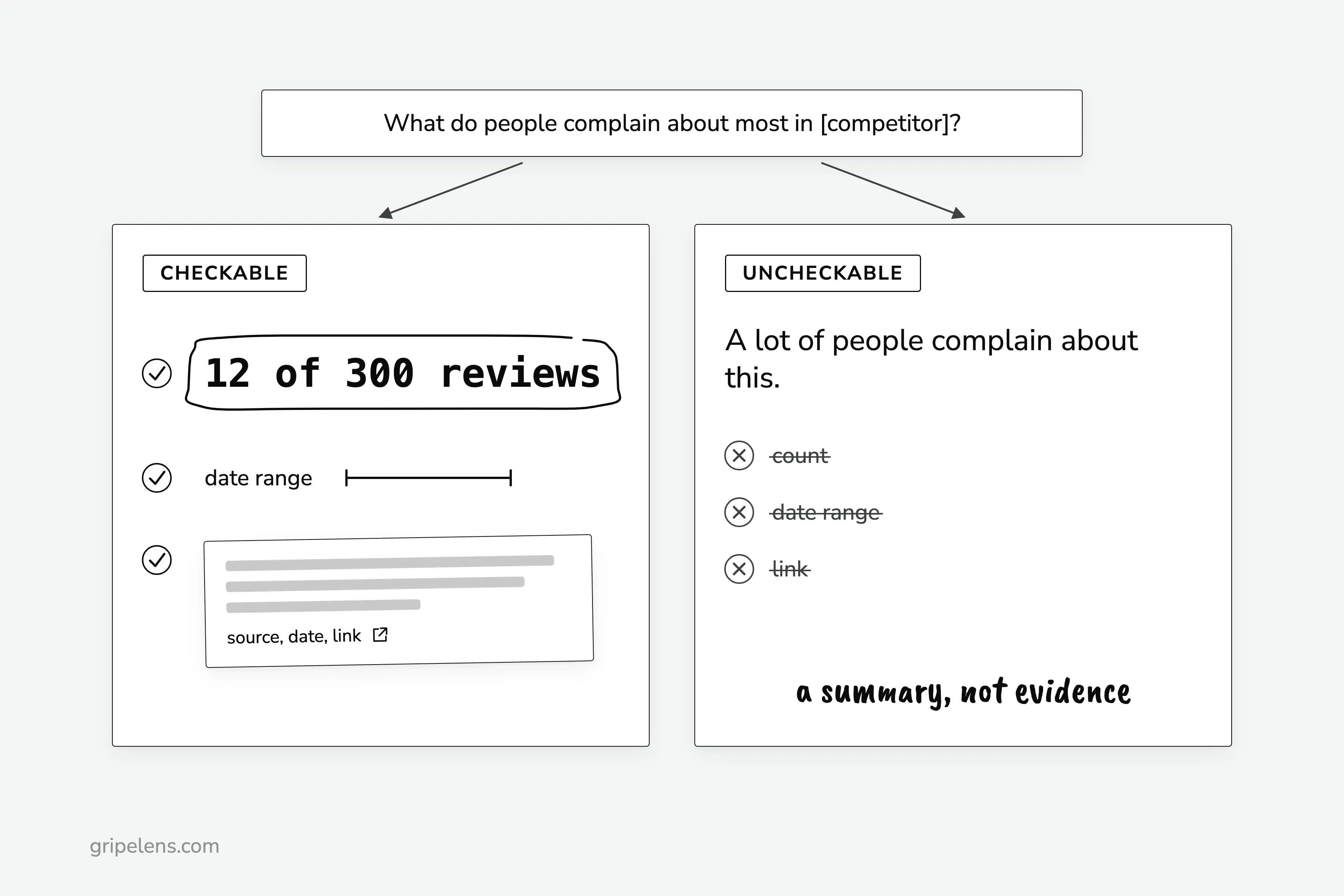
Before you trust one, check four things:
- A count with its base: “12 of 300 reviews”, not “a lot of people”.
- The date range: a complaint from three years ago may already be fixed.
- A quote with source, date and a link you can open: if the link doesn’t open, the quote doesn’t count.
- The source mix: one store, or several? A theme that shows up only on Google Play is a different finding from one that shows up everywhere.
So how do the servers do on this?
They differ. Appbot’s reviews tool returns the reviews behind any number, and Ask Appbot answers state the review count and date range. Syften returns matches, so the counting is your agent’s, and you’re trusting whatever number the model produces.
Counts can be bent at the source, too. A vendor’s review drive can drop a run of glowing reviews into a few weeks, and I wrote up how to spot review bursts on G2 and Capterra.
Here’s one test to run in any trial: “What do people complain about most in [competitor], with counts and three linked quotes?” If the answer can’t show the base, the dates and three links that open, it’s a summary, not evidence.
Counting and dating quotes across six sources is the slow part by hand. You can do it in a spreadsheet, or have Gripelens do this step: a sample report with counted, dated themes shows what each answer comes with.
Which One Should You Pick?
Pick by where your competitors’ reviews live first, then by what you want back: counted themes or a stream of mentions.
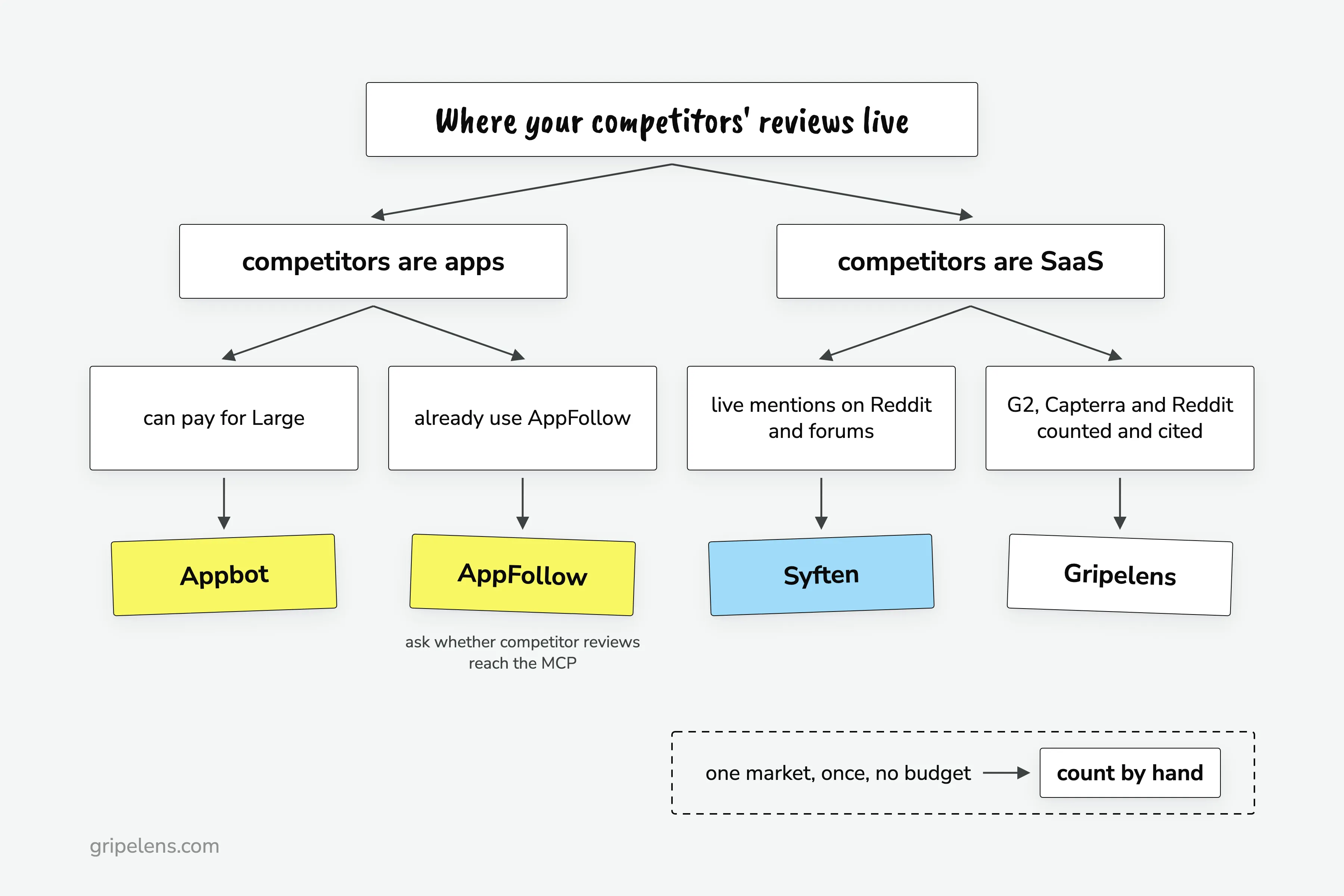
- Your competitors are apps and you can pay for Large: Appbot.
- You already use AppFollow for your own app: AppFollow, after asking whether competitor reviews reach the MCP.
- You want live mentions on Reddit and forums for an agent to read: Syften.
- Your competitors are SaaS products and you need G2, Capterra and Reddit counted and cited: Gripelens.
- One market, once, no budget: count by hand.
On price, Appbot’s MCP starts at $166 a month billed annually on Large and Syften’s at $119.95 a month on PRO. AppFollow says its MCP is on any plan, including Free.
Still unsure? Run the test question from the last section during a trial. Appbot and Syften both give you 14 days without a card.
If You Want Competitors’ Complaints in Claude or Cursor
If you want competitors’ complaints counted and cited inside Claude or Cursor, get early access. Launch pricing is locked for a year for the first wave.
FAQ
Which MCP Server Can Read Competitors’ App Reviews?
Appbot says so in its MCP FAQ: any source you track, including competitor apps, is available through its MCP, on the Large plan and up. AppFollow tracks competitor apps and shows their reviews in its feed, but its MCP pages don’t state that competitors’ reviews come through the MCP, so ask its support. Gripelens returns competitors’ reviews across six sources, including the App Store and Google Play.
Can an MCP Server Read G2 or Capterra Reviews?
Of the four servers here, only Gripelens reads G2 and Capterra. Appbot and AppFollow read app stores, and AppFollow also reads Trustpilot. Syften watches Reddit, Hacker News, forums and the public web, and doesn’t list review sites as sources.
How Much Does a Customer Review MCP Server Cost?
Appbot’s MCP starts on the Large plan, from $166 a month billed annually (Appbot’s plans page on 2026-11-02). Syften’s MCP is on PRO at $119.95 a month (2026-10-21). AppFollow’s comparison page says its MCP is open on any plan, including the free one, and its paid plans start at $19 a month billed annually (2026-11-02). Gripelens’s MCP and API come with a paid plan, priced on its pricing page.
Can a Review MCP Server Reply to Reviews for Me?
AppFollow’s can: its example prompt drafts replies to negative reviews and posts them once you approve. Appbot’s MCP is read-only, and so is Gripelens’s. Syften’s MCP can change your monitoring filters, but it doesn’t reply to anything.