Build Your Own Review Scraper or Buy a Tool? The Real Cost
Scraping 500 G2 reviews costs about $3 on Apify. Blocked sources, analysis and upkeep cost more. A dated cost table: DIY chain vs Kimola, Appbot, Gripelens.
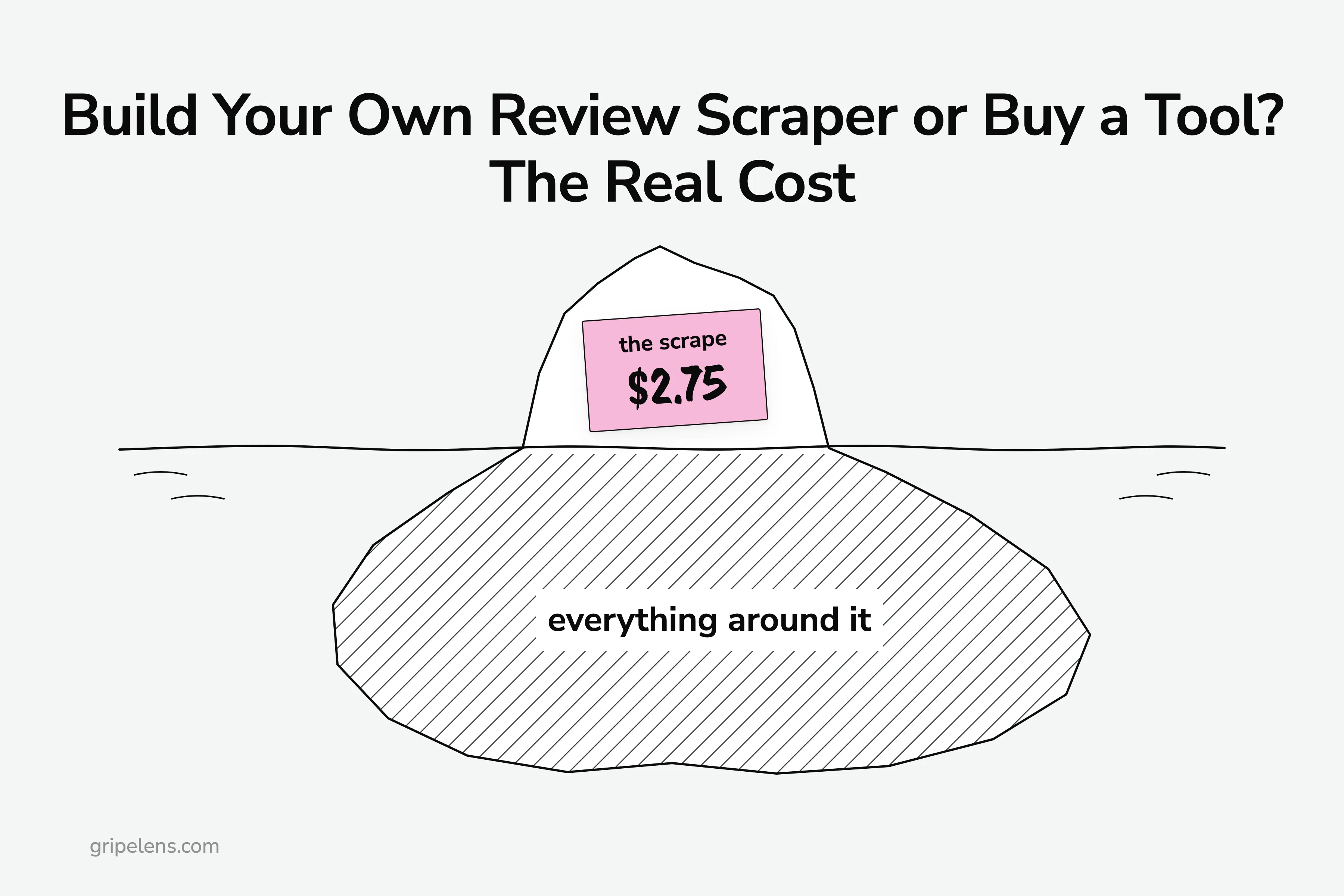
Should you build your own review scraper or buy a tool? Build it if you need one source, once: 500 G2 reviews cost about $2.75 in scraper fees. Buy once you need several sources on a schedule, because the scrape is the cheap part and everything around it (blocked sources, counting, quoting, upkeep) costs the time.
I research competitor reviews by hand before building anything: for this product I logged 36 tools in the category with their prices and 101 quoted complaints, each with its source and date. Doing it, I hit blocked sources: G2 refused my reads and showed me a captcha.
The usual DIY plan is to wire a ready-made scraper or a browser script into Claude and let the model sort the rows. That’s how the MCP servers that feed reviews to Claude work: connectors that let Claude call outside tools.
Below: how I compared four options, what each costs for a 500-review job, which review sites let a scraper in, who finds the competitors, what happens after the scrape, what upkeep costs, and who should pick which.
Key takeaways
- The scrape is cheap: 500 G2 reviews cost about $2.75 in actor fees (Apify’s name for a ready-made scraper) on Apify’s $19 Starter plan, so building wins for one source pulled once.
- Per one actor’s own docs, plain proxies often hit DataDome (an anti-bot service) on G2 and a Cloudflare 403 (the server saying “forbidden”) on Capterra, so a DIY chain pays for an unblocker (Apify’s paid proxy that gets past anti-bot checks) and for re-runs.
- The hidden cost comes after the scrape: counting themes against a base, dating quotes and checking sample size are your hours in every DIY chain.
- Kimola starts free (150 queries a month) but collects G2, Capterra and Reddit one page at a time through a browser extension; Appbot covers app stores only.
- Every option except Gripelens needs you to supply the competitor list.
How I Compared the Four Options
I build Gripelens, so weigh this accordingly. I compared a DIY scraper chain, Kimola, Appbot and Gripelens on six criteria, in this order:
- Cash cost for a 500-review job. G2, and G2 plus Capterra, priced for the DIY chain; other sources marked where I didn’t price them.
- Review sources each option reaches.
- Who handles blocking when a site refuses the scraper.
- Who supplies the competitor list.
- What you get after the scrape: raw rows, or themes with counts, a sample size and dated, linked quotes, plus flags for review bursts and quotes old enough that the problem “may be fixed”.
- Who keeps it running when a source changes.
I read the DIY prices on 2026-11-19 from apify.com/pricing (with the monthly-billing toggle checked), the two Apify actor pages and claude.com/pricing. Kimola and Appbot come from fact sheets I checked against their own pricing and docs pages on 2026-11-16. Gripelens comes from its own product description; its prices sit on the pricing page, not here.
One note on stale numbers. Several “best scraping tools” lists still print Apify’s Starter plan at $29 a month. The live page read $19 billed monthly ($17 billed annually) on 2026-11-19.
What Does Each Option Cost for a 500-Review Job?
Here’s the whole chain priced for one job: 500 reviews of one competitor. The DIY row is the scraper plus an LLM (a large language model, here Claude) plan, and the prices in the table carry the date I read them.
| Option | Entry price | Cost for 500 reviews | Sources reached | Who supplies competitors | Who handles blocking | What you get | Prices read |
|---|---|---|---|---|---|---|---|
| DIY chain (Apify + Claude) | Apify Starter $19/month billed monthly (Free plan: $5 credit); Claude Pro £18/month billed monthly, separate line | 500 G2 reviews ≈ $2.75 actor fees; 500 G2 + Capterra ≈ $0.755 event fees; both plus Unblocker ($1.5 per 1,000 requests) and compute | G2, Capterra priced; App Store, Google Play, Trustpilot, Reddit not priced here | You | You (Unblocker) | Raw rows | 2026-11-19 |
| Kimola | Free, 150 queries/month; Basic £39/month billed monthly (£32 annual), 3,000 queries | At least 500 queries, above the Free plan’s 150 a month, so Basic at £39/month billed monthly (3,000 queries) at minimum; 1 query per analysed row up to 500 characters, longer rows more; scraping and classifier steps also use queries | App Store (500 cap), Google Play, Trustpilot by link; G2, Capterra, Reddit via browser extension | You | Kimola for link sources; your browser for extension pages | Themes, sentiment; counts per theme not described on its pages | 2026-11-16 |
| Appbot | Small $59/month billed monthly ($49 annual); no free plan, 14-day trial | One competitor app is 1 of the 5 sources on Small: $59/month billed monthly, or inside the 14-day trial; app store reviews only | App Store, Google Play, Microsoft Store | You, by hand | n/a (app stores only) | Topics, sentiment; Ask Appbot (Large, from $219/month billed monthly) states how many reviews an answer rests on | 2026-11-16 |
| Gripelens | See pricing | See pricing | App Store, Google Play, Trustpilot, G2, Capterra, Reddit/HN | Gripelens finds them | Gripelens | Themes with counts and sample size; quotes with source, date and link | n/a (own product) |
The tool prices here are a subset; I’ve laid out what review analysis tools cost across the whole category elsewhere.
So what does the scrape itself cost? Apify’s Starter plan is $19 a month billed monthly, and that $19 comes back as credit to spend on actors. The G2 Reviews Scraper charges $5.49 per 1,000 G2 reviews on Apify’s Starter tier, so 500 reviews cost about $2.75, well inside the credit. On the Free plan, the same actor page estimates the $5 credit covers about 700 reviews.
For G2 and Capterra together, Review Radar, a founder-built actor with 2 users when I checked, charges $0.005 per run and $0.0015 per review: $0.755 for 500. Its page says Unblocker and compute are billed on top, and I don’t know how many Unblocker requests a review takes. So I can’t give an all-in figure for G2 plus Capterra.
The bought tools price the same job differently. Kimola needs at least 500 queries for 500 reviews, more than the Free plan’s 150 a month, so the job needs Basic at £39 a month billed monthly. Appbot counts one competitor app as 1 of the 5 sources on Small, which is $59 a month billed monthly, or free during the 14-day trial.
Either way, the scrape is the small number.
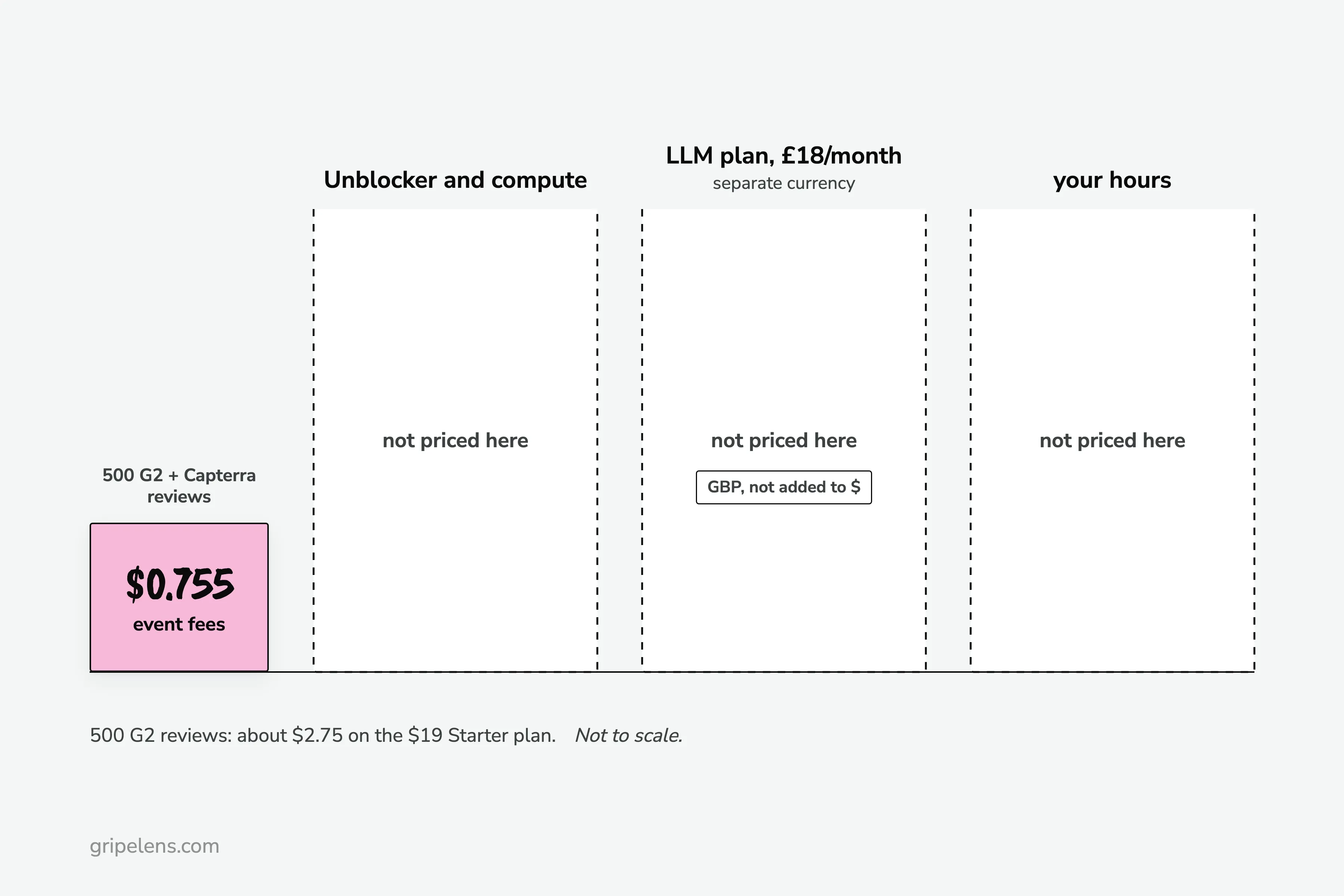
The diagram marks three blocks “not priced here” for a reason. None of the $0.755 pays for the Unblocker and compute, the LLM plan at £18 a month (in its own currency, so I don’t add it to the dollars), or your hours counting, quoting and re-running.
Which Review Sources Will Let You In?
The best evidence on blocking comes from a scraper’s own author. Review Radar’s documentation says plain residential or datacenter proxies “often get Cloudflare 403 on Capterra and DataDome on G2”. Review Radar’s output rows even carry type: "error" for “block, mismatch, empty page”.
Per source, here’s what I hit or found:
- G2. On 2026-10-07, G2 answered my direct reads with an HTTP 403 and a captcha. The only full, dated G2 quotes I got came from reviews AWS Marketplace mirrors on its product pages.
- Capterra. Cloudflare 403s without an unblocker, per the Review Radar docs above.
- Reddit. While researching this post, Reddit’s search endpoint answered my query with a 403. The thread pages still loaded as normal pages. Earlier, about 40 minutes of slow retries against an archive API got only 5 Reddit comments into a 101-complaint table.
- App Store and Google Play. Readable. My sample report on five time-tracking apps read 2,685 App Store reviews, and Kimola pulls up to 5,000 Google Play reviews per product from a pasted link.
So what does that mean for each option?
A DIY chain pays for the Unblocker on G2 and Capterra and re-runs whatever comes back as an error row. Kimola fetches its link sources itself, but G2, Capterra and Reddit come in only through its Airset Generator browser extension, one page at a time, visible reviews only. Appbot stays in the app stores (App Store, Google Play, Microsoft Store). Gripelens reads its six sources itself.
Who Finds the Competitors?
Before any scrape, you need a list of products to pull. Every DIY chain starts from URLs you paste: the G2 actor’s required input is a G2 product or seller URL.
An r/SaaS post framed the job as “500 reviews spread across App Store, G2, Trustpilot and Reddit” from three competitors. Which three? The scraper won’t tell you.
The bought tools mostly don’t either:
- Appbot. You add competitor apps by hand, and each one counts against your plan: “A source is a single app in a single app store.”
- Kimola. Its docs show every report starting from a link, keyword or file you supply. I saw no automatic competitor discovery, though I haven’t confirmed it’s absent.
- Gripelens. You type a product or category name and it finds the competitors.
If you already know your rivals, skip this criterion. If you’re new to the category, it’s the step most likely to go wrong, because a missing competitor never shows up in the rows.
What Happens After the Scrape?
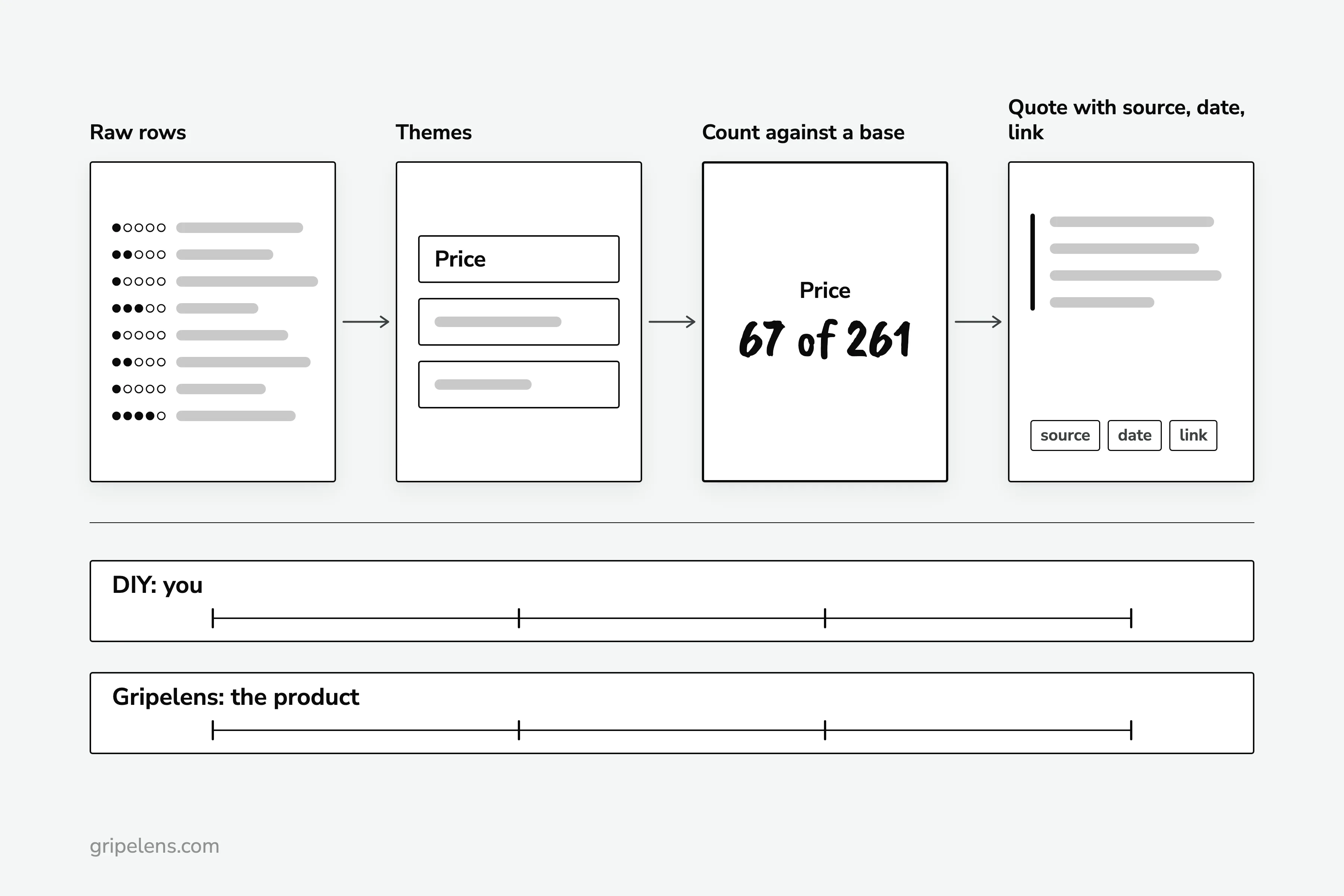
A scrape returns rows. What you need is themes, each counted against a base, with a sample size and quotes that carry a date and a link. None of the pages that rank for this question price that step.
The default DIY plan in that r/SaaS thread, from u/GolfVulture, is short: “Use apify or playwright MCPs to scrape them into Claude and then analyze it. Can be done in Claude code”. It works for the first pass. Then the hand work starts.
What does the hand work look like?
- Count against a base. My time-tracker sample report coded 261 negative items out of 2,685 App Store reviews read. Price was 67 of 261. A theme without the 261 behind it is a vibe.
- Read a sample per theme. u/darvidas, in the same thread: “Then I only read ~10-20 reviews per theme Just to sanity-check and grab good quotes.”
- Keep the receipts. u/CapMonster1, replying to a G2 and Capterra actor launch: “i’d want the actual quotes, dates, and count”. And: “a battlecard built from one-star reviews will tell a very different story from one using the full sample”.
The LLM line is Claude Pro at £18 a month billed monthly. If you already pay for one, that line is sunk; the hours aren’t. I wrote up how to analyse thousands of reviews by hand, counts included.
Or have Gripelens do this step: it merges themes across sources with a count and sample size on each, and every quote shows its source, date and link. The sample report shows the output format.
What Does a Scraper Cost to Keep Running?
Who fixes the scraper when a source changes? With a DIY chain, you do. Review Radar launched on r/SideProject, and its author had added an automatic retry 11 days after launch “so runs get both sources more reliably”. That’s a fix inside two weeks, from the person who wrote it.
The G2 Reviews Scraper is labelled “Maintained by Community” and rated 2.7 from 4 reviews. One founder’s “own” competitor-review scraper on r/startupideas turned out to lean on a third-party Chrome extension for Google Play (u/darvidas: “I used this Google Play Reviews Extractor”). And on X, @mikefutia posted “I just vibe-coded a Shopify review-scraper with Claude Opus 5.5.” A reply: “What if you use Shopify but your competitors don’t?” One source, one platform.
In an r/webscraping thread about scraping product pages, u/charlesthayer put it plainly: “During MVP stage you can save a little money with code like Playwright and Puppeteer, but unless it’s super core to the business, crawling IS it’s own business, so it’s a distraction for you.”
I can’t give you an hours figure. Count your own:
- fixing a run that came back blocked
- re-running a source after a fix
- re-checking counts after the re-run changed the rows
The bought tools carry most of that upkeep. Appbot backfills full review history on signup, for your apps and competitor apps. Kimola collects its link sources, but you collect its extension pages yourself, in your browser. Gripelens maintains its six sources itself.
Who Should Pick Which?
Whether to build your own review scraper or buy a tool comes down to source count and frequency. One source once, build; app stores only, Appbot; themes over sources you can paste by link, starting free, Kimola; several sources on a schedule without a competitor list of your own, a tool that finds competitors and counts.
A DIY Scraper Chain
Best suited to a technical founder who needs one source (G2 or the App Store), pulled once or rarely, and will count and quote by hand. 500 G2 reviews cost about $2.75 on Apify Starter.
The trade-off: you own the blocking (an unblocker on G2 and Capterra), the re-runs and every count. App Store, Google Play, Trustpilot and Reddit each need another actor or script.
Kimola
Best suited to a founder who wants themes and sentiment over reviews they can paste by link (App Store, Google Play, Trustpilot), starting on a free plan of 150 queries a month; Basic is £39 a month billed monthly.
The trade-off: G2, Capterra and Reddit come in through a browser extension one page at a time, you supply every link, and the query count per review is hard to predict. Prices are in GBP. I compared Kimola and its alternatives in more depth.
Appbot
Best suited to an app team tracking its own app and a few competitor apps in the App Store and Google Play. Small is $59 a month billed monthly, with 5 sources.
The trade-off: app stores only (no G2, Capterra, Trustpilot or Reddit), no free plan, and competitors added by hand count against the plan’s source limit.
Gripelens
I build this one. Best suited to a founder who needs several review sources and wants counted themes with dated, linked quotes, without supplying the competitor list. It reads six sources and finds the competitors from a product or category name.
The trade-off: you don’t control the scraper or get a raw-row pipeline you can modify, and it reads six sources only, so no Amazon or Google Business. Prices are on the pricing page.
If You’d Rather Not Build the Chain
If you want the counted, quoted version of a competitor’s reviews without building the scraper, the unblocker and the counting sheet, get early access: launch pricing is locked for a year for the first wave.
Get early access. If you’d rather build it, the cost table above is where your budget starts.
FAQ
How hard is it to build your own review scraper?
For one source, not very: a technical founder can start from a ready-made Apify actor for G2 and skip writing the scraper at all. It gets harder at G2 and Capterra, which block plain proxies, so you pay for an unblocker and re-run failed pages. And founder-built actors can need fixes fast: Review Radar’s author added an automatic retry 11 days after launch.
Which tool should I use to scrape reviews?
It depends on how many sources you need and how often. For one source pulled once, use an Apify actor and count by hand. For app stores only, Appbot. For themes over sources you can paste by link, starting on a free plan, Kimola. For several sources on a schedule without a competitor list of your own, use a tool that finds the competitors and counts the themes for you. The “Who Should Pick Which?” section above has one paragraph per option with its trade-off.
How much does it cost to scrape 500 reviews?
About $2.75 in actor fees for 500 G2 reviews on Apify’s Starter plan, at $5.49 per 1,000 reviews (actor page read 2026-11-19). For 500 G2 and Capterra reviews through Review Radar, $0.755 in event fees, plus Unblocker and compute. The Starter plan itself is $19 a month billed monthly, and the analysis step (an LLM plan and your hours) is extra.
Can I just paste reviews into ChatGPT or Claude?
Yes, for a few hundred reviews, if you count each theme against the total yourself and keep the link beside each quote. Then read 10 to 20 reviews per theme to check the grouping, the way one founder on r/SaaS described it.