AppFollow Alternatives: 7 Best Picks by the Job You Need
AppFollow now shows competitor apps' reviews, but you add each one by hand and G2, Capterra and Reddit are only listed options. 7 alternatives compared.
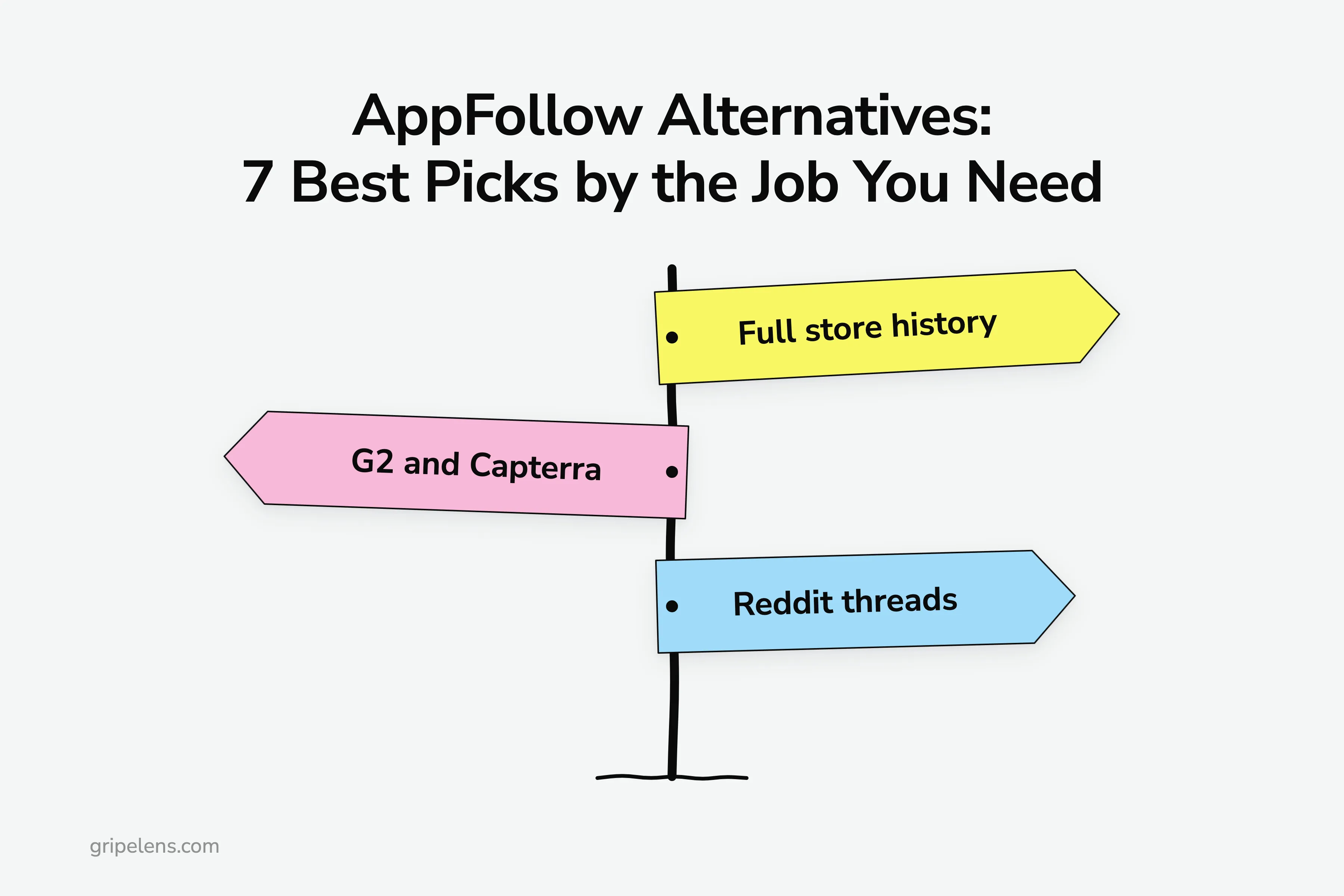
The best AppFollow alternative depends on the job you need done: Appbot for competitor apps’ full review history in the app stores, Kimola or Gripelens if your competitors’ reviews also sit on G2, Capterra or Reddit, and AppFollow’s own free plan if 10 competitors with recent reviews is enough. AppFollow isn’t the problem at its own job (replying to your app’s reviews, plus app store optimisation, or ASO), and since September 2026 it shows competitor apps’ reviews too, so the limits below are about researching rivals.
I research competitor reviews by hand before building anything: for this product I logged 36 tools in the category with their prices and 101 quoted complaints, each with its source and date. I also build Gripelens, one of the seven below.
Below: how I compared them, a table of AppFollow and seven alternatives, what AppFollow now does for competitor research and where it stops, why the usual alternatives lists miss, one section per tool, and which to pick for which job.
Key takeaways
- Appbot for competitor apps’ full history in the stores ($49 a month billed annually for 5 sources, and each competitor app in each store is one); Kimola or Gripelens when competitors’ reviews also live on G2, Capterra or Reddit.
- AppFollow has shown competitor apps’ reviews with an AI summary since September 2026, but you add every competitor by hand, they stay read-only, and G2, Capterra and Reddit are only listed options in its early-access Feedback Hub.
- On a zero budget, start with AppFollow Free (10 competitor slots, 7 days of history) or Enterpret’s free App Review Analyzer (up to 5 pasted store URLs).
- G2’s 10 “AppFollow alternatives” include 0 tools built to read competitor apps’ reviews; they’re ASO, attribution, analytics, market-data and reputation tools.
- Thematic ($25,000 a year), Unwrap (from $24,000 a year) and Chattermill (contact sales) suit a team analysing its own feedback at volume.
How I Compared Them
I build Gripelens, so weigh this accordingly. Nothing on this page is an affiliate link.
I applied six criteria, in this order:
- Whose reviews it reads, and from where: competitors’ public reviews, your own feedback, or both; the app stores, Steam, Trustpilot, G2, Capterra or Reddit; built in, by browser extension, or through your own integrations. A source a tool only lists as an option doesn’t count as read.
- Who adds the competitors: found for you from a product or category name, or added by you one app or link at a time.
- What tracking one competitor costs on the plan: a competitor slot, a plan source, a tracked link, or feedback volume.
- How much review history you get.
- Whether a theme comes with a count and the sample size it’s out of.
- Entry price and how you buy: a free plan, a self-serve paid plan, or a sales-led annual contract.
I read each vendor’s pricing, feature, docs and blog pages in a browser: AppFollow, Appbot and Kimola on 2026-11-16, and Enterpret, Thematic, Unwrap and Chattermill on 2026-11-03. I didn’t buy plans, start trials or run Enterpret’s analyzer. I counted G2’s list of AppFollow’s alternatives on 2026-11-16.
AppTweak, Appfigures and App Radar show up on the ranking pages as well. They answer the ASO job (app store optimisation: the keywords and listing text that decide where an app shows in store search), and I haven’t profiled them. So they’re not compared here.
AppFollow Alternatives at a Glance
The first row is AppFollow itself, so you can read every cell against it. The seven alternatives follow in the same order as their sections below.
| Tool | Whose reviews, which sources | Who adds competitors | What a competitor costs on the plan | Review history | Count and sample size per theme | Entry price |
|---|---|---|---|---|---|---|
| AppFollow | Your apps plus competitor apps (read-only); app stores, Steam, Trustpilot; G2, Capterra, Reddit only listed in early-access Feedback Hub | You, by name or store URL | Competitor slots: 10 Free, 30 ASO, 100 Essential, 250 Team | 7 days Free, 30 ASO, 365 Essential, full Team; competitor scope not stated | Topic percentages in AI Summary; sample size not stated | Free; ASO $19/mo billed annually; Essential $129/mo billed annually |
| Appbot | Your apps and competitor apps; App Store (iOS, macOS), Google Play, Microsoft Store | You, by hand | One plan source per app per store (Small 5, Medium 40) | Full history backfilled, competitor apps included | Ask Appbot states the review count and date range (Large and up) | No free plan; $49/mo billed annually, 14-day trial |
| Kimola | Any reviews you link; about 20 link platforms incl. App Store, Google Play, Trustpilot; G2, Capterra, Reddit by Chrome extension | You, by link | Tracked links (5 on Basic) and queries | Per-link caps: App Store up to 500 reviews, Google Play up to 5,000 | Not described | Free 150 queries/month; £32/mo billed annually |
| Gripelens | Competitors’ public reviews; App Store, Google Play, Trustpilot, G2, Capterra, Reddit/Hacker News (HN) | Found from a product or category name | See pricing | Full history, quotes older than 18 months flagged “may be fixed” | Count and sample size on every theme | Founder pricing |
| Enterpret | Your own feedback (50+ sources); free analyzer reads pasted store URLs | You (analyzer: up to 5 store URLs) | Feedback volume and Agent credits | Not stated for competitors | Not stated on product pages | Free analyzer; paid by demo, no public price |
| Thematic | Your feedback; App Store and Google Play apps you name, competitors included; no G2 | You, by naming apps | 25,000 comments a year on Foundation | Not stated | Theme volumes; sample size not named | $25,000/yr, no free tier or trial |
| Unwrap | Your own channels; no G2, Capterra or Reddit integration | No competitor benchmarking seen | Volume and integrations | Your own history | Volumes; sample size not seen | From $24,000/yr, 30-day trial |
| Chattermill | Your own feedback via integrations (App Store, Google Play, G2, Capterra, Trustpilot) | No competitor discovery seen | Volume, integrations, team size | Not stated | Not stated | Contact sales |
Where a cell says “not stated” or “not seen”, the vendor’s public pages didn’t say, which isn’t proof the product lacks it. Kimola publishes its prices in GBP.
What Does AppFollow Do for Competitor Research Now?
Fair first. Since September 2026, competitor apps appear in AppFollow’s Reviews feed and Rating analysis, with filters, tags, an AI summary and sentiment. The Free plan holds 10 competitor slots and lists an “MCP connector” (MCP lets an AI assistant such as Claude or ChatGPT query a tool directly), and a Benchmark Report compares one tracked app with up to 19 competitors on new reviews, sentiment and bug share; its pages don’t say which plan includes the report.
People like it at its own job. One Reddit poster who tried it beside AppTweak wrote: “Tried free trials of both. Preferred AppFollow for sure.”
So where does it stop for researching rivals? In five places:
- Who finds the competitors. You add each one “by name or store URL”. I saw no way to start from a category and have the rivals found for you.
- What you can do with them. On the same page, AppFollow says: “Apps added as competitors can be monitored through public data, but they cannot use store connections, integrations, or review replies.”
- Which sources. The Reviews feed covers the app stores, Steam and Trustpilot. Reddit, G2 and Capterra are options in its Feedback Hub, which is in early access and names Steam as the first supported source. AppFollow’s own advice on that kind of list applies: “A source in a picker tells you nothing about sentiment analysis, replies, history, or thread depth for that source, so ask for a demo on your own data first.”
- How far back. A week on Free, 30 days on ASO ($19 a month billed annually, $29 monthly, 30 competitors), a year on Essential ($129 a month billed annually, 100 competitors), everything on Team ($425 a month billed annually). Whether competitor apps follow the same window, the pricing page doesn’t say.
- How a theme is sized. The AI Summary shows topic percentages, and AppFollow’s own post on summaries says overlap “can push the total above 100%”, while reviews left out can pull it below. I saw no sample size per theme.
Then the MCP. AppFollow’s MCP page scopes it to data “for the apps you already track”. Whether a tracked competitor counts, that page doesn’t say, so check with AppFollow before you build on it.
My comparison of MCP servers that read customer reviews covers which ones reach competitors.
Why Do the Usual AppFollow Alternatives Lists Miss?
G2’s “Top 10 Alternatives to AppFollow” shows 10 product cards. Going by each card’s own G2 description, they split like this:
- ASO: 1 (AppTweak)
- Business or e-commerce review and reputation: 4 (Birdeye, Podium, Reputation, Reviews.io)
- Mobile attribution: 2 (Adjust, AppsFlyer)
- Product analytics: 2 (Amplitude, Google Analytics)
- Web and app market data: 1 (Similarweb)
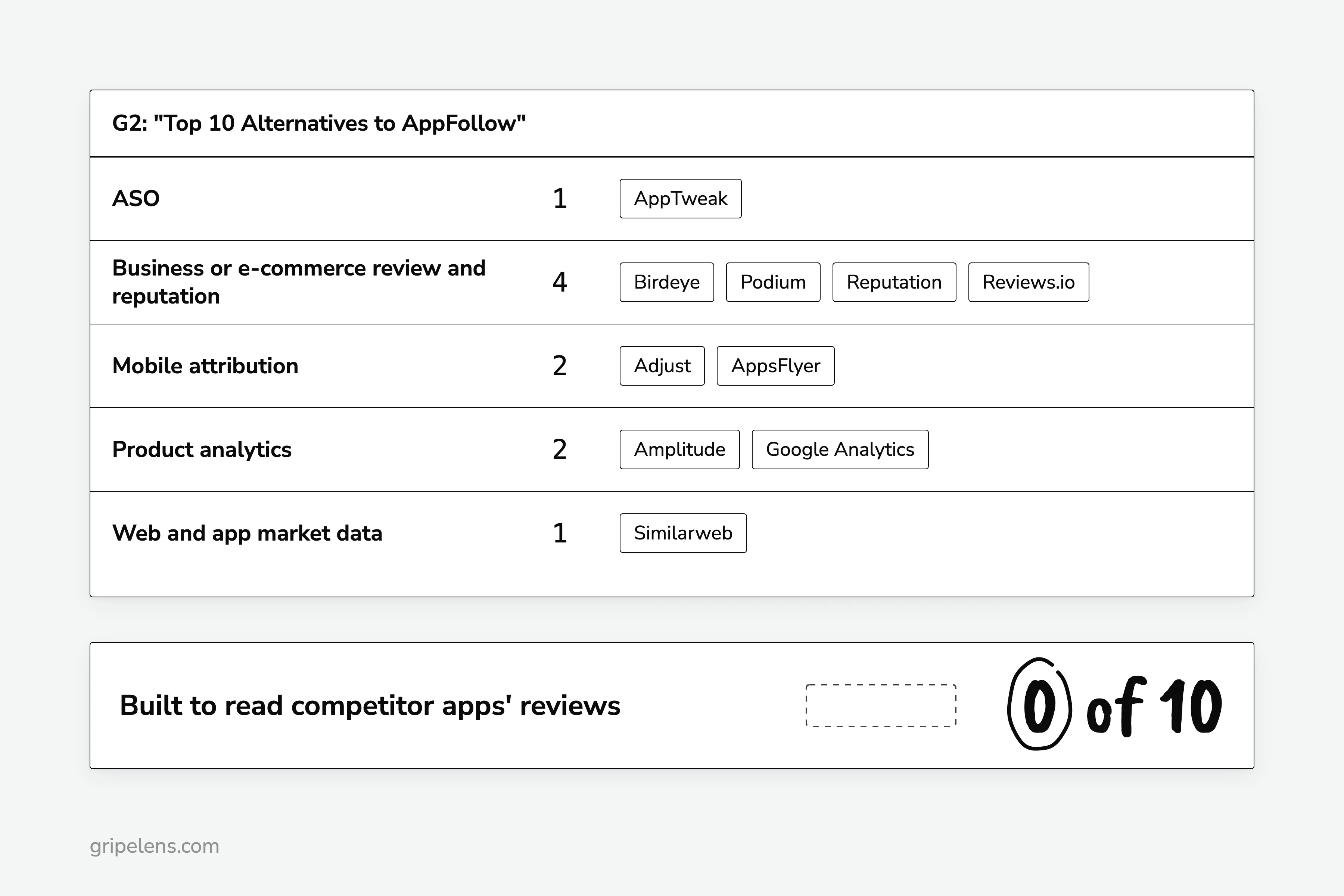
Built to read competitor apps’ reviews: 0 of 10. The category split is my reading of each card, so treat it as rough. The zero isn’t.
The rest of the first page isn’t much closer. Of the top 6 Google results for this search, 3 are rival vendors’ pages (Appbot, Enterpret and AppTweak), and two of those list themselves first. I read 6 of the 9 results, and none mentions AppFollow’s September competitor feed or treats the job as reading competitors’ reviews.
Why the mismatch? Going by what ranks, the search reads as ASO. The Reddit thread that ranks for it asks, “Is anyone using anything else for ASO?”, and an X list of mobile tools files AppFollow under “ASO & Research Tools”.
A fair list for an ASO buyer. The wrong one for a founder reading rivals’ complaints.
What Are the Best AppFollow Alternatives?
Sorted by the job, starting with the stores. Each one gets who it suits, one fact against AppFollow, and a trade-off.
Appbot
Appbot is best suited to founders who want competitor apps’ full review history in the App Store and Google Play, not only the window an AppFollow plan gives them.
What does Appbot give you that AppFollow doesn’t? The past.
Appbot promises “Full review history backfilled from app launch on signup”, competitor apps included, where AppFollow’s plans below Team keep 7, 30 or 365 days and don’t say whether that covers competitor apps.
The meter is different too: every competitor app uses one plan source per store, and the Small plan is $49 a month billed annually for 5 sources. On Large and up, Ask Appbot states how many reviews an answer rests on and their date range.
Trade-off: it reads app stores only (Apple’s App Store, Google Play and the Microsoft Store), so no Trustpilot or Steam, both of which AppFollow covers. There’s no free plan, only a 14-day trial, and no ASO keyword tracking, which AppFollow has. The rest is in where Appbot itself stops.
Kimola
Kimola is best suited to founders whose competitors’ reviews sit on G2, Capterra or Reddit today, not in a source a picker only lists.
That’s the line against AppFollow’s Feedback Hub: Kimola reads those sites now. A Chrome extension reaches 24 further sites, G2, Capterra and Reddit among them, beside pasted links from about 20 platforms, the App Store and Google Play included. Pricing fits in one line: free for 150 queries a month on Starter, £32 a month billed annually on Basic, which tracks 5 links.
Trade-offs:
- Link scraping stops at “up to 500 reviews” on the App Store and “up to 5,000” on Google Play. A different limit from AppFollow’s history window, but a limit.
- You supply every link; I saw no competitor discovery.
- Queries meter each analysed row, one per 500 characters, and scraping can add more.
That’s the short version of what Kimola leaves to you.
Gripelens
This is my product. Gripelens is best suited to founders who want the competitors found for them and their complaints counted across the stores, G2, Capterra and Reddit.
Against AppFollow, three things differ:
- You type a product or category and it finds the competitors. In AppFollow you add each one by name or store URL.
- Every complaint theme carries a count and the sample size it’s out of, where AppFollow’s AI Summary gives topic percentages.
- Quotes older than 18 months are flagged “may be fixed”, and review bursts (a sudden spike, likely a vendor campaign) and thin samples are flagged too.
The sample report shows the output. It read 2,685 App Store reviews of five time trackers, and Harvest’s 2026 repricing came to 38 of Harvest’s 70 complaints. Prices are on the pricing page.
Trade-off: it’s new, with no published usage, accuracy or speed numbers. It skips the half of AppFollow that runs your own app: no review replies, no managing your app’s reviews, no ASO. No Steam or Microsoft Store (AppFollow’s feed reads both), and no Samsung, Huawei or Amazon Appstore. It’s built for the question of what competitor apps’ one-star reviews tell you, not for running your own app.
Enterpret
Enterpret is best suited to anyone who wants a free one-off look at up to 5 competitor apps before paying for anything.
Its free App Review Analyzer compares “up to 5 Google Play or Apple App Store URLs” that you paste. That’s fewer apps than AppFollow Free’s 10 competitor slots, and it’s a one-off comparison rather than ongoing tracking. Enterpret’s paid product reads your own feedback instead, sells by demo only, and recommends at least 1,000 combined feedback records a month.
Trade-off: you find and paste the URLs, and the analyzer is the only free piece; the paid product has no public price. I sorted Enterpret’s paid product and cheaper options on their own page.
Thematic
Thematic is best suited to a feedback team with an annual budget that wants competitors’ App Store and Google Play reviews next to its own surveys and tickets.
Its store integrations pull “your and your competitors’” app reviews, and you name the apps, much as you do in AppFollow. Foundation costs $25,000 a year for 25,000 comments.
Trade-off: no free tier or trial, no G2 integration, and by its own FAQ it “works best with at least 2,000 rows of verbatims”, meaning 2,000 individual pieces of feedback.
Unwrap
Unwrap is best suited to a product team analysing its own channels at volume.
Pricing starts at $24,000 a year, set by volume and integrations rather than seats, with a 30-day trial on your data. That’s the opposite end from AppFollow, which lists self-serve prices from free and reads competitor apps as well as yours.
Trade-off: I saw no competitor review benchmarking, and none of its 45 integration docs covers G2, Capterra or Reddit.
Chattermill
Chattermill is best suited to a large consumer brand with steady feedback volume and a sales-led budget.
Its own FAQ says it’s not a fit if “You’re not consistently collecting more than 5,000 pieces of customer feedback every month”. AppFollow lists its prices on the page; Chattermill is contact-sales only.
Trade-off: no trial, and it’s built around your own feedback; I saw no competitor discovery.
Staying on AppFollow Free, the Consoles, or Doing It Yourself
None of these counts toward the seven. Each is still a real option.
AppFollow Free remains the zero-cost start for up to 10 competitor apps, if the Free plan’s 7 days of history is enough for the decision in front of you. App Store Connect and Google Play Console cost nothing too, but each is built around your own apps: App Store Connect’s help and Play Console’s help both describe the reviews of “your app”.
Then there’s the do-it-yourself route. On X, @Emil__Lio runs an ASO keyword workflow at “total spend: $0”: it seeds keywords from his and competitors’ app store reviews, uses AppFollow’s free tier as a keyword spy, and runs on Claude Code. One builder’s setup, not a trend.
If you build your own, copy @mikawuf’s rule: “Numbers come from a tool, never from the model. Test it: ask your agent for the popularity of 5 keywords twice in new chats. If the numbers change, they were invented.” The same test works on complaint counts.
Which AppFollow Alternative Should You Pick?
Which job did you open AppFollow for? Start there. Each line below names a job and the tool for it, and two of the jobs aren’t competitor research at all.
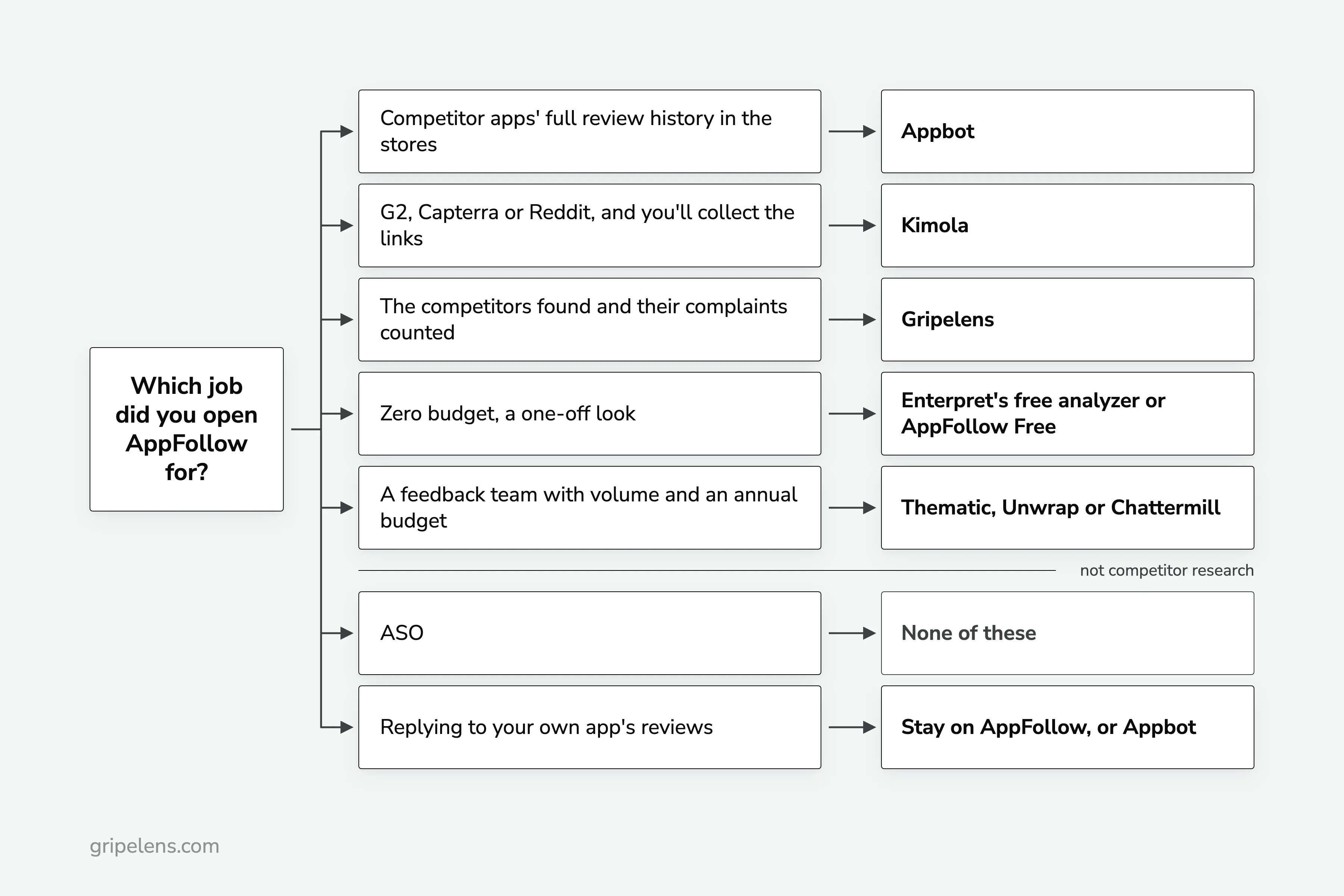
- Competitor apps’ full review history in the stores: Appbot.
- Competitors’ reviews on G2, Capterra or Reddit, and you’ll collect the links: Kimola.
- The competitors found and their complaints counted across all of those: Gripelens.
- Zero budget, a one-off look: Enterpret’s free analyzer for up to 5 apps, or AppFollow Free for 10. My list of app review tools an indie developer can afford goes further down that road.
- A feedback team with volume and an annual budget: Thematic if named competitor apps matter, Unwrap or Chattermill for your own channels.
- ASO: none of these. AppTweak, Appfigures and App Radar are the ASO-first names on the ranking pages, and I haven’t compared them.
- Replying to your own app’s reviews: stay on AppFollow, or look at Appbot, whose Large plan adds AI Replies and Auto Replies.
If You Want the Competitors Found for You
If typing a category beats adding rival apps one at a time, and you want their complaints counted across the App Store, Google Play, G2, Capterra, Trustpilot and Reddit, the sample report shows what comes back. Launch pricing is locked for a year for the first wave.
FAQ
Is There a Free Alternative to AppFollow?
Often the answer is AppFollow’s own Free plan, with 10 competitor slots and 7 days of history. Two other no-cost starts: Kimola’s free Starter tier, 150 queries a month on review links you collect yourself, and Enterpret’s App Review Analyzer, a one-off comparison of up to 5 App Store or Google Play URLs. Apple’s and Google’s own consoles cost nothing too, but they stop at the apps in your account.
Can AppFollow Track Competitor Apps’ Reviews?
Yes. Since September 2026, competitor apps appear in AppFollow’s Reviews feed and Rating analysis with an AI summary and sentiment. You add each one by name or store URL, and they stay read-only: no replies, store connections or integrations. On Free you see a week of history, on Essential a year. Whether competitor apps get the same window, AppFollow’s pricing page doesn’t say.
Does AppFollow Read G2, Capterra or Reddit Reviews?
Not in its Reviews feed, which covers the app stores, Steam and Trustpilot. G2, Capterra and Reddit appear as source options in its Feedback Hub, which is in early access and names Steam as the first supported source. If you need those sites read today, Kimola gets to them with its Chrome extension, and G2, Capterra and Reddit are three of Gripelens’s six built-in sources.
How Much Does AppFollow Cost?
AppFollow has a Free plan. ASO is $19 a month billed annually ($29 monthly), Essential is $129 ($179 monthly), Team is $425 ($599 monthly), and Enterprise has a custom price. Those are the prices on AppFollow’s pricing page as read on 2026-11-16; they apply to new customers and exclude VAT.
Is AppFollow an ASO Tool or a Review Tool?
Both. One subscription covers review management and replies for your own apps, plus ASO, the keyword and listing work that decides where an app shows in store search. That’s why “alternatives” lists mix ASO tools with review tools, and why the right replacement depends on which half you use.