How to Find Customer Pain Points in Reviews (Count to Three)
A pain point is any problem three different reviewers raise inside your window, counted out of n. Four steps, run on 261 real complaints.
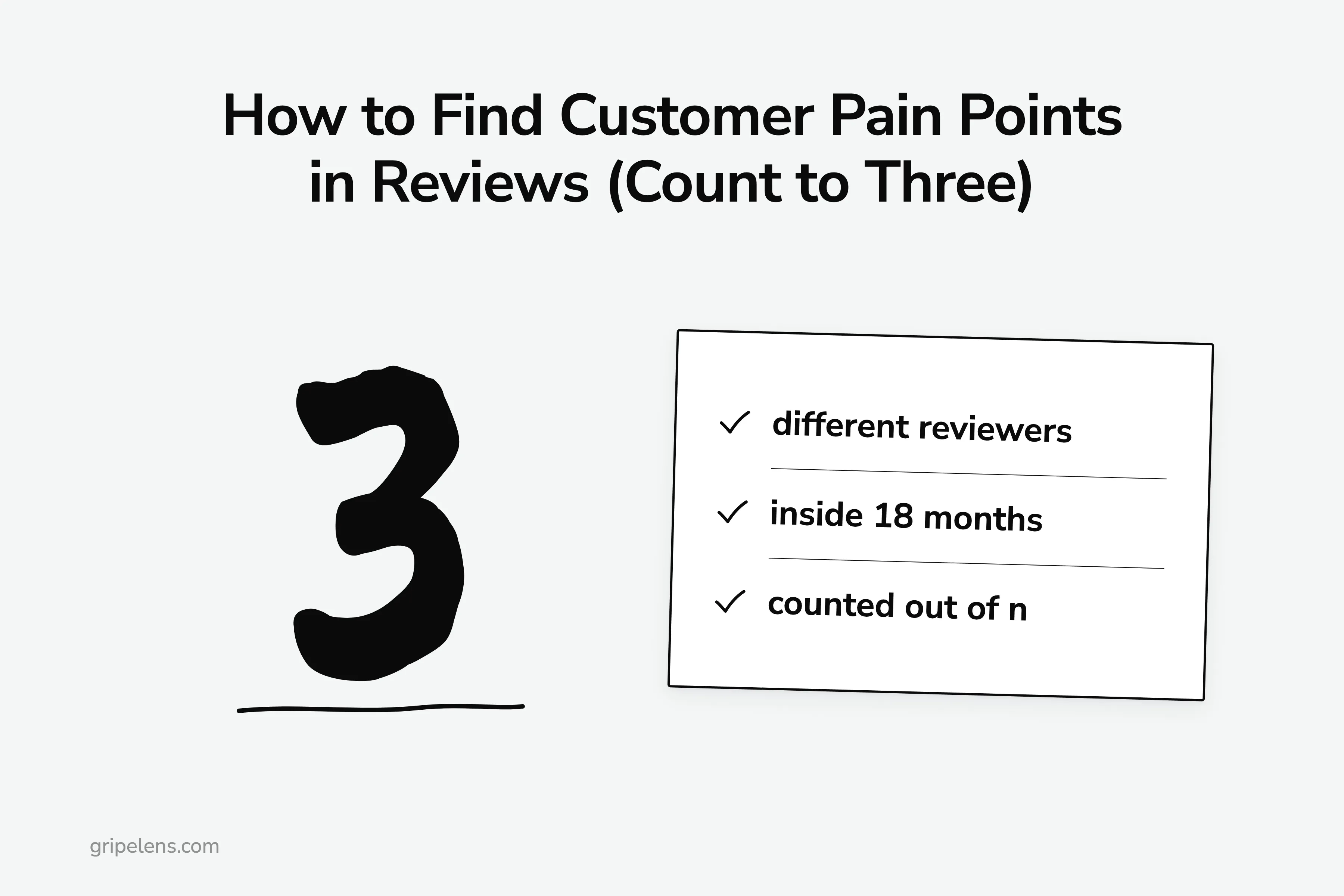
To find customer pain points in reviews, work in four steps: pull the low reviews, tag each complaint, count different reviewers, and drop anything older than 18 months. A problem becomes a pain point when three different reviewers raise it inside that window, and you write it as a count out of the reviews you read.
I research competitor reviews by hand before building anything: for this product I logged 36 tools in the category with their prices and 101 quoted complaints, each with its source and date. On 8 October 2026 I coded 261 complaints about five time-tracking apps, and the bar below is the one I ran on them.
Whether you count by hand or with one of the tools that count and date competitor reviews, you need the same thing first: a rule for what a complaint has to clear before it earns the name.
Below: what counts as a pain point, the four steps, what happened when I ran the rule on 261 time-tracker complaints, and when three mentions isn’t enough.
Key takeaways
- A pain point is a problem, of any type, that three different reviewers raise inside your window, written as a count out of n.
- Type and verdict are separate: tag a complaint as a bug, a missing feature or a price complaint first, and decide “pain point”, “note to watch”, “may be fixed” or “one-off” only after counting.
- Independent means different reviewers. An organic burst after a dated change counts; a likely vendor review drive gets weighted less.
- On 261 coded time-tracker complaints, 27 of 35 app-theme cells passed three mentions, 22 stayed inside 18 months, and 15 came from two or more review sites.
- Three is a floor, not proof: a thin pile (Everhour, 3 complaints in 24 months) can’t produce a pain point at all.
What Counts as a Customer Pain Point in a Review?
A customer pain point in a review is a verdict, not a kind of complaint. Every complaint has two labels, and none of the seven ranking pages I read keeps them apart:
- Type, tagged per review: what the complaint is about. Bug, feature request, price or policy, usability, support.
- Verdict, decided per theme after you count: pain point, note to watch, may be fixed, one-off.
The four verdicts, one line each:
- Pain point: three or more different reviewers inside the window.
- Note to watch: three or more in total, but only one or two inside the window.
- May be fixed: reaches three only on items older than the window; nothing fresh.
- One-off: fewer than three mentions in total (one or two).
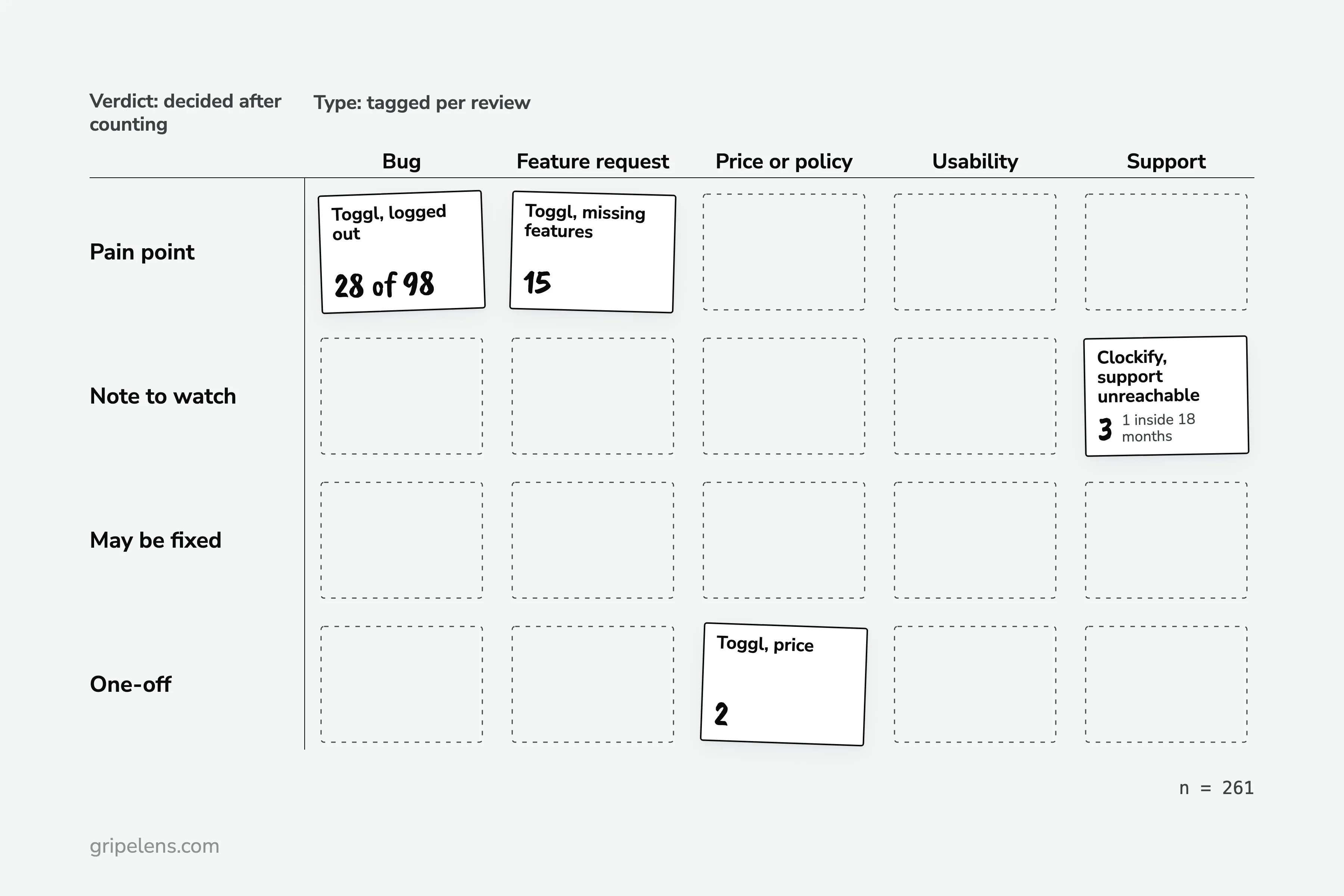
So a bug can be a pain point, and so can a feature request. Neither is one until it clears the count.
The guides that rank for this search mostly say “look for patterns”. The two that give a number say five reviews in three months, or ten reviews about the same problem. Neither says whether those reviews have to come from different people, out of how many, or how old they can be.
Four examples from my time-tracker sample (n = 261):
| Complaint | Type | Count | Verdict |
|---|---|---|---|
| Toggl, logged out | Bug | 28 of Toggl’s 98 | Pain point |
| Toggl, missing features | Feature request | 15 (9 on the App Store alone, 30 Oct 2024 to 3 Sep 2026) | Pain point |
| Clockify, support unreachable | Support | 3, only 1 inside 18 months, Trustpilot only | Note to watch |
| Toggl, price | Price or policy | 2 | One-off |
The logged-out bug, in one reviewer’s words: “every couple of days it logs me out saying that my session has expired.” (Toggl, 2 stars, 18 March 2025). The missing-features cell holds asks like this one: “there is no alarm (on iPhone at least) at the end of a pomodoro setting. This seems to have been a feature request from users for over six months, but still not implemented.” (Toggl, 3 stars, 8 February 2026).
Then there’s Toggl’s price row. Price was the loudest theme across all five apps, 67 of 261, and only 2 of those were Toggl’s. A pain point for the market isn’t automatically one for every product in it.
Step 1: Pull the Low Reviews and Write Down n
Read the 1 to 3 star reviews, plus the cons field (the “what do you dislike” box on G2 and Capterra) of the 4 and 5 star ones, and write down how many you read and how many you kept, per source. That number is n, and every count you report later sits on top of it.
My n for the time-tracker sample:
- App Store: 2,685 read, 859 at 1 to 3 stars, 178 coded
- Trustpilot: 88 read, 62 coded
- G2: 60 read (cons at any rating), 21 coded
That’s 261 coded complaints in total.
Finding customer pain points from reviews starts with the happy ones too. When I researched review tools in October 2026, most Capterra reviews were 4 to 5 stars, so most of my 101 complaints came out of the cons fields of positive reviews. The complaints hid in 5-star reviews.
If your pile runs into the thousands, I’ve written up coding a large pile of reviews by hand separately.
How many reviews is enough?
I don’t have a hard minimum, and I haven’t seen a sourced one. What I can show you is what too few looks like. Everhour had 3 negative items in 24 months, each in a different theme, so no theme could ever reach three. Timely’s 12 produced one pass, flagged as thin and single-source.
On r/AskMarketing, someone who had read their reviews until “my mind just went blank” asked: “I have 30 reviews does the enough?” One reply: “30 reviews is actually enough to start”. That’s a practitioner’s starting point, not evidence. Write n down either way.
Step 2: Tag Each Complaint by Type, Then by Theme
One row per review. Give it one type tag, one or more theme tags, and paste the reviewer’s exact words next to them.
Types first. I use five:
- Bug: something broke.
- Feature request: a wish, or “would be good if”.
- Price or policy: a price rise, a paywall, refunds, billing.
- Usability: clunky, slow to get the job done.
- Support: nobody answered.
Themes are narrower: what exactly broke, or what exactly costs too much. The ten I ended up with for time trackers:
- price rises and paywalled features
- crashes and freezes
- logged out, sign-in and sign-up failures
- lost entries and sync failures
- clunky time entry
- missing features
- surprise charges, no refunds
- support unreachable
- an update made it worse
- mobile app lacks web features
Here’s a review that gets “price or policy” as its type and “price rises and paywalled features” as its theme: “I’m ok with a limited free version. I’m not ok with having to pay for features that once were available for free.” (Clockify, 1 star, 6 July 2026)
One review can carry several themes. 53 of my 261 did. Another 19 fit no theme at all, and that’s fine: a theme list that swallows everything is a list nobody can count.
Step 3: Count Independent Mentions, Not Reviews
Count per theme, and per app if you’re comparing several. A theme becomes a candidate pain point at three independent mentions.
Independent means different reviewers:
- One review is one item, however many themes it carries.
- The same App Store review can show up in several country storefronts. I deduped them by review id.
- A burst of different reviewers reacting to a dated change still counts. Clockify got 8 Trustpilot price complaints between 16 and 19 June 2026, right after its free-plan cut went live.
- A burst with no dated cause gets weighted less. Nine of the ten newest Toggl reviews on G2 are dated 6 October 2026, which looks like a vendor review drive. I’ve dated the reviews to spot vendor drives on G2 and Capterra before.
Why three?
It’s a floor, not a statistical threshold, so treat it as rough. One is a story. Two can be a coincidence. Three different people describing the same failure is worth writing down.
Other people pick other numbers. On r/AskMarketing the advice was “whatever shows up 5+ times is a pattern, a one off is just a story” (u/expansiondesk). A restaurant owner on r/smallbusiness went lower and added a window: “One cold-entree review is a Tuesday. Three ‘wait’ tags in a month is a scheduling problem” (u/WasteZucchini5333). Both are practitioner numbers, mine included.
When I counted my October 2026 complaint research the same way, 15 of its 18 themes reached three items and 3 didn’t (competitor coverage at 2, short history window at 1, stale data treated as current at 1). The trap there was different. Per-seat pricing had 8 items, but from only 2 products. Many mentions, few products: a pain point for those two, not for the whole category.
This is the step that hurts by hand: copying reviews across sources, keeping every date, counting each theme per source. Do it in a spreadsheet, or have Gripelens do this step: it counts each theme per source, keeps a dated quote with a link behind every theme, marks review bursts and thin samples, and flags quotes older than 18 months “may be fixed”. The sample report shows the output.
Step 4: Drop What’s Too Old to Trust
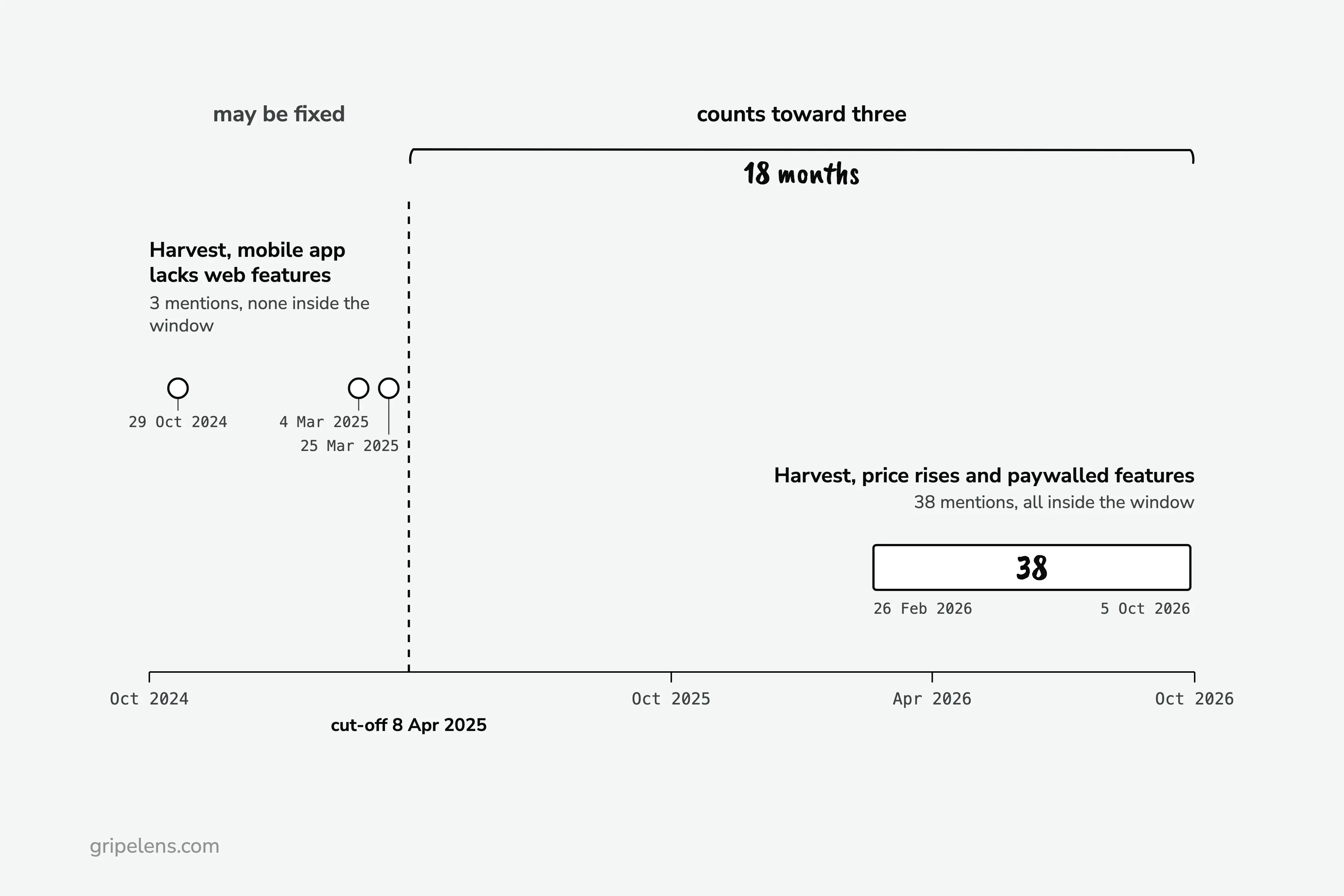
Then apply a freshness window to every count. I use 18 months back from the day you read: anything older gets “may be fixed” and doesn’t count toward the three. My sample ran on 8 October 2026 over a window from 9 October 2024, so the cut-off was 8 April 2025, and 53 of 261 items predated it.
Apps change. A Hacker News commenter put it well: “a review might be complaining about a missing feature in a particular product but now fully implemented.” (thisisit, 22 September 2024)
Take Harvest’s mobile app lacking web features. Three mentions, on 29 October 2024, 4 March 2025 and 25 March 2025. None inside the window.
Passes the count. Fails the window.
Verdict: may be fixed, so check the current app before acting on it. Compare Harvest’s price complaints from the same sample: 38 items, from 26 February 2026 to 5 October 2026, all 38 inside the window, after its 2026 repricing. Same app, same three-mention bar, opposite answer.
What Happens When You Run the Rule on 261 Complaints?
I ran the three-mention rule on every app-theme cell in the time-tracker sample. Definitions first: a cell is one app plus one theme (for example “Toggl, logged out”); three mentions means 3 or more items in the cell; fresh means dated on or after 8 April 2025; two sources means items from at least two of App Store, Trustpilot and G2.
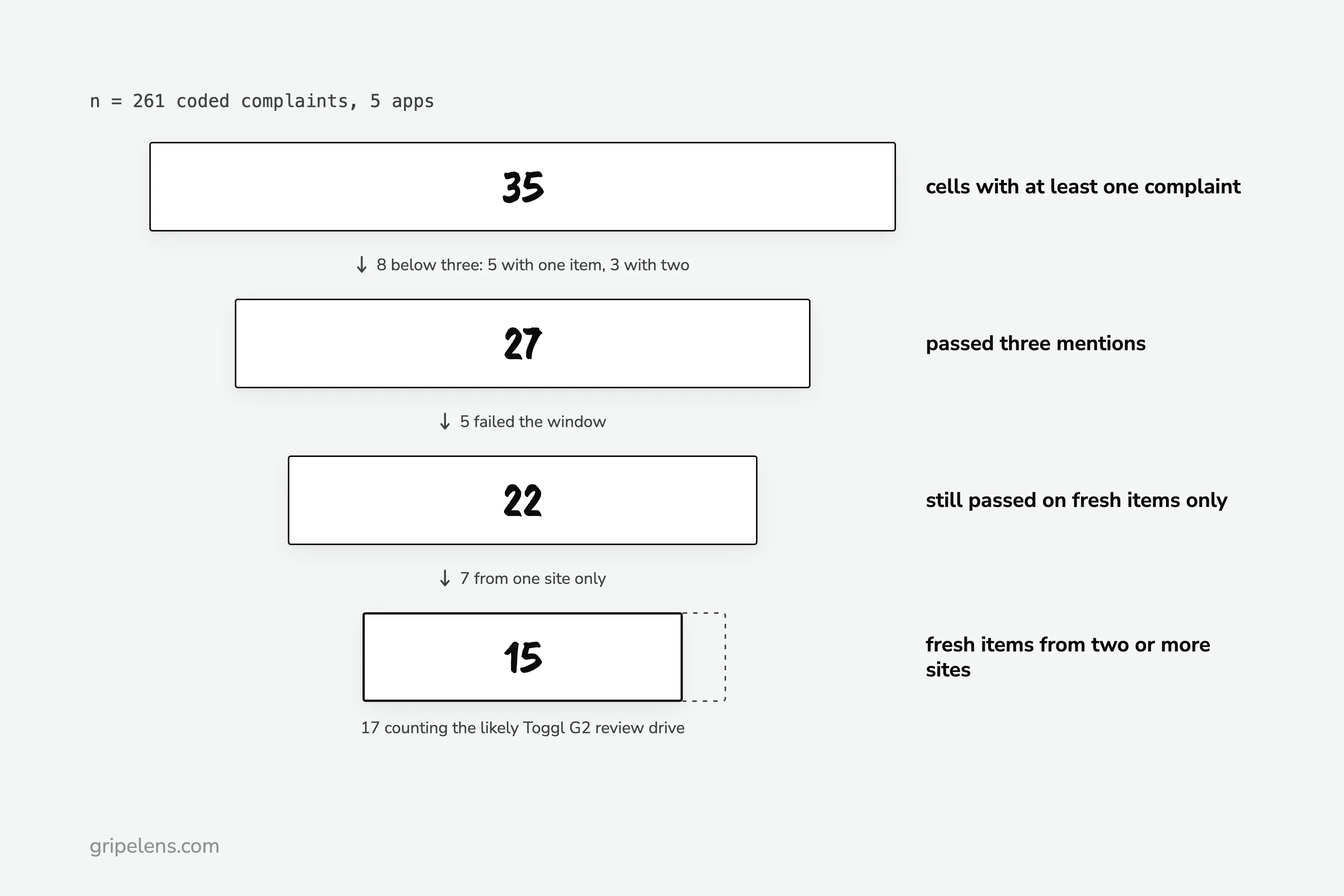
The funnel, n = 261 across five apps:
- 35 cells had at least one complaint
- 5 had one item, 3 had two
- 27 passed three mentions
- 22 still passed counting fresh items only
- 15 had fresh items from two or more sites, or 17 if you count a likely review drive as a second source
No cell passed three mentions only because of that Toggl G2 cluster. Five cells where the freshness or source check changes the reading:
| Cell | Mentions | Fresh | Sources | Verdict |
|---|---|---|---|---|
| Harvest, mobile app lacks web features | 3 | 0 | App Store | May be fixed |
| Toggl, price | 2 | 1 | App Store | One-off (price is 67 of 261 market-wide) |
| Toggl, missing features | 15 (9 App Store, 6 G2 on 6 to 7 Oct 2026) | 13 | App Store + G2 cluster | Pain point on the App Store items alone |
| Clockify, support unreachable | 3 | 1 | Trustpilot | Note to watch |
| Harvest, an update made it worse | 5 | 1 | App Store | Note to watch (4 of 5 older than the window) |
Three more cells worth a line each:
- Clockify, price. 8 Trustpilot complaints in four days, right after a dated change. Different reviewers, one cause: it counts.
- Timely, crashes and freezes. 12 of Timely’s 12, all fresh, all App Store. Passes the count, but it’s a thin sample from one source.
- Toggl, Pomodoro alarm. Exactly three, inside the missing-features cell, and only two have a recorded date in the window. It stays a note to watch.
So 5 of the 27 cells that looked like something didn’t survive the window. Of the 22 that did, 7 had fresh items from one site only (5 if you count the Toggl G2 cluster as a second source).
When Three Mentions Isn’t Enough
Three is the floor for the word “pain point”. It isn’t the bar for your roadmap. Three cases where it can mislead, all from my sample:
- A thin pile. Everhour’s 3 complaints and Timely’s 12 can’t tell you much, whatever the count says.
- A single source. Timely’s crashes are all App Store.
- A review drive. Toggl’s G2 reviews on 6 October 2026.
The 15 two-source cells are where the next pass starts. Before a pain point goes into a plan, I run the five-check pattern test: share of n, sources, spread or burst, recency, and a dated cause.
Hunting a gap across a whole category rather than judging one product? Then the bar moves up to the same complaint across five or more apps.
And a count still isn’t a decision. As u/vonana put it on r/AskMarketing, “a frequency is a summary, an insight has to point at a decision”. A pain point earns a decision only when you can name what you’d change.
If You Want the Counting Done for You
If you want the counts, dates and burst flags done for you across six sources, that’s the job Gripelens does.
Get early access: launch pricing is locked for a year for the first wave. If you’d rather keep the spreadsheet, the four steps above work by hand.
FAQ
How many reviews do you need to find a pain point?
There’s no fixed minimum, so state your n and let the reader judge. What you can say is when a pile is too thin: Everhour had 3 negative reviews in 24 months, each about something different, so no theme could reach three mentions. Thirty reviews is a number one Reddit reply gives as a starting point, not evidence that 30 is enough.
Is a feature request a pain point?
A feature request is a type of complaint, not a verdict. It becomes a pain point when three different reviewers ask for it inside your window. Toggl’s missing features cleared that easily: 15 mentions, 13 of them inside the window, and even without the 6 G2 reviews from two days in October 2026, 7 App Store reviews fall inside it.
Should I ignore one-star reviews that only appear once?
Don’t delete them. Log them as one-offs and recount next month, because a one-off can turn into three after a dated change. Clockify’s free-plan cut shows how fast that can happen: 8 Trustpilot price complaints in the four days after it went live in June 2026.
How old can a review be and still count?
I use 18 months back from the day you read. Anything older gets a “may be fixed” label and doesn’t count toward the three mentions. In my time-tracker sample, 53 of 261 complaints were older than that, and one Harvest theme passed the count with all three mentions outside the window.